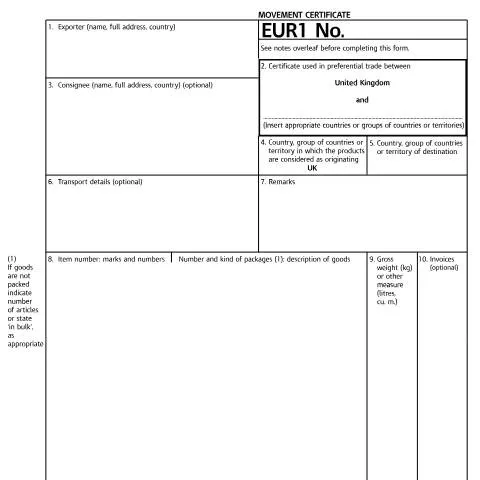
When Global Trade Meets Regional Preferences: Understanding Movement Certificate EUR1
The complexities of international trade often hinge on seemingly mundane paperwork that carries extraordinary legal weight. Among the most significant certificates in post-Brexit Britain's trade arsenal is the EUR1 movement certificate, a document that can mean the difference between paying standard duties and benefiting from preferential tariff rates when exporting goods from the UK to partner countries.
This certificate represents far more than administrative formality—it serves as legal proof that goods qualify for reduced or eliminated customs duties under specific trade agreements. For UK exporters navigating the post-Brexit landscape, understanding when and how to obtain EUR1 certification has become essential for maintaining competitive pricing in international markets.
The Legal Foundation of Preferential Trade Certification
Movement certificate EUR1 operates within the framework of preferential trade agreements between the United Kingdom and various countries or groups of countries. Unlike standard export documentation, this certificate carries specific legal weight under international trade law, confirming that goods meet the stringent rules of origin requirements necessary for preferential treatment.
The certificate's authority derives from bilateral or multilateral trade agreements that the UK has negotiated independently since leaving the European Union. Each agreement contains detailed protocols concerning the definition of originating products, and the EUR1 certificate serves as the formal mechanism for claiming benefits under these protocols.
Originating Status: The Core Requirement
For goods to qualify for EUR1 certification, they must achieve originating status under the relevant trade agreement. This typically means:
- The goods were wholly obtained or produced in the UK
- The goods underwent sufficient working or processing in the UK to acquire originating status
- The goods satisfy specific percentage thresholds for UK content or value addition
- The manufacturing process meets technical requirements outlined in product-specific rules
The determination of originating status involves complex calculations and documentation. Exporters must maintain detailed records of their supply chains, including the origin of raw materials, components, and the nature of processing undertaken within the UK.
Navigating the Application Process Through HMRC
Obtaining EUR1 certification requires interaction with HM Revenue and Customs, which serves as the competent authority for issuing these certificates. The process involves both the exporter's declaration and official customs endorsement, creating a two-tier system of accountability.
Pre-Application Requirements
Before submitting form C1299, exporters must establish their eligibility and gather comprehensive supporting documentation. This preparatory phase often proves more time-consuming than the actual application process:
| Documentation Category | Typical Requirements | Verification Purpose |
|---|---|---|
| Supply Chain Records | Supplier declarations, purchase invoices, bills of materials | Establishing origin of components and raw materials |
| Manufacturing Evidence | Production records, process documentation, facility certificates | Demonstrating substantial transformation or processing |
| Commercial Documentation | Export invoices, packing lists, shipping documents | Confirming transaction details and consignment information |
The Dual Declaration System
Form C1299 incorporates a unique dual declaration system that distributes responsibility between the exporter and HMRC. The exporter's declaration in section 12 constitutes a formal statement that goods meet originating conditions, while the customs endorsement in section 11 provides official validation of this claim.
This system creates shared accountability—exporters bear primary responsibility for accuracy, while HMRC provides institutional backing for the certificate's international recognition. The customs endorsement includes specific details such as the issuing office, date, and official signature, all crucial for acceptance by importing country authorities.
Strategic Applications Across Different Trade Scenarios
EUR1 certificates serve multiple functions beyond basic duty reduction, making them valuable tools in various commercial contexts. Understanding these applications helps exporters maximise their strategic value.
Direct Export Benefits
The primary function involves claiming preferential tariff treatment when exporting directly to agreement partner countries. This can result in substantial cost savings for importers, making UK goods more competitive in foreign markets. The certificate accompanies the goods throughout their journey, providing customs authorities in the destination country with necessary proof for applying reduced duty rates.
Complex Supply Chain Scenarios
EUR1 certificates also facilitate more sophisticated trade arrangements. When UK-origin goods are exported to an intermediate country before reaching their final destination, proper certification can preserve preferential status through multiple borders. This proves particularly valuable for:
- Goods transiting through third countries without processing
- Temporary exports for processing or assembly before re-export
- Split shipments where different portions of an order follow different routes
Consignment and Warehousing Arrangements
The optional consignee field in section 3 reflects the certificate's flexibility in modern logistics arrangements. Goods can be certified for export even when the final recipient is unknown at the time of shipment, accommodating:
- Consignment stock arrangements in overseas warehouses
- Distribution centre operations serving multiple end customers
- Trade show exhibits and demonstration equipment
Compliance Framework and Penalty Implications
The EUR1 system operates under strict compliance requirements enforced through the Customs and Excise Management Act 1979. Section 167 of this Act makes it an offence to provide untrue information to HMRC officers, establishing serious legal consequences for non-compliance.
Accuracy Standards and Record-Keeping
The certificate's notes emphasise the importance of accuracy through specific formatting requirements. Erasures and overwriting are prohibited, and any corrections must be properly initialised and endorsed by customs authorities. This reflects the document's legal status and the need for clear, unambiguous information.
Exporters must maintain comprehensive records supporting their originating status claims. These records remain subject to HMRC inspection, and the exporter's declaration includes an explicit undertaking to provide additional evidence upon request and to permit account inspections and manufacturing process checks.
Verification Mechanisms
The certificate includes provisions for post-issuance verification through sections 13 and 14. Foreign customs authorities can request verification of certificate authenticity and accuracy by contacting HMRC's Leeds Regional Centre. This system provides international confidence in UK-issued certificates while creating additional compliance obligations for exporters.
Practical Considerations for Efficient Certificate Management
Successful EUR1 utilisation requires attention to operational details that can significantly impact processing times and acceptance rates. These practical considerations often determine whether the certificate delivers its intended commercial benefits.
Timing and Workflow Integration
EUR1 applications must be integrated into export workflows to avoid delays. The certificate should ideally be obtained before goods are shipped, as retrospective certification can create complications with importing country customs authorities. Exporters typically establish standard procedures that trigger EUR1 applications at specific points in their order processing systems.
The sequential numbering requirement in the goods description section demands careful attention to detail. Each item must be preceded by a sequential number, with unused space struck through to prevent unauthorised additions. This systematic approach helps prevent errors that could invalidate the certificate.
Multi-Shipment and Bulk Certification Strategies
For companies with regular export patterns, developing efficient certification strategies becomes crucial. Some exporters establish master documentation systems that streamline the preparation of supporting evidence for similar products or regular customers. This approach reduces preparation time while maintaining compliance with originating status requirements.
The certificate's flexibility in describing goods "in accordance with commercial practice" allows exporters to use terminology familiar to their industry while ensuring sufficient detail for identification purposes. This balance between commercial practicality and regulatory compliance requires careful judgment in completing the goods description sections.
Post-Brexit Evolution and Future Adaptations
The EUR1 system has evolved significantly since the UK's departure from the European Union, reflecting the country's new position in international trade relationships. Understanding these changes helps exporters anticipate future developments and adapt their certification strategies accordingly.
Agreement-Specific Variations
Different trade agreements may impose varying requirements for EUR1 certification, reflecting negotiated preferences and specific industry considerations. Exporters must remain aware of agreement-specific rules when completing section 2 of the form, which identifies the relevant preferential trade relationship.
The UK's growing network of trade agreements continues to expand the potential applications for EUR1 certificates. As new agreements are negotiated and existing ones are updated, exporters may find additional opportunities for preferential treatment or encounter modified certification requirements.
Digital Transformation Prospects
While the current system relies on paper-based certificates with physical signatures and stamps, international trade is gradually moving toward digital certification systems. The UK government has expressed interest in developing electronic alternatives that would maintain the legal certainty of traditional certificates while improving processing efficiency and reducing administrative burdens.
These developments may eventually transform how exporters interact with the EUR1 system, potentially integrating certification processes with existing digital trade platforms and customs systems. However, such changes would require international coordination to ensure continued recognition by importing country authorities.
Managing Certificate Challenges and Dispute Resolution
Despite careful preparation, exporters may encounter situations where EUR1 certificates are challenged, rejected, or require correction. Understanding available remedies and dispute resolution mechanisms helps protect commercial interests when problems arise.
Amendment and Correction Procedures
When errors are discovered in issued certificates, HMRC provides mechanisms for correction, though these processes require careful documentation and may involve resubmission of supporting evidence. The strict rules against erasures mean that significant errors typically necessitate issuing replacement certificates rather than attempting corrections to original documents.
Exporters should maintain detailed records of all certification requests and supporting documentation to facilitate any necessary corrections or disputes. This documentation proves essential when dealing with challenges from importing country customs authorities or requests for additional verification.
Appeals and Independent Review
The certificate form references the Adjudicator's Office as an independent review mechanism for complaints not satisfactorily resolved by HMRC. This service provides free, independent examination of disputes, though it focuses on procedural complaints rather than technical determinations about originating status.
For exporters facing systematic challenges with EUR1 certification, engaging with HMRC through formal complaint procedures may help identify process improvements or clarify interpretation of originating rules. The Adjudicator's recommendations, while not binding, carry significant weight in resolving disputes and improving administrative practices.
Practical Steps for UK Businesses to Obtain EUR1 and EUR-MED Certificates
Securing EUR1 and EUR-MED movement certificates requires UK businesses to navigate a structured application process through HM Revenue & Customs (HMRC). The procedure begins with establishing approved exporter status, which streamlines future certificate requests and demonstrates compliance with origin requirements.
To initiate the process, businesses must first register with HMRC's Customs Declaration Service (CDS) and obtain an Economic Operator Registration and Identification (EORI) number. This unique identifier, beginning with "GB" followed by 12 digits, serves as the foundation for all customs-related activities. Companies without an EORI number cannot proceed with movement certificate applications, making this registration the essential first step.
The application for approved exporter status involves submitting form C1454 to HMRC, accompanied by comprehensive documentation demonstrating the business's capability to determine product origin accurately. This includes detailed records of supply chains, manufacturing processes, and quality control systems. HMRC typically processes these applications within 45 working days, though complex cases involving multiple product lines or international supply chains may require additional time.
Once approved exporter status is granted, businesses receive an authorisation number that must appear on all self-certified movement certificates. This number follows a specific format: "GB" followed by the company's unique identifier. The authorisation remains valid indefinitely, provided the business maintains compliance with origin determination requirements and submits annual compliance reports to HMRC.
For individual certificate requests without approved exporter status, businesses must complete form EUR1 or EUR-MED and submit it to their local HMRC office alongside supporting documentation. This includes commercial invoices, bills of lading, and detailed origin calculations demonstrating how the product qualifies for preferential treatment. Processing times for individual applications typically range from 5-10 working days, depending on the complexity of the origin determination.
HMRC requires specific information on each certificate application, including the harmonised system (HS) code for the exported goods, precise product descriptions, and detailed origin calculations. The origin calculation must demonstrate that sufficient processing occurred within the UK or relevant preference zone to qualify for preferential treatment. This involves calculating the value of non-originating materials against the total ex-works price, ensuring compliance with specific percentage thresholds or technical requirements outlined in the relevant trade agreement.
Businesses must maintain comprehensive records supporting their origin claims for a minimum of four years from the certificate issue date. These records should include supplier declarations, purchase invoices, production records, and any subcontracting agreements that might affect origin determination. HMRC conducts regular compliance visits and may request immediate access to these supporting documents, making robust record-keeping essential for maintaining certification privileges.
Common Challenges and Compliance Issues in Movement Certificate Processing
UK exporters frequently encounter specific challenges when applying for EUR1 and EUR-MED certificates, particularly regarding complex supply chain documentation and evolving regulatory requirements. Understanding these common pitfalls helps businesses prepare more effective applications and maintain compliance with HMRC expectations.
One of the most frequent issues involves incomplete or inconsistent supplier declarations. Many UK manufacturers rely on components sourced from multiple countries, requiring detailed supplier declarations confirming the origin status of each input. HMRC often rejects applications where supplier declarations lack specific information, such as precise HS codes, country of origin determination methods, or valid certification dates. Businesses should establish standardised supplier declaration templates and conduct regular audits to ensure all suppliers provide compliant documentation.
Another significant challenge relates to determining origin for goods undergoing multiple processing stages across different countries. The "sufficient working or processing" criteria can be particularly complex for products involving assembly operations, quality testing, or packaging in multiple locations. HMRC requires clear documentation showing that the final processing stage in the UK or preference zone adds sufficient value or technical transformation to confer origin status. This often necessitates detailed cost breakdowns and technical specifications that many businesses struggle to compile comprehensively.
Cumulation provisions present additional complexity, particularly for EUR-MED certificates covering goods with components from multiple Mediterranean partner countries. Businesses must demonstrate that all cumulated materials maintain their originating status throughout the supply chain, requiring extensive documentation from suppliers in different jurisdictions. HMRC has specific requirements for validating cumulation claims, including certified translations of foreign supplier declarations and verification of partner country certification systems.
Timing issues frequently cause complications, particularly for businesses operating just-in-time delivery schedules. EUR1 certificates must be applied for before or at the time of export, with limited provisions for retrospective applications in exceptional circumstances. HMRC defines "exceptional circumstances" narrowly, typically limited to cases involving urgent humanitarian shipments or force majeure events. Businesses should factor certificate processing times into their export planning, particularly during peak periods when HMRC processing may experience delays.
Post-Brexit regulatory changes have introduced additional compliance challenges, particularly regarding Northern Ireland trade arrangements. Goods moving from Great Britain to Northern Ireland, then onward to EU destinations, face complex origin determination requirements under the Northern Ireland Protocol arrangements. HMRC has issued specific guidance for these movements, but businesses often struggle to interpret the interaction between UK domestic rules and EU origin requirements for Northern Ireland trade.
Digital transformation initiatives within HMRC have also created temporary compliance challenges as systems migrate to new platforms. The Customs Declaration Service (CDS) replacement of the previous CHIEF system has required businesses to adapt their internal processes and update their software systems. Some legacy EUR1 applications experienced processing delays during the transition period, highlighting the importance of early application submission and contingency planning for system maintenance periods.
Sector-Specific Considerations and Industry Applications
Different industry sectors face unique challenges and opportunities when utilising EUR1 and EUR-MED movement certificates, with sector-specific rules and processing requirements that significantly impact application strategies and compliance approaches.
The automotive sector represents one of the most complex applications of movement certificate requirements, given the industry's intricate supply chains and high-value component integration. UK automotive exporters must navigate detailed rules of origin that often require specific regional value content thresholds or technical requirements related to engine specifications, transmission systems, or safety components. The sector's reliance on just-in-time manufacturing makes certificate processing timing critical, as production delays can cascade through entire supply chains. HMRC has established dedicated automotive specialists who understand the sector's unique requirements, including the treatment of research and development costs in origin calculations and the handling of common platform arrangements between manufacturers.
Textile and clothing manufacturers face particularly stringent "double transformation" requirements for many EUR-MED applications, where both fabric production and garment assembly must occur within the preference zone to qualify for preferential treatment. This creates complex supply chain management challenges, as UK clothing manufacturers must source fabrics from EU or Mediterranean partner countries rather than lower-cost Asian suppliers to maintain origin status. The sector also deals with detailed technical requirements related to yarn specifications, dyeing processes, and finishing treatments that must be documented comprehensively in certificate applications.
Chemical and pharmaceutical companies encounter unique challenges related to active ingredient sourcing and complex manufacturing processes involving multiple chemical transformations. Origin determination often requires detailed analysis of molecular structures and processing stages to determine whether sufficient transformation has occurred. The pharmaceutical sector faces additional regulatory layers, as movement certificates must align with medicines licensing requirements and good manufacturing practice standards. HMRC requires comprehensive documentation of chemical processes, including reaction pathways, purification stages, and quality control procedures that demonstrate substantial transformation beyond simple mixing or packaging operations.
Food and agricultural exporters must consider both origin requirements and complex health certification procedures that interact with movement certificate applications. Products involving multiple agricultural inputs from different countries require careful documentation of processing stages, particularly for value-added products like processed foods or beverages. The sector also faces seasonal variations in supply sources that can affect origin status throughout the year, requiring flexible certification strategies and detailed supplier management systems.
Technology and electronics manufacturers deal with rapidly evolving product specifications and global supply chains that complicate origin determination. The sector's reliance on standardised components from multiple suppliers requires sophisticated tracking systems to maintain accurate origin records. Software integration and digital services components present particular challenges for origin determination, as traditional manufacturing-based rules may not adequately address value creation through software development or digital integration services.
The renewable energy sector faces emerging challenges as new technologies and manufacturing processes evolve faster than traditional origin rules. Solar panel assembly, wind turbine component manufacturing, and battery production involve complex technical requirements that HMRC continues to develop guidance for. The sector's focus on sustainability also raises questions about how environmental processing requirements interact with traditional origin determination methods.
Financial services and professional services sectors engaging in goods export as part of broader service packages must carefully separate goods and services components for origin determination purposes. This includes situations where UK professional services companies export technical equipment or materials alongside consulting services, requiring clear separation of goods value from services value in certificate applications.