Understanding the Exhibit Cover Sheet Process for Adult Deed Poll Applications
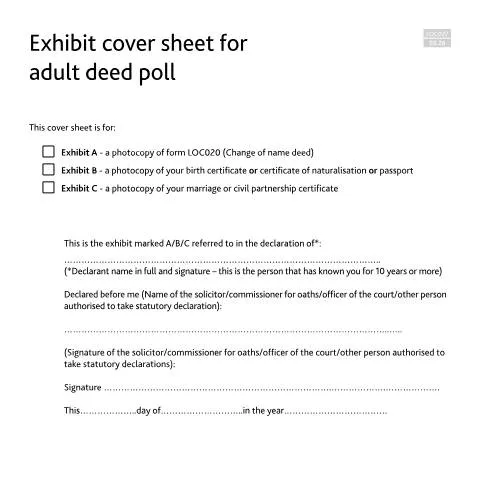
When changing your name by deed poll in England and Wales, the Form LOC027 exhibit cover sheet serves as the official documentation wrapper that accompanies three critical pieces of evidence required by HM Courts & Tribunals Service. This seemingly straightforward administrative document plays a pivotal role in the statutory declaration process, acting as the formal bridge between your identity change request and the court's validation system.
The exhibit cover sheet operates within a specific legal framework where a statutory declaration must be witnessed by an authorised person who has known you for at least ten years. This requirement distinguishes the deed poll process from other name change procedures and ensures the court can verify the authenticity of your application through established personal connections rather than purely documentary evidence.
Unlike simple administrative forms, the LOC027 requires careful coordination between multiple parties: yourself as the applicant, your long-term acquaintance serving as declarant, and an authorised witness such as a solicitor, commissioner for oaths, or court officer. Each must fulfil specific obligations for the process to meet legal standards.
The Three-Exhibit Structure and Documentation Requirements
Form LOC027 operates on a precise three-exhibit system, with each exhibit serving a distinct evidential purpose in establishing your identity and legal right to change your name. Understanding what qualifies for each exhibit category prevents delays and ensures your application meets court requirements from the outset.
| Exhibit | Required Document | Purpose | Key Requirements |
|---|---|---|---|
| Exhibit A | Form LOC020 photocopy | The actual deed poll document | Must be completed and signed according to legal requirements |
| Exhibit B | Birth certificate, naturalisation certificate, or passport copy | Establishes current legal identity | Must show your current legal name clearly |
| Exhibit C | Marriage or civil partnership certificate copy | Documents any previous name changes | Only required if you've changed name through marriage/partnership |
The exhibit system reflects the court's need to trace your complete naming history. Exhibit B establishes your original legal identity, while Exhibit C accounts for any intermediate name changes through marriage or civil partnership. This comprehensive approach ensures no gaps exist in your identity documentation that could complicate future legal or administrative processes.
Crucially, all documents must be photocopies rather than originals. The court system specifically requires copies because the exhibits become part of the court record and cannot be returned. However, these copies must be clear and legible, with all text and official markings clearly visible.
Document Quality and Acceptance Standards
HM Courts & Tribunals Service maintains specific standards for document copies submitted as exhibits. Photocopies must reproduce all security features visible on the original documents, including watermarks, official seals, and registration numbers. Poor quality copies that obscure critical information will result in application rejection.
For Exhibit B, if using a passport copy, ensure both the photo page and any pages showing name changes are included. Birth certificates must be full certificates rather than short-form versions, as these contain the complete information required for identity verification. Naturalisation certificates must clearly show both your original name and any subsequent changes.
Navigating the Declarant and Witness Requirements
The LOC027 form's witness section creates a dual-verification system that distinguishes deed poll applications from standard administrative processes. The declarant - the person who has known you for ten years or more - serves as your personal identifier, while the authorised witness validates the legal process itself.
Finding an appropriate declarant often presents the first practical challenge. The ten-year requirement means casual acquaintances cannot serve this role, limiting options to family members, long-term colleagues, or established friends. However, the declarant cannot be related to you by blood or marriage, creating additional constraints for some applicants.
The declarant's role extends beyond simply signing the form. They must be prepared to provide their full name and address clearly, and their signature must match any identification they might need to provide if questions arise about the declaration. Some courts may contact declarants directly to verify their statements, making their accessibility and reliability crucial factors.
Authorised Witness Categories and Selection
The authorised witness requirement offers several options, each with different practical implications for your application process:
- Solicitors provide the most straightforward option but typically charge fees for witnessing services, often ranging from £10 to £50 depending on the practice
- Commissioners for oaths offer similar services at potentially lower costs and may have more flexible appointment availability
- Court officers can witness declarations at court buildings during business hours, usually without charge but requiring travel to court premises
- Other authorised persons include certain bank managers, medical practitioners, and senior civil servants, though availability varies significantly
The witness must be physically present when both you and your declarant sign the form. Remote witnessing or separate signing sessions do not meet legal requirements, making coordination essential for successful completion.
Timing Considerations and Processing Implications
The LOC027 exhibit cover sheet operates within broader deed poll processing timelines that affect when your name change becomes legally effective. Unlike some administrative processes where submission equals immediate processing, deed poll applications require court review and approval, creating specific timing considerations for your planning.
Court processing times typically range from 10 to 15 working days after submission, though this can extend during busy periods or if additional documentation is required. The timing becomes particularly important if you need your new name for specific deadlines, such as passport applications for planned travel or employment documentation for new positions.
The exhibit cover sheet must be completed and signed on the same day as your statutory declaration. You cannot prepare the LOC027 in advance and add signatures later, as the date certification requires contemporaneous completion. This constraint means scheduling coordination between yourself, your declarant, and your authorised witness becomes critical for efficient processing.
Strategic Timing for Name Change Implementation
Consider the broader implications of your name change timing when preparing your LOC027 submission. If you're planning major life events such as marriage, home purchase, or international travel, the deed poll process should be completed well in advance to allow time for updating all relevant documentation.
Some organisations, particularly financial institutions and government agencies, require additional processing time to update their records after receiving deed poll documentation. Beginning the process early provides buffer time for these administrative updates without disrupting important personal or professional commitments.
Common Pitfalls and Application Vulnerabilities
The LOC027 form's apparent simplicity masks several technical requirements that frequently cause application delays or rejections. Understanding these potential issues helps ensure successful first-time submission and avoids the frustration of restarting the entire process.
Incomplete declarant information represents the most frequent error on LOC027 submissions. The form requires the declarant's full name and signature, but applicants often overlook the need for complete contact information. Courts may reject applications where they cannot verify declarant details if questions arise during processing.
Date inconsistencies create another common problem. The witness must certify the specific date when the statutory declaration was made, and this date must match across all related documents. Mismatched dates suggest the documents were not completed simultaneously, raising questions about the process's validity.
Signature and Identification Complications
Signature variations between documents can trigger additional scrutiny or rejection. If your declarant's signature on the LOC027 differs significantly from their signature on other identification documents, courts may question the declaration's authenticity. Encouraging consistent signature style across all deed poll documentation helps avoid these complications.
The authorised witness's credentials must be clearly established on the form. Witnesses should include their professional qualifications or official position when signing, as courts verify these credentials during processing. Insufficient witness identification information delays applications while courts seek clarification.
Integration with Broader Name Change Documentation
The LOC027 exhibit cover sheet functions as part of a comprehensive documentation package that extends beyond the immediate deed poll process. Understanding how this form connects with other required documents helps ensure your complete application meets all legal and administrative requirements.
Your completed LOC027 becomes part of the permanent court record associated with your name change. This means the quality and accuracy of information provided have long-term implications for future legal or administrative processes that might reference your deed poll documentation.
The exhibit system created by LOC027 establishes a clear documentary trail that other organisations can follow when verifying your name change. Banks, employers, and government agencies often request specific exhibits rather than the entire deed poll package, making the organised presentation facilitated by LOC027 particularly valuable for ongoing administrative needs.
Post-Approval Documentation Strategy
Once HM Courts & Tribunals Service approves your deed poll application, the LOC027 and its associated exhibits provide the foundation for updating your identification across all relevant organisations. Many institutions require copies of specific exhibits to process name change requests, making high-quality initial documentation essential for smooth transitions.
Consider obtaining multiple certified copies of your approved deed poll documentation, including the LOC027 exhibit package. Different organisations may require original certified copies rather than photocopies, and having multiple copies available streamlines the process of updating your records across various institutions simultaneously.
Special Circumstances and Alternative Pathways
Certain situations create additional complexity for LOC027 completion that requires modified approaches or alternative documentation strategies. Understanding these special circumstances helps determine whether the standard exhibit cover sheet process suits your specific situation or whether alternative legal pathways might be more appropriate.
International applicants face particular challenges with the ten-year declarant requirement. If you've lived in the UK for less than ten years, finding someone who meets the declarant criteria may be impossible. In such cases, additional statutory declarations from multiple shorter-term acquaintances may be required, though this involves more complex legal procedures.
Individuals with limited social connections due to circumstances such as immigration, social isolation, or recent relocation may struggle to identify appropriate declarants. Professional relationships with doctors, lawyers, or social workers might provide alternatives, though these require careful consideration of professional boundary issues and potential conflicts of interest.
Document Availability Challenges
Some applicants face difficulties obtaining the documents required for Exhibit B or Exhibit C. Birth certificates from certain countries may not be readily available, or previous marriage certificates might be lost or destroyed. In these cases, alternative documentation pathways exist, though they typically involve additional legal procedures and extended processing times.
The court system recognises that not all individuals have straightforward access to standard identity documents. However, alternative documentation requires specific legal justification and often involves additional statutory declarations explaining the circumstances preventing standard document provision.
Common Challenges and How to Navigate Them
Whilst the LOC027 form itself is relatively straightforward, applicants frequently encounter specific hurdles during the name change process that can delay or complicate their application. Understanding these common pitfalls helps ensure your deed poll registration proceeds smoothly.
One of the most frequent issues arises with witness requirements. Your deed poll must be witnessed by two individuals who are not related to you and who have known you personally for at least two years. The witnesses must be over 18 and of sound mind. Many applicants mistakenly assume work colleagues who've known them for the required period suffice, but if these colleagues are also friends outside work, this may not meet the strict independence requirement. Professional contacts such as your GP, solicitor, or bank manager often serve as ideal witnesses, provided they've known you for the requisite period.
Document authentication presents another common stumbling block. When submitting your deed poll with Form LOC027, the court requires either the original document or a certified copy. Certified copies must be endorsed by specific authorised individuals including solicitors, notaries public, commissioners for oaths, or certain public officials. A simple photocopy, even if notarised abroad, will not suffice. If you're posting your application, consider using recorded delivery and include a stamped addressed envelope if you need your original deed poll returned.
Timing issues frequently catch applicants off guard, particularly regarding the 21-day publication period. Once your name change is registered, it must be published in The London Gazette for 21 consecutive days before it becomes legally effective. This publication period cannot be shortened, regardless of urgency. Plan accordingly if you need your name change to take effect by a specific date, such as before a wedding or job start date.
International complications can arise for applicants with overseas connections. If you hold foreign citizenship or have assets abroad, your UK deed poll may not be automatically recognised in other jurisdictions. Some countries require additional authentication, such as apostille certification through the Foreign, Commonwealth & Development Office. Others may require you to follow their domestic name change procedures entirely. Research the requirements in any relevant jurisdiction before proceeding.
Financial institutions sometimes pose unexpected challenges. Whilst banks are legally required to accept deed polls for name changes, some may have internal policies requiring additional documentation or cooling-off periods. Contact your bank, building society, and any credit providers before beginning the process to understand their specific requirements. Some may accept notification before your deed poll is formally registered, whilst others insist on waiting for the full legal process to complete.
Post-Registration: Managing Your New Legal Identity
Successfully registering your deed poll through Form LOC027 marks the beginning, not the end, of your name change journey. The systematic updating of your records across various institutions requires careful planning and attention to detail to avoid complications with your new legal identity.
Begin with essential government records, as these often serve as primary proof of identity for other organisations. Your passport application through HM Passport Office should be your first priority, as this provides the strongest form of identification. Include your enrolled deed poll certificate and current passport with your application. Processing times can extend significantly if additional verification is required, so apply well in advance of any planned travel.
DVLA records require separate updating for both your driving licence and any vehicle registrations. Use form D1 for licence changes, including your enrolled deed poll certificate as evidence. Vehicle registration updates require form V62 if you need a replacement V5C logbook. Remember that your insurance policies must also reflect your new name to remain valid - notify your insurer immediately after receiving your updated driving licence.
HM Revenue and Customs requires notification through multiple channels depending on your circumstances. Employed individuals should inform their employer's payroll department, who will update PAYE records accordingly. Self-employed individuals must update their Self Assessment records and may need to re-register for VAT if applicable. If you receive tax credits or benefits, notify both HMRC and the Department for Work and Pensions separately, as their systems don't automatically synchronise.
Financial services require methodical updating to prevent account freezes or transaction blocks. Contact each provider individually rather than assuming they'll accept notification from other institutions. Mortgage providers often require formal notification in writing, including certified copies of your deed poll certificate. Investment accounts, pensions, and insurance policies each have their own procedures - some may require new application forms rather than simple amendments.
Professional and academic credentials need careful handling to maintain their validity. Contact professional bodies, universities, and training organisations to understand their specific requirements for name change recognition. Some may issue new certificates, whilst others provide supplementary documentation linking your old and new names. Medical records require updating with your GP surgery, dental practice, and any specialists - this is particularly important for prescription medications and emergency medical situations.
Digital identity management has become increasingly complex with the proliferation of online services. Government Gateway accounts, NHS login credentials, and local authority online services all require individual updating. Some platforms may temporarily restrict access during the verification process, so plan for potential service interruptions. Social media and professional networking platforms should also be updated to maintain consistency across your digital presence.
Legal Implications and Ongoing Obligations
Changing your name through deed poll registration via Form LOC027 creates specific legal obligations and implications that extend far beyond the initial paperwork. Understanding these ongoing responsibilities helps ensure full compliance with UK law and prevents potential complications in various legal contexts.
Your enrolled deed poll creates a permanent public record that cannot be reversed through simple administrative procedures. If you later wish to change your name again, you must execute a new deed poll and complete the entire registration process afresh. This includes the 21-day publication requirement and associated fees. Courts may scrutinise multiple name changes more carefully, particularly if they occur within short timeframes or appear designed to avoid legal obligations.
Disclosure obligations vary significantly depending on your circumstances and the context in which you're asked about previous names. Enhanced DBS checks will reveal your previous identity, as will certain financial applications and legal proceedings. When completing official forms, read the questions carefully - some ask specifically about "known by any other name" whilst others inquire about "legal name changes" or "previous names." The scope of required disclosure can differ substantially between these formulations.
Criminal proceedings and legal disputes require particular attention to name change disclosure. If you're involved in court proceedings, either as a party or witness, you must typically disclose any previous names to ensure proper service of documents and avoid potential contempt of court charges. Similarly, if you're subject to any existing court orders, these remain valid under your new name, and you must inform the relevant court of your name change.
Professional licensing and regulatory compliance often impose additional obligations. Healthcare professionals, financial services workers, and legal practitioners typically must notify their regulatory bodies of name changes within specified timeframes. Failure to do so can result in disciplinary action or licence suspension. Some professions maintain public registers that require formal updating procedures beyond simple notification.
Immigration and nationality matters require careful consideration if you're not a British citizen. Your name change may affect visa applications, settlement applications, or naturalisation proceedings. Some immigration applications specifically ask about name changes and may require additional documentation or explanation. If you're subject to immigration control, ensure your name change doesn't inadvertently complicate your legal status.
Contract law implications can be complex, as existing contracts remain valid but may require formal notification of your name change to other parties. Lease agreements, employment contracts, and financial agreements typically include clauses about notification requirements for name changes. Review your existing contractual obligations to ensure compliance with any specific notification procedures or timeframes.
Inheritance and estate planning considerations become particularly important with name changes. Wills and beneficiary designations should be updated to reflect your new legal name, though properly drafted documents often include provisions for name changes. However, if you're named as a beneficiary in someone else's will under your previous name, ensure the executors are notified of your name change to prevent distribution complications.
International legal recognition varies significantly between jurisdictions and can affect everything from marriage recognition to business dealings. Some countries have reciprocal arrangements recognising UK deed polls, whilst others may require additional authentication or local registration procedures. If you have ongoing legal matters, business interests, or family connections abroad, research the specific requirements for name change recognition in those jurisdictions before proceeding with your UK deed poll registration.