The Critical Link Between Child Name Changes and Legal Recognition
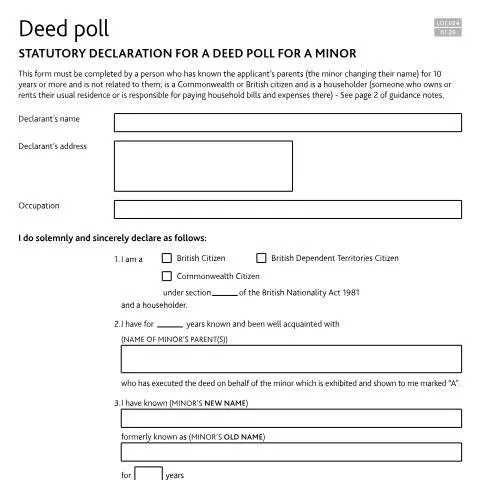
When parents in England and Wales decide to change their child's name through a deed poll, the process extends far beyond simply creating a new document. Form LOC024 represents a crucial but often misunderstood component of this legal transformation—a statutory declaration that serves as independent verification of the child's identity and the authenticity of the name change process.
This declaration must be completed by someone entirely separate from the family unit: a third party who has known the parents for at least ten years, possesses British or Commonwealth citizenship, and qualifies as a householder. The requirement reflects the courts' determination to prevent fraudulent name changes whilst ensuring proper legal recognition of legitimate alterations to a child's identity.
The form operates within the broader framework of deed poll procedures administered by HM Courts & Tribunals Service, yet its completion falls to civilian declarants rather than court officials or the parents themselves. This unique positioning creates both opportunities and complications for families navigating the name change process.
Qualifying as a Declarant: The Ten-Year Relationship Requirement
The statutory declaration hinges on finding an appropriate declarant who meets three distinct criteria, each carrying specific legal implications. The ten-year acquaintance requirement proves particularly challenging for younger parents or those who have relocated frequently.
The relationship must be with the child's parents rather than the child directly, though the declarant must also demonstrate personal knowledge of the minor. This dual requirement often catches families off-guard, particularly when they assume a family friend who knows their child well will automatically qualify.
Citizenship and Residency Verification
The declarant must hold British citizenship, British Dependent Territories citizenship, or Commonwealth citizenship under the British Nationality Act 1981. Naturalised citizens qualify equally with those holding citizenship by birth, but the declarant must be prepared to verify their status if questioned.
The householder requirement demands more than simple residence. The declarant must either:
- Own their usual residence outright or through mortgage arrangements
- Rent their property under formal tenancy agreements
- Hold primary responsibility for household bills and expenses at their residence
This criterion excludes lodgers, adult children living with parents without financial responsibility, and individuals in temporary accommodation arrangements. The requirement reflects the courts' desire for declarants with established community ties and verifiable addresses.
The Relationship Prohibition
Blood relatives, relatives by marriage, and step-family members cannot serve as declarants, regardless of how well they know the family or how long the relationship has existed. This prohibition extends to godparents in many interpretations, though the specific wording focuses on blood and marriage relationships rather than ceremonial or religious connections.
Navigating the Declaration Content: Section-by-Section Requirements
Form LOC024 demands precise completion across seven numbered declarations, each requiring specific information that must align with supporting documentation. Errors or omissions at this stage frequently necessitate restarting the entire process.
Citizenship Declaration and Supporting Evidence
Section 1 requires the declarant to specify their exact citizenship category by ticking the appropriate box. Commonwealth citizenship must reference the specific section of the British Nationality Act 1981 under which it was acquired, information many declarants lack readily available.
The householder declaration in this same section requires no supporting documentation within the form itself, but declarants should prepare to provide evidence if challenged during the oath-taking process.
Parental Knowledge and Timeline Documentation
Section 2 demands the exact number of years the declarant has known the parents, not approximations or ranges. This figure must be at least ten years, and many oath commissioners will verify this calculation based on the declaration date.
The reference to the deed poll as "exhibited and shown to me marked 'A'" requires the actual deed poll document to be present during the declaration process. Copies or drafts cannot substitute for the executed original.
| Section | Key Requirement | Common Error |
|---|---|---|
| 3 | Personal knowledge of child using new name | Stating years known as child rather than years using new name |
| 4 | Identification of citizenship document | Vague references like "passport" instead of specific document titles |
| 5 | Identity confirmation between deed and citizenship document | Failing to physically verify both documents simultaneously |
The Identity Verification Challenge
Sections 4 and 5 create the most complex requirements within the declaration. The declarant must identify the specific citizenship document being used as evidence—whether a British passport, naturalisation certificate, or other qualifying documentation—and confirm that the child referenced in this document matches the child named in the deed poll.
This verification becomes particularly intricate when children have undergone previous name changes or hold documents issued under different names. The declarant must be satisfied that all documents refer to the same individual, despite potential name variations.
The Oath-Taking Process: Beyond Simple Completion
Completing Form LOC024 represents only the initial stage of the statutory declaration process. The declarant must then present the form, supporting documents, and themselves before an authorised official who can administer oaths under English law.
Solicitors represent the most commonly accessed option for oath-taking, though their fees vary considerably across different practices and geographic areas. Many solicitors will require advance appointments and may request sight of all documentation before agreeing to administer the oath.
Commissioners for Oaths and Alternative Officials
Commissioners for Oaths operate independently from solicitors' practices, though many commissioners are themselves qualified solicitors. Their fees are typically lower than full legal practices, and they often offer more flexible appointment scheduling.
Officers of the Senior Court provide another avenue for oath administration, though accessing these officials usually requires visiting court buildings during specific hours. This option may prove more cost-effective but less convenient for declarants in rural areas.
The "Other" category on the form accommodates additional authorised officials, including certain magistrates, justices of the peace, and notaries public. However, declarants should verify that their chosen official holds current authority to administer statutory declarations specifically.
Documentation Requirements During Oath Administration
The oath administrator will require sight of:
- The completed Form LOC024
- The original deed poll document (marked as exhibit "A")
- The child's citizenship documentation (marked as exhibit "B")
- The declarant's own identification and citizenship proof
Many administrators also request evidence of the declarant's householder status, though this requirement varies between individual officials.
Document Assembly and Exhibit Management
The statutory declaration process requires careful coordination of multiple documents, each playing a specific role in establishing the child's identity and the validity of the name change. The exhibit system—marking documents as "A" and "B"—must be maintained consistently throughout the process.
Exhibit "A" consists of the deed poll document itself, which must be the original version signed by the parents or legal guardians. Photocopies, certified copies, or electronic versions cannot serve as exhibit "A" during the declaration process, though certified copies may be acceptable for subsequent administrative uses.
Citizenship Documentation as Exhibit "B"
The choice of citizenship document significantly impacts the declaration's complexity and acceptance by subsequent authorities. British passports provide the most straightforward evidence, particularly when issued under the child's previous name, as they clearly establish both citizenship and identity.
Birth certificates present more complex considerations. While they establish citizenship for children born in the UK to qualifying parents, they may not provide sufficient identification if the child's appearance has changed significantly since birth or if the certificate predates previous name changes.
Naturalisation certificates and registration documents serve as exhibit "B" for children who acquired British citizenship after birth. These documents typically provide stronger evidence of citizenship than birth certificates but may require additional identity verification if they were issued under different names.
Managing Multiple Name Changes
Children who have undergone previous name changes create additional complexity within the statutory declaration framework. The declarant must be satisfied that all documents refer to the same individual, despite potential variations in recorded names.
In such cases, additional documentation may be necessary to establish the chain of identity between the child's original name, any intermediate names, and the proposed new name. This might include previous deed polls, court orders, or other official recognition of earlier name changes.
Integration with Broader Deed Poll Procedures
Form LOC024 operates as one component within the larger deed poll process for minors, which differs significantly from adult name change procedures. Understanding these differences helps families navigate the complete requirements efficiently.
Unlike adult deed polls, which can be created and executed privately, minor name changes require either parental agreement (demonstrated through joint execution of the deed poll) or court orders in cases of parental dispute. The statutory declaration provides independent verification that supports both routes.
Court Involvement and Administrative Recognition
While HM Courts & Tribunals Service administers the statutory declaration form, the courts do not automatically review or approve individual name changes. The declaration serves as evidence for subsequent administrative processes rather than requiring judicial approval.
Government departments, educational institutions, and other official bodies rely on the statutory declaration to verify the authenticity of deed poll documents. Without this supporting declaration, many organisations may refuse to recognise the name change or require additional verification processes.
The declaration becomes particularly crucial when applying for new documentation in the child's changed name. Passport applications, school registrations, and medical records updates typically require both the deed poll and the supporting statutory declaration.
Long-term Implications and Record Keeping
Families should maintain original copies of both the deed poll and the completed statutory declaration indefinitely. These documents may be required years later for various administrative purposes, including university applications, employment verification, or international travel documentation.
The statutory declaration creates a permanent record of the name change process, including the declarant's identity and the verification procedures followed. This record can prove invaluable if questions arise about the name change's validity or if additional verification becomes necessary.
Addressing Common Complications and Procedural Obstacles
The statutory declaration process encounters predictable obstacles that can delay or complicate completion. Understanding these challenges allows families to prepare more effectively and avoid unnecessary delays.
Declarant availability represents the most frequent complication. The specific requirements for citizenship, householder status, and relationship duration create a narrow pool of eligible declarants, and suitable individuals may have limited availability for oath-taking appointments.
Geographic and Accessibility Considerations
Rural families often struggle to access authorised oath administrators within reasonable distances. While solicitors and commissioners operate in most towns, their availability for statutory declarations varies significantly.
Urban areas typically provide multiple options for oath administration, but higher demand can create longer waiting periods for appointments. Some administrators require several days' notice, particularly during busy periods such as the beginning of school terms when many families pursue name changes.
Accessibility considerations extend beyond simple geography. Declarants with mobility limitations may require administrators willing to provide home visits, though such services command premium fees and limited availability.
Document Authenticity and Verification Challenges
Oath administrators occasionally question the authenticity of supporting documents, particularly when citizenship evidence appears unusual or unfamiliar. Foreign-issued naturalisation documents, older passport formats, or certificates from Crown Dependencies may receive additional scrutiny.
These challenges typically require additional verification steps, such as contacting issuing authorities or obtaining certified translations for documents containing foreign language elements. Such complications can extend the process significantly and may require multiple appointments to complete.
The declarant's own documentation may also face scrutiny, particularly regarding householder status or citizenship evidence. Administrators may request additional proof beyond that explicitly required by the form, creating unexpected delays and expenses.
Financial Considerations and Administrative Efficiency
The statutory declaration process involves several fee structures that families should understand before beginning the procedure. These costs extend beyond the simple form completion to encompass oath administration, document certification, and potential additional verification requirements.
Solicitor fees for oath administration typically range from moderate to substantial amounts, with significant variation based on location and practice policies. Urban practices may charge premium rates, while smaller rural firms might offer more competitive pricing but limited availability.
Commissioner for Oaths fees generally undercut solicitor charges, though the specific amount varies by individual commissioner and geographic area. Some commissioners offer package deals for multiple documents or family groups, which can provide savings when several children require name changes simultaneously.
Additional costs may arise from document certification, travel to oath administrators, or replacement documentation if original exhibits become damaged during the process. Families should budget for these potential expenses when planning their name change procedures.
The timing of the statutory declaration within the broader deed poll process can significantly impact overall efficiency and cost. Coordinating all required elements—deed poll execution, declarant availability, and oath administration—requires careful scheduling to avoid delays that might necessitate document renewal or additional procedures.