Understanding the Statutory Declaration Process for Deed Poll Name Changes
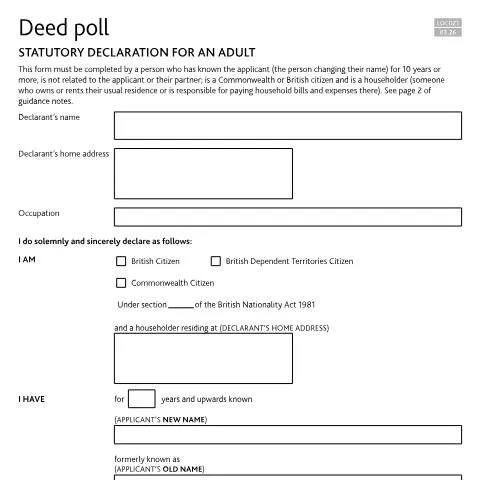
When an adult chooses to change their name by deed poll in England and Wales, the legal process requires more than just signing a document. Form LOC021 represents a crucial safeguard within the UK's name change framework – it's the statutory declaration that provides independent verification of both the applicant's identity and their genuine intention to adopt a new name permanently.
This declaration serves as corroborating evidence that the name change is legitimate and not being undertaken for fraudulent purposes. Unlike the deed poll itself, which the applicant signs, this form must be completed by someone who has known the applicant for a substantial period and can vouch for their identity and circumstances.
The form operates under the Statutory Declarations Act 1835, meaning that providing false information carries serious legal consequences, including potential prosecution for perjury. This legal weight ensures that the declaration process maintains its integrity as a protective measure within the broader name change system.
Who Must Complete This Declaration and Why
The declarant – the person completing Form LOC021 – must satisfy several specific criteria that reflect the document's role as an independent verification mechanism. These requirements are non-negotiable and designed to ensure the declarant has both the standing and knowledge necessary to make a meaningful declaration.
Essential Qualifying Criteria
The declarant must be someone who has known the applicant for 10 years or more. This extended timeframe ensures the declarant has sufficient knowledge of the applicant's identity and circumstances to make an informed declaration. The relationship cannot be casual – it must involve genuine, ongoing knowledge of the person.
Crucially, the declarant must not be related to the applicant or their partner. This independence requirement prevents conflicts of interest and ensures the declaration comes from a genuinely impartial source. Family members, including in-laws, step-relatives, and partners' family members, are all excluded from acting as declarants.
The declarant must hold British citizenship, British Dependent Territories citizenship, or Commonwealth citizenship. This requirement reflects the form's role within the UK legal system and ensures the declarant understands the legal implications of making a statutory declaration under English law.
The Householder Requirement
Perhaps the most complex criterion is the "householder" requirement. The declarant must be someone who either owns or rents their usual residence, or is responsible for paying household bills and expenses at that address. This requirement serves multiple purposes:
- It establishes that the declarant has a settled address and stable circumstances
- It provides a degree of social and financial responsibility that adds weight to their declaration
- It ensures the declarant can be contacted if questions arise about the declaration
Young adults living with parents, lodgers who don't pay bills directly, or people in temporary accommodation may not qualify as householders, even if they meet other criteria.
Navigating the Form's Technical Requirements
Form LOC021 follows the precise language requirements of statutory declarations, with specific fields that must be completed accurately. The form's structure reflects legal precedent dating back to the Victorian era, which explains its formal terminology and rigid format.
Critical Information Fields
The declarant must provide their full name, complete home address, and occupation. The address given here must match the address where they qualify as a householder – inconsistencies can invalidate the declaration.
The citizenship section requires the declarant to specify their exact citizenship status and, where applicable, the relevant section of the British Nationality Act 1981 under which they hold that status. Commonwealth citizens should be prepared to specify which Commonwealth country granted their citizenship.
The form requires both the applicant's old name (as it appears on their birth certificate or other founding document) and their new chosen name exactly as it will appear on the deed poll. Any discrepancies between the names on this declaration and those on the actual deed poll can cause complications later.
Documentary Evidence Requirements
The declaration references two key documents that must be present during the declaration process. Document "A" is the executed deed poll itself – the declarant must physically see this document and confirm it relates to the person they know. Document "B" is proof of the applicant's citizenship, typically a birth certificate, passport, or naturalisation certificate.
| Document | Purpose | Must Be Original |
|---|---|---|
| Deed Poll (Document "A") | Proves the name change has been formally executed | Yes |
| Citizenship Proof (Document "B") | Establishes applicant's legal status in UK | Yes |
| Declarant's ID | Confirms declarant's identity and address | Certified copy acceptable |
The Swearing Process and Authorised Officials
Once completed, Form LOC021 cannot simply be submitted – it must be sworn before an authorised official who can administer statutory declarations. This swearing process transforms the completed form from a draft document into a legally binding declaration.
Authorised Officials and Their Roles
Several categories of officials can administer statutory declarations, each bringing different advantages and considerations:
Solicitors are the most commonly used officials for this purpose. They understand the legal implications of statutory declarations and can often provide guidance on completing the form correctly. Most high street solicitors offer this service, though fees vary considerably across different regions and firms.
Commissioners for Oaths are specifically appointed to administer oaths and declarations. They may be solicitors, but some are retired legal professionals or court officials who maintain this specific authority. They often charge lower fees than full-service solicitors.
Officers of the Senior Court can administer declarations at court buildings, though this option may be less convenient for many applicants. Court officers typically charge standard fees set by the court system.
What Happens During the Swearing
The swearing process involves more than just signing the completed form. The authorised official must:
- Verify the declarant's identity using appropriate documentation
- Confirm the declarant understands the content and implications of their declaration
- Witness the declarant's signature on the form
- Complete their own section, including their official stamp or seal
The official will charge a fee for this service, typically ranging from £5 to £20, though some solicitors may charge more, particularly in central London or other high-cost areas.
Timing and Integration with the Broader Name Change Process
The statutory declaration doesn't exist in isolation – it forms part of a coordinated process that must be carefully sequenced to ensure all elements align correctly.
Coordination with Deed Poll Execution
The deed poll itself must be executed before the statutory declaration is sworn. This is because the declarant needs to see the completed deed poll (Document "A") during the declaration process. However, the declaration should be sworn as soon as possible after the deed poll is signed to ensure the declarant's recollection of events remains fresh and accurate.
Many applicants find it helpful to have the deed poll prepared and the declarant identified before beginning the formal process. This allows for a swift progression from signing the deed poll to swearing the declaration, typically within the same week.
Subsequent Use of the Declaration
Once sworn, the statutory declaration accompanies the deed poll when the applicant updates their records with various organisations. Different bodies have varying requirements:
- HM Passport Office typically requires both the deed poll and statutory declaration for passport updates
- DVLA may accept the deed poll alone for driving licence changes, but some offices request the declaration
- Financial institutions often want to see the statutory declaration as additional verification
- Employers may require the declaration for payroll and pension record updates
Common Complications and Resolution Strategies
Despite its straightforward appearance, Form LOC021 can present unexpected challenges that require careful navigation to avoid delays or rejection.
Declarant Availability and Qualification Issues
Many applicants discover that finding a suitable declarant is more challenging than anticipated. Friends who have known them for 10 years may not qualify as householders, while suitable householders may not have known them long enough. International students, young professionals who have moved frequently, or people who have experienced family estrangement often face particular difficulties.
In such cases, applicants may need to expand their search beyond immediate social circles. Former teachers (who must still meet the householder requirement), long-term family friends, former employers, or community leaders may provide solutions. Religious leaders, local councillors, or long-standing neighbours can sometimes serve as declarants if they meet all criteria.
Documentation Challenges
Citizenship documentation can present unexpected hurdles. Commonwealth citizens may struggle to obtain appropriate proof of citizenship, particularly if their original documents were issued decades ago. Similarly, naturalised British citizens may find that older certificates don't meet current requirements for clarity or completeness.
When original documents are unclear, damaged, or insufficient, applicants may need to obtain certified replacement documents before proceeding. This can add weeks or months to the name change timeline, particularly for documents from overseas authorities.
Geographic and Practical Constraints
The requirement for physical presence during the swearing process can create logistical challenges, particularly when the declarant and an authorised official are in different locations. Rural areas may have limited access to solicitors or commissioners for oaths, while urban areas may have long waiting times for appointments.
Some authorised officials offer mobile services, visiting clients at their homes or workplaces for an additional fee. This can be particularly valuable when the declarant has mobility issues or lives in an area with limited legal services.
Legal Implications and Long-term Considerations
The statutory declaration creates lasting legal obligations and protections that extend well beyond the immediate name change process.
Ongoing Legal Responsibilities
By making the declaration, the declarant accepts legal responsibility for the accuracy of their statements. This responsibility doesn't end when the declaration is sworn – it continues indefinitely. If questions arise years later about the name change, the declarant may be called upon to provide additional information or clarification.
This ongoing responsibility explains why some potential declarants are reluctant to complete the form, particularly if they have concerns about the applicant's motives for changing their name or their own understanding of the legal implications.
Protection Against Fraud
From the applicant's perspective, the statutory declaration provides valuable protection against future challenges to their name change. The independent verification it provides can be crucial if questions arise about the legitimacy of the name change, whether from employers conducting background checks, immigration authorities, or other official bodies.
The declaration also protects against identity theft or fraudulent use of the name change process. The requirement for an independent witness who has known the applicant for an extended period makes it significantly more difficult for someone to assume another person's identity through fraudulent name change documentation.
Strategic Considerations for Different Life Circumstances
The statutory declaration requirement affects different groups of name change applicants in varying ways, and understanding these differences can help inform timing and approach decisions.
Professional and Career Implications
For professionals in regulated industries, the statutory declaration may need to align with specific professional body requirements. Solicitors, doctors, teachers, and financial services professionals often face additional scrutiny when changing names, and the statutory declaration provides valuable supporting evidence for their professional regulators.
Some employers, particularly those in security-sensitive industries, may require sight of the statutory declaration before updating employment records. This can affect timing decisions, particularly for applicants who wish to minimise workplace disruption during their name change process.
International Considerations
Applicants who hold dual citizenship or who may need to use their UK documents overseas should consider how the statutory declaration will be viewed by foreign authorities. Some countries require apostille certification of UK statutory declarations before recognising them, which adds additional steps and costs to the process.
EU citizens who changed their names before Brexit may find that their statutory declarations require additional authentication for use in EU member states, reflecting the changed legal relationship between the UK and EU systems.
The Form LOC021 statutory declaration represents a sophisticated balance between accessibility and security within the UK's name change system. While its requirements may initially seem onerous, they serve essential protective functions that benefit both individual applicants and the broader integrity of identity documentation systems. Understanding these requirements and planning accordingly ensures that the statutory declaration supports rather than complicates the name change journey.