When a Director's Journey Ends: Understanding the TM01 Termination Process
The departure of a director from a UK company marks a significant administrative milestone that extends far beyond internal boardroom decisions. Whether triggered by resignation, retirement, removal, or corporate restructuring, the formal termination of a director's appointment requires precise documentation through Companies House form TM01. This process sits at the intersection of company law compliance and public record maintenance, ensuring transparency in corporate governance whilst protecting the legal interests of all stakeholders involved.
The TM01 form serves as the definitive mechanism for removing director appointments from the official Companies House register, creating a permanent public record of when an individual or corporate entity ceased their directorial responsibilities. This administrative step carries considerable weight—failure to file accurately or promptly can result in continued legal obligations for the departing director and potential compliance issues for the company.
The Legal Framework Behind Director Terminations
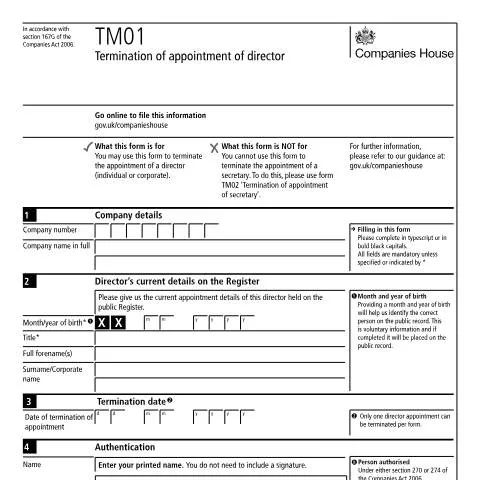
Section 167G of the Companies Act 2006 provides the statutory foundation for the TM01 form, establishing the mandatory requirements for notifying Companies House when director appointments end. This legislation reflects Parliament's commitment to maintaining accurate corporate records whilst balancing administrative efficiency with legal certainty.
The Act distinguishes clearly between different types of company officer roles, which explains why the TM01 form applies exclusively to directors—both individual and corporate directors. Company secretaries require separate treatment through form TM02, reflecting the distinct legal nature of these appointments and their different regulatory requirements.
Under the current framework, companies must notify Companies House of director terminations within 14 days of the change occurring. This tight timeframe underscores the importance of prompt action, particularly given that delayed filings can result in penalties and continued public record entries that may create confusion about the company's current management structure.
Corporate vs Individual Director Considerations
The form accommodates both individual and corporate directors, though the completion process varies slightly. For individual directors, the form requires personal details including full name and optional date of birth information. Corporate directors necessitate the full corporate name as registered with Companies House, creating a clear audit trail for complex corporate structures.
This dual approach reflects modern corporate reality, where subsidiary companies, holding companies, or specialist management entities may hold director positions across multiple corporate structures. The TM01 form ensures that regardless of the director type, the termination process maintains consistent standards of public disclosure.
Navigating the Form's Critical Data Points
The TM01 form's structure reflects a careful balance between comprehensiveness and usability, though several sections require particular attention to avoid processing delays or rejections by Companies House.
Section 1: Company Identification Accuracy
The company details section demands precise matching with existing Companies House records. The company name must appear exactly as registered, including any punctuation, spacing, or capitalisation. Similarly, the eight-digit company number requires careful verification—a single digit error will result in form rejection.
Companies with recent name changes face additional complexity here. If a director termination relates to a period before a name change, filers must ensure they reference the correct company details corresponding to the termination date, not necessarily the current registered name.
Section 2: Director Identification Precision
The director details section requires information that matches the current appointment record held by Companies House. This creates a crucial verification step—the details entered must correspond exactly to those appearing on the public register at the time of termination.
For individual directors, providing the month and year of birth remains voluntary but highly recommended. This optional information significantly reduces the risk of mistaken identity, particularly for directors with common names. Once provided, this birth information becomes part of the public record permanently.
| Director Type | Required Information | Optional Elements | Common Pitfalls |
|---|---|---|---|
| Individual | Full name, title | Month/year of birth | Name variations, maiden names |
| Corporate | Full corporate name | None | Abbreviated vs full legal name |
Section 3: The Critical Termination Date
The termination date field represents perhaps the most legally significant element of the entire form. This date determines when the director's legal obligations formally ceased, affecting everything from potential personal liability for company debts to ongoing fiduciary duties.
The date format follows the standard DD/MM/YYYY structure, and the significance extends beyond mere record-keeping. For directors facing potential disqualification proceedings or personal liability issues, the precise termination date can determine the scope of their legal exposure. Similarly, for companies undergoing insolvency procedures, director termination dates affect the timeline of potential wrongful trading claims.
Authentication Authority and Corporate Hierarchy
The authentication section reveals the sophisticated hierarchy of authority within UK corporate law. The TM01 form may be authenticated by a surprisingly broad range of individuals, reflecting different scenarios under which director terminations occur.
Standard authenticators include existing directors, company secretaries, and persons authorised under sections 270 or 274 of the Companies Act 2006. This flexibility ensures that director terminations can proceed even when the departing director is unwilling or unable to participate in the process.
Insolvency-related authenticators expand this authority to include liquidators, administrators, administrative receivers, and various types of receivers. This comprehensive list acknowledges that director terminations often occur during financial distress, when normal corporate governance structures may be disrupted or superseded by insolvency procedures.
Specialised Authentication Scenarios
The inclusion of Charity Commission receivers, CIC managers, and judicial factors reflects the specialised nature of certain corporate structures. Charitable companies and Community Interest Companies operate under additional regulatory oversight, whilst Scottish companies may involve judicial factors in specific circumstances.
This broad authentication framework prevents director terminations from being blocked by uncooperative departing directors whilst maintaining appropriate safeguards against fraudulent or unauthorised filings.
Filing Mechanics and Processing Realities
Companies House operates on a principle of administrative efficiency balanced with accuracy requirements. The TM01 form exemplifies this approach through its structured format requirements and comprehensive checking mechanisms.
The form must be completed in typescript or bold black capitals, reflecting Companies House's document scanning and processing systems. This requirement isn't merely aesthetic—unclear or inappropriately formatted submissions may face rejection or delays, extending the period during which incorrect director information remains on the public record.
Digital vs Postal Submission Routes
Companies House encourages online filing through their digital platform, though postal submissions remain available for those requiring paper-based processes. Online submissions typically process faster and provide immediate confirmation of receipt, whilst postal submissions may face longer processing times and potential delays due to document handling requirements.
The choice between digital and postal filing often depends on the company's broader administrative practices and the complexity of the termination scenario. Companies managing multiple director changes or operating under time pressure frequently favour online submission for its speed and reliability.
Public Record Implications and Ongoing Visibility
Every TM01 filing creates a permanent entry in the Companies House public record, accessible to anyone conducting company searches. This transparency serves multiple stakeholders: creditors assessing company management stability, potential business partners evaluating governance structures, and regulatory authorities monitoring compliance patterns.
The public nature of director termination records means that timing and accuracy carry reputational as well as legal significance. Directors facing personal insolvency, disqualification proceedings, or other legal challenges must consider how termination timing might affect public perception of their professional circumstances.
Historical Record Integrity
Once filed, TM01 forms become part of the company's permanent historical record. Unlike some other company filings that may be corrected or updated, director termination records typically remain unchanged, emphasising the importance of accuracy during initial submission.
This permanence affects how companies and directors approach the termination process, particularly in situations involving disputes or uncertain termination circumstances. The public record will reflect whatever termination date appears on the TM01 form, regardless of any subsequent disagreements about the actual cessation of duties.
Strategic Considerations for Complex Termination Scenarios
Director terminations rarely occur in isolation, often forming part of broader corporate restructuring, succession planning, or crisis management strategies. The TM01 form must be considered within these wider contexts to ensure optimal outcomes for all stakeholders.
Companies undergoing significant changes—mergers, acquisitions, or ownership transitions—frequently require multiple director terminations alongside new appointments. In such scenarios, careful coordination of TM01 filings with corresponding appointment forms (such as AP01 for new directors) ensures continuity of corporate governance whilst maintaining compliance with statutory requirements.
Succession Planning and Continuity
Well-planned director terminations often coincide with succession arrangements, requiring careful attention to timing and sequencing. Companies must ensure that adequate directorial capacity remains following any termination, particularly where minimum director requirements apply or where specific qualifications or authorisations are necessary for ongoing operations.
The TM01 form's requirement for single-director processing means that companies managing multiple simultaneous terminations must file separate forms for each departing director. This individual approach provides clarity in the public record whilst requiring careful administrative coordination to ensure all terminations are properly documented.
Post-Filing Consequences and Ongoing Obligations
The successful filing of a TM01 form triggers several important consequences that extend beyond the immediate administrative completion of the termination process. Understanding these implications helps companies and departing directors manage the transition effectively whilst avoiding potential complications.
From the company's perspective, the TM01 filing formally removes the director from the statutory register, ending their authority to act on the company's behalf and potentially triggering updates to bank mandates, insurance policies, and other commercial arrangements that reference specific directors.
For the departing director, the TM01 filing provides crucial legal protection by establishing a clear termination date for potential future liability issues. However, certain legal obligations may continue beyond the termination date, particularly regarding actions taken whilst in office or ongoing fiduciary duties in specific circumstances.
Compliance Monitoring and Follow-Up Actions
Companies House processing of TM01 forms typically completes within a few working days for online submissions, though complex cases or incomplete forms may require additional processing time. Companies should monitor their public record to confirm that termination changes have been properly reflected, particularly where immediate accuracy is crucial for ongoing business operations.
The integration of TM01 data with other regulatory systems means that director terminations may trigger notifications to HMRC, particularly where the departing director held specific tax responsibilities or where the company operates in regulated sectors requiring ongoing oversight of management changes.
Common Complications and How to Address Them
While filing form TM01 appears straightforward, several complications can arise that may delay processing or result in rejection. Understanding these potential issues beforehand can save considerable time and avoid unnecessary correspondence with Companies House.
Signature and Authentication Problems
One of the most frequent causes of rejection involves signature requirements. If the departing director refuses to sign the form, you cannot simply proceed without their signature. Companies House requires either the director's own signature or evidence that they cannot provide it due to specific circumstances such as mental incapacity (supported by medical evidence) or their whereabouts being unknown despite reasonable efforts to contact them.
When a director's location is unknown, you must demonstrate that you have made genuine attempts to contact them through their last known address, email, or through mutual contacts. Document these attempts as Companies House may request evidence. In cases of mental incapacity, you will need to provide appropriate medical certification or court documentation.
For companies with multiple directors, ensure that the remaining directors who sign the form have the authority to do so under the company's articles of association. Some articles require unanimous consent for director removals, while others may specify particular voting thresholds or procedures.
Timing and Effective Date Disputes
The effective date of termination often causes confusion, particularly when the departure involves disputes or disciplinary matters. The date you enter on form TM01 should reflect the actual date the directorship ended, not the date you file the form or when the decision was made.
If a director was removed at a board meeting, the effective date is typically the date of that meeting, provided proper notice was given and the meeting was validly constituted. For resignations, the effective date is usually when the resignation was communicated to the company, unless the director specified a future date in their resignation notice.
Be particularly careful with weekend dates or bank holidays. While directorships can end on any day, ensure your internal records align with the date specified on the TM01 form. Discrepancies between board minutes, resignation letters, and the Companies House filing can create problems later, especially if HMRC or other agencies request information about the director's period of service.
Outstanding Obligations and Liabilities
Directors often assume that filing TM01 immediately releases them from all company obligations, but this is not always the case. Certain liabilities can continue beyond the termination date, particularly those arising from actions taken while serving as a director.
Before filing, ensure the departing director has returned all company property, including documents, keys, company credit cards, and electronic devices. They should also transfer or close any accounts where they held signatory rights, such as bank accounts, supplier accounts, or government registrations where they were the nominated contact.
Consider whether the director held any specific licences or authorisations on behalf of the company. For example, if they were the designated responsible person for alcohol licensing or held professional qualifications required for the company's operations, you may need to arrange alternative cover before their departure becomes effective.
Record Keeping and Internal Documentation Requirements
Proper documentation extends far beyond the TM01 form itself. Companies must maintain comprehensive records of director appointments and terminations, both for legal compliance and practical business management.
Statutory Books and Internal Records
Your company's register of directors must be updated immediately upon filing TM01. This register, which can be maintained at the registered office or with Companies House under the central filing system, should show the exact date of termination and be available for public inspection during business hours.
Update your register of directors' residential addresses simultaneously, though this information remains confidential and is not publicly accessible. If the departing director had a service address different from their residential address, both entries need updating or removal as appropriate.
Board minutes should comprehensively document the circumstances of the director's departure. For resignations, minute the receipt of the resignation letter and any board discussion about transition arrangements. For removals, ensure minutes reflect that proper procedures were followed, including any required notice periods and voting processes specified in your articles of association.
Insurance and Indemnity Considerations
Review your directors' and officers' insurance policy to understand coverage for former directors. Many policies provide 'run-off' cover for claims arising from acts committed while the person was a director, but this varies significantly between insurers and policy terms.
If your company has provided indemnities to directors, consider whether these continue post-departure and ensure appropriate documentation exists. Some companies choose to provide deed polls or formal indemnity letters to departing directors, particularly where the departure is amicable and the director acted in good faith throughout their tenure.
Document any handover procedures, including transfer of responsibilities to remaining directors or new appointees. This is particularly important for directors who held specific roles such as health and safety responsibilities, data protection officer duties, or regulatory compliance functions.
Communication and Stakeholder Management
Plan your communication strategy before filing TM01. Key stakeholders typically need notification of director changes, including banks, insurers, major suppliers, and customers where the departing director had significant relationships.
Banks often require updated mandate forms when directors change, particularly if the departing director was a signatory. Some banks may freeze accounts temporarily until new mandates are provided, so arrange this before the effective termination date where possible.
Professional advisers such as accountants, solicitors, and business consultants should also be notified, especially if they had direct relationships with the departing director or if the director was their primary contact point.
Regulatory Implications Across Different Sectors
Director terminations can trigger additional regulatory requirements depending on your company's activities and sector. Understanding these implications ensures compliance across all relevant regulatory frameworks.
Financial Services and Regulated Activities
Companies authorised by the Financial Conduct Authority (FCA) face specific obligations when directors change. If the departing director held a 'controlled function' under FCA rules, you must notify the regulator within seven business days using the appropriate forms, typically Form C or Form D depending on the circumstances.
The FCA distinguishes between different types of departure, including resignation, dismissal, and retirement, each potentially requiring different notification procedures. Where a director departure results from disciplinary action or concerns about fitness and propriety, additional disclosure requirements may apply.
For companies holding consumer credit licences, director changes must be reported to the FCA as they may affect the company's ongoing authorisation. Similarly, investment firms, insurance intermediaries, and other regulated entities have specific timescales and procedures for notifying director departures.
Professional Services and Licensing Requirements
Law firms, accounting practices, and other professional service companies often have additional requirements when directors or partners change. The Solicitors Regulation Authority (SRA), for example, requires notification of changes to firm managers and owners within specified timeframes.
For companies holding alcohol or entertainment licences, departing directors who were designated premises supervisors or licence holders must arrange for alternative cover. Local licensing authorities typically require formal applications to vary licences when responsible persons change.
Construction companies may need to update their principal contractor registrations with the Health and Safety Executive if the departing director held specific health and safety responsibilities. Similarly, companies in regulated industries such as pharmaceuticals, aviation, or telecommunications may have sector-specific notification requirements.
Tax and Employment Implications
HMRC should be notified of director changes through your regular PAYE submissions, but you may also need to submit specific forms if the director received benefits in kind or if there are outstanding tax liabilities. Form P11D submissions for the tax year must still be completed for departing directors, covering the period up to their termination date.
If the departing director was also an employee, ensure proper calculation of final salary, holiday pay, and any statutory entitlements. TUPE regulations may apply if the director's responsibilities are being transferred to another entity or if their departure is connected with a business transfer.
Consider pension scheme implications, particularly for directors who were members of company pension schemes. Trustees may need formal notification of the change in status, and the departing director may have options regarding their pension benefits that require consideration within specific timeframes.
For companies operating internationally, consider whether the director change affects any overseas registrations, tax positions, or regulatory approvals. Some jurisdictions require local directors or have specific notification requirements when UK parent company directors change.