When Corporate Governance Shifts: Managing Secretary Departures Through Form TM02
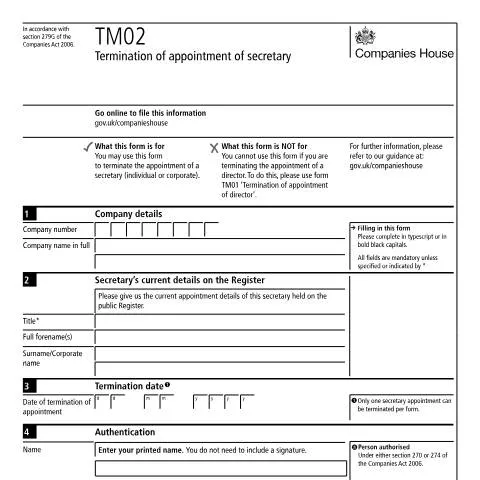
The departure of a company secretary marks a significant moment in corporate governance, whether driven by resignation, retirement, or strategic restructuring. Form TM02 serves as the statutory instrument to formally terminate a secretary's appointment, ensuring the public record at Companies House reflects current reality. This process, governed by section 279G of the Companies Act 2006, requires precision and timeliness to maintain regulatory compliance whilst protecting both the departing secretary and the company from potential liability gaps.
Unlike director appointments which carry fiduciary duties and broader strategic responsibilities, secretary terminations through TM02 focus purely on administrative and statutory compliance roles. The form's streamlined nature reflects this distinction, yet the implications of improper handling can create significant operational challenges, particularly for companies navigating periods of governance transition or corporate restructuring.
Statutory Framework and Legal Positioning
The Companies Act 2006 establishes clear parameters around secretary appointments and terminations, with section 279G specifically addressing the formal cessation process. Private companies are not legally required to appoint a secretary, making TM02 terminations often part of broader governance simplification strategies. Public companies, however, must maintain a secretary appointment at all times, meaning TM02 submissions typically coincide with immediate replacement appointments.
The legal framework distinguishes between individual secretaries and corporate secretaries, both accommodated within TM02's structure. Corporate secretaries, often professional service firms, may terminate appointments whilst maintaining ongoing relationships with the company in different capacities. Individual secretaries might be employees whose roles are being redefined or external appointees whose services are no longer required.
Crucially, TM02 cannot be used for director terminations, even where an individual holds dual director-secretary roles. Such situations require separate TM01 and TM02 submissions, with careful attention to sequencing to avoid inadvertent governance gaps that could affect the company's ability to execute statutory filings or board resolutions.
Authentication Requirements and Corporate Authority
Form TM02 requires authentication by authorised individuals, reflecting the sensitivity of governance changes. Directors, existing secretaries, and persons authorised under sections 270 or 274 of the Companies Act 2006 can authenticate terminations. This framework prevents unauthorised removal of secretaries whilst ensuring legitimate governance transitions proceed smoothly.
In practice, authentication often reveals complex corporate dynamics. Departing secretaries may authenticate their own terminations, particularly in amicable resignations. However, contested removals typically require director authentication, potentially creating administrative challenges where the secretary controls day-to-day filing processes. Companies should establish clear succession protocols to avoid such complications.
Navigating the Termination Timeline and Effective Dates
The termination date specified in TM02 carries significant legal and practical implications, determining when statutory duties formally cease and potential liability exposures crystallise. Retrospective terminations are permitted, allowing companies to regularise situations where secretaries departed before formal paperwork completion. However, such arrangements may create interim periods where statutory responsibilities remain unclear.
Forward-dated terminations enable planned transitions, particularly valuable during notice periods or structured handovers. Companies often coordinate TM02 submissions with new secretary appointments, ensuring continuous coverage of statutory obligations. The timing becomes particularly critical around year-end periods when annual filings and accounts submissions require secretary involvement or oversight.
| Termination Scenario | Recommended Timing | Key Considerations |
|---|---|---|
| Immediate resignation | Within 14 days of departure | Ensure ongoing statutory compliance coverage |
| Planned retirement | Effective date aligns with final working day | Coordinate with replacement appointment |
| Corporate restructure | Align with broader governance changes | Consider multiple simultaneous appointments/terminations |
| Service provider change | Seamless transition date | Maintain continuity of professional services |
Coordination with Ongoing Corporate Activities
Secretary terminations rarely occur in isolation, often forming part of broader corporate changes requiring careful orchestration. Annual return filings, accounts submissions, and board resolutions may all be affected by secretary departures, particularly where the departing secretary held significant administrative responsibilities or signing authorities.
Companies should audit all ongoing statutory obligations before submitting TM02, ensuring alternative arrangements exist for time-sensitive filings. This becomes particularly complex for groups of companies where a single secretary serves multiple entities, as termination timing must consider the collective statutory obligations across the corporate structure.
Completing the TM02 Form: Technical Requirements and Common Pitfalls
Form TM02's apparent simplicity masks several technical requirements that frequently cause rejection or delay. The secretary's current details must exactly match the public register, including precise spelling, title usage, and corporate name formatting. Discrepancies, even minor ones, trigger automatic rejection, requiring resubmission and potential delays in reflecting the termination.
Individual secretary details require particular attention to name variations and title usage. Professional qualifications or honours included in the original appointment must be replicated exactly, even where the departing secretary's preferences have changed. Corporate secretaries present different challenges, as company names may have changed since appointment, requiring careful verification against both current and historical register entries.
Authentication Mechanics and Signature Requirements
The authentication process has evolved significantly with digital filing adoption. Electronic submissions require printed name entry without traditional signatures, whilst postal submissions maintain conventional signature requirements. This dual approach reflects the transition towards digital-first corporate administration whilst accommodating companies preferring traditional filing methods.
Authentication authority must exist at the time of form submission, not merely at the termination date. This distinction becomes relevant where authenticating directors or secretaries themselves face appointment changes around the same period. Companies should verify authentication authority immediately before submission to avoid technical rejections.
Digital Versus Postal Submission Channels
Companies House actively encourages online filing through its WebFiling service, offering faster processing and immediate confirmation of successful submissions. Digital submissions typically process within 24-48 hours, compared to postal submissions which may take several working days depending on mail delivery and manual processing queues.
However, certain situations favour postal submission, particularly complex cases requiring explanatory cover letters or situations where digital authentication proves problematic. Companies operating multiple entities often benefit from postal batch submissions, allowing coordinated processing of related governance changes across corporate groups.
Processing Implications and Public Record Updates
Once processed, TM02 submissions immediately update the public register, making termination information visible to searchers. This transparency serves important commercial purposes, allowing creditors, customers, and business partners to verify current governance arrangements. However, it also means that internal governance disputes or unexpected departures become part of the permanent public record.
The public visibility of termination dates can reveal sensitive information about corporate changes, potentially affecting commercial relationships or triggering contractual review clauses. Companies should consider these implications when determining termination timing, particularly during sensitive commercial negotiations or restructuring activities.
Special Circumstances and Complex Corporate Structures
Multinational corporations and complex group structures often present unique challenges for TM02 submissions. Cross-border service arrangements, where UK companies utilise overseas corporate secretaries, require careful attention to address formatting and authentication requirements. Similarly, professional service firms serving multiple group companies must coordinate terminations to avoid inadvertent gaps in statutory coverage.
Insolvency situations introduce additional complexities, as liquidators, administrators, and receivers gain authentication authority under specific circumstances. These insolvency practitioners must balance their statutory duties with practical governance needs, often requiring rapid secretary changes to facilitate insolvency proceedings whilst maintaining essential corporate functions.
Corporate Secretary Firms and Professional Service Transitions
The termination of corporate secretary appointments often reflects changing professional service relationships rather than governance failures. Firms may withdraw from client relationships due to conflict concerns, capacity constraints, or strategic repositioning, requiring smooth transitions to maintain statutory compliance.
Such transitions frequently involve detailed handover processes, including transfer of corporate records, ongoing matter management, and coordination with replacement providers. TM02 timing must accommodate these practical requirements whilst ensuring continuous statutory coverage throughout the transition period.
Post-Termination Obligations and Record Management
Secretary termination through TM02 does not immediately absolve the departing secretary of all obligations, particularly regarding confidentiality and record management. Statutory duties formally cease on the termination date, but professional obligations may continue under separate contractual arrangements or regulatory requirements.
Companies should establish clear protocols for retrieving corporate documents, access credentials, and confidential information from departing secretaries. This process becomes particularly important where secretaries maintained significant administrative responsibilities or held custody of important corporate records, including statutory registers, board minutes, or compliance documentation.
The termination also triggers review requirements for various corporate arrangements, including banking mandates, professional service agreements, and insurance policies that may reference the secretary role. Companies should audit these relationships promptly after TM02 submission to ensure continued operational effectiveness and avoid potential service disruptions.
Ongoing Compliance Monitoring and Governance Continuity
Following secretary termination, companies must demonstrate continued compliance with statutory obligations, even where no replacement secretary is appointed. Directors assume direct responsibility for statutory filings and compliance monitoring, requiring clear internal protocols to prevent inadvertent breaches or missed deadlines.
This transition period often reveals the true extent of the departing secretary's contributions, highlighting areas where additional support or professional services may be required. Companies should conduct comprehensive compliance audits following secretary terminations, ensuring all ongoing obligations are properly managed and resourced within the revised governance structure.
Special Circumstances and Complex Scenarios
Whilst the standard TM02 process covers most secretary resignations, certain circumstances require additional consideration and may involve supplementary documentation or procedures.
Death of a Company Secretary
When a company secretary dies whilst in office, the TM02 form must still be filed, but the process differs significantly. The cessation date becomes the date of death, and this must be clearly stated in the relevant section. Companies House typically requires a copy of the death certificate to be submitted alongside the TM02, though this isn't explicitly stated on the form itself.
The person filing the TM02 in these circumstances—usually a remaining director or the company's solicitor—should include a covering letter explaining the situation. This helps Companies House process the filing appropriately and may prevent queries or requests for additional information.
Importantly, if the deceased secretary held other roles within the company (such as being a director or shareholder), separate forms will be required for each position. The company should also consider whether the secretary's estate has any ongoing obligations or entitlements related to their former role.
Secretary Removal Due to Disqualification
In rare cases, a company secretary may be removed due to legal disqualification. This could occur if they're convicted of certain criminal offences or become subject to disqualification orders. The TM02 should be filed promptly following the disqualification taking effect, with the cessation date being the date the disqualification order comes into force.
Companies should be aware that continuing to employ a disqualified person as secretary could result in both the company and its directors facing penalties. The TM02 filing in such cases serves as important evidence that the company has acted appropriately once aware of the disqualification.
Multiple Secretary Changes
Some companies may need to terminate multiple secretaries simultaneously—perhaps during a corporate restructure or following an acquisition. Each secretary requires a separate TM02 form; Companies House doesn't accept bulk filings for secretary terminations.
When filing multiple TM02s, it's advisable to submit them as a batch with consistent cessation dates where appropriate. This creates a clear administrative record and helps avoid confusion about the company's current secretary arrangements.
Secretary Companies and Corporate Appointees
Where the outgoing secretary is itself a company (a corporate secretary), additional considerations apply. The TM02 must include the corporate secretary's company number and registered office address. If the corporate secretary is being wound up or struck off, this should be noted in any covering correspondence.
Corporate secretaries often provide services to multiple companies, so their resignation from one company doesn't necessarily indicate any broader issues. However, companies should verify that any handover arrangements are properly documented and that access to confidential information is appropriately managed.
Record Keeping and Internal Documentation Requirements
Beyond the statutory filing requirements, companies must maintain comprehensive internal records relating to secretary appointments and terminations. These obligations extend well beyond simply filing the TM02 with Companies House.
Board Minutes and Resolutions
The decision to accept a secretary's resignation or to remove a secretary should be properly minuted at a board meeting. These minutes should record the date of the decision, the effective cessation date, and any relevant circumstances. Where the secretary is being removed rather than resigning, the minutes should document the reasons for removal and confirm that proper notice has been given.
Board minutes serve as crucial evidence of the company's decision-making process and can be important if questions later arise about the timing or circumstances of the secretary's departure. They should be signed by the chairman of the meeting and stored with the company's other statutory records.
If the secretary's termination is connected to other corporate actions—such as a change in company ownership or structure—the minutes should cross-reference these related decisions to create a clear chronological record.
Employment and Service Records
Where the secretary is also an employee, the company must maintain employment records in accordance with standard employment law requirements. This includes final pay calculations, holiday entitlements, and any relevant notice periods or garden leave arrangements.
Even where the secretary role is non-executive or undertaken by a corporate service provider, the company should maintain records of the service agreement terms and any handover arrangements. This is particularly important for ensuring continuity of corporate governance and compliance obligations.
Companies should also document what access rights the departing secretary had to company systems, premises, or confidential information, and confirm that these have been appropriately revoked or transferred.
Statutory Register Updates
The company's internal register of secretaries must be updated to reflect the termination. This register should show the cessation date and should be updated before or simultaneously with filing the TM02. The register forms part of the company's statutory books and must be available for inspection by members and, in some cases, the public.
Companies should ensure that their internal records are consistent with the information filed at Companies House. Discrepancies between internal records and public filings can create compliance issues and may indicate poor corporate governance.
Post-Filing Compliance and Ongoing Obligations
Filing the TM02 is not the end of the process—companies must ensure ongoing compliance with their secretary-related obligations and address any consequential requirements that arise from the termination.
Immediate Post-Filing Actions
Once Companies House has processed the TM02, companies should verify that their public record has been correctly updated. This can be checked through the Companies House online service or by ordering an up-to-date company information document. Any errors should be reported to Companies House immediately.
The company should also update its own systems and documentation to reflect the change. This includes updating letterheads, websites, and any other materials that reference the secretary's details. Banks and other financial institutions should be notified if the secretary was an authorised signatory or had other banking privileges.
Professional advisers—including accountants, solicitors, and other service providers—should be informed of the change, particularly if they regularly corresponded with the secretary or relied on their authority for certain matters.
Appointment of Replacement Secretary
For private companies, appointing a replacement secretary is optional but may be advisable depending on the company's circumstances. Public companies must appoint a replacement secretary without delay, as they are legally required to have a secretary at all times.
If appointing a replacement, this requires filing form AP03 with Companies House. The timing of this appointment can be important—companies may choose to appoint a replacement before the existing secretary's termination becomes effective to ensure continuity.
Where no immediate replacement is appointed, companies should consider how the secretary's duties will be handled. Many secretary functions can be performed by directors, but some specific obligations may require particular attention or alternative arrangements.
Impact on Other Corporate Arrangements
The secretary's departure may affect other corporate arrangements and documents. Articles of association sometimes contain specific provisions about secretary appointments, and these should be reviewed to ensure continued compliance.
Loan agreements, property leases, and other contracts may reference the company secretary or require their involvement in certain processes. Companies should review these arrangements and notify counterparties where necessary.
Insurance policies, particularly directors' and officers' insurance, may need to be updated to reflect the change in company officers. The departing secretary should be informed about any ongoing coverage that may apply to their former role.
Regulatory and Tax Considerations
Certain regulated companies may need to notify their industry regulators about changes in key personnel, including company secretaries. This is particularly relevant for financial services companies, where the secretary may be considered a senior manager or controlled function holder.
From a tax perspective, HMRC doesn't typically need to be notified directly about secretary changes, but companies should ensure that any PAYE or employment tax obligations related to the secretary's departure are properly handled.
Companies should also consider whether the secretary's departure affects any ongoing compliance obligations or deadlines. If the secretary was responsible for particular regulatory filings or returns, arrangements must be made to ensure these continue to be handled appropriately.