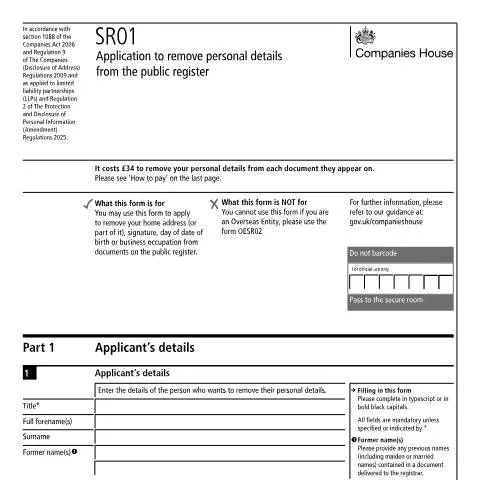
Who Needs to Protect Their Personal Details from Public Scrutiny
When you become a company director, shareholder, or person with significant control, your personal information becomes part of the public record at Companies House. While transparency is essential for business regulation, this exposure can create serious privacy and security concerns for individuals whose home addresses, signatures, or other sensitive details are accessible to anyone.
The SR01 form addresses a growing need among business professionals who find their personal information vulnerable to misuse. Identity thieves, stalkers, or competitors can exploit publicly available home addresses and signatures. Directors of controversial businesses, high-profile entrepreneurs, or those involved in contentious industries face particular risks when their residential details remain on public display.
This application process isn't automatic protection—it requires careful consideration of which information needs removing and from which specific documents. The £34-per-document fee structure means strategic planning is essential, as removing details from multiple filings across several companies can become costly quickly.
Directors and Officers Facing Exposure Risks
Company directors bear the greatest exposure through Companies House filings. Your home address appears on appointment forms (AP01), annual confirmations, and incorporation documents. Each filing creates a permanent public record, meaning years of business activity can leave an extensive trail of personal information.
Secretaries, particularly those working from home or small practices, face similar vulnerabilities. Their residential addresses often serve dual purposes as business correspondence addresses, making removal more complex due to ongoing operational requirements.
Shareholders and PSCs in Sensitive Positions
People with significant control (PSCs) holding 25% or more company ownership find their details mandatorily published. This includes beneficial owners, trustees managing shares, or family members holding control through complex ownership structures. High-net-worth individuals or those in public-facing roles often discover their residential information accessible to unwanted attention.
Shareholders in smaller companies, particularly family businesses, may inadvertently expose home addresses when their shares were issued using residential details rather than professional correspondence addresses.
Understanding What Information Can Be Hidden
The SR01 form allows removal of four specific types of personal information, each with distinct limitations and conditions. Understanding these restrictions prevents wasted applications and ensures compliance with Companies House requirements.
| Information Type | What Can Be Removed | What Remains Visible | Key Restrictions |
|---|---|---|---|
| Date of Birth | Day only (e.g., the '15' from 15/03/1980) | Month and year (e.g., 03/1980) | Cannot remove complete date |
| Home Address | Full residential address | Partial postcode or country only | Must provide replacement if current officer |
| Business Occupation | Job title/description | Name and other details | Directors only, incorporation/appointment docs |
| Signature | Handwritten signature image | Printed/typed name | Does not include typed names |
Home Address Removal Complexities
Home address removal involves the most intricate conditions. If your residential address serves as a company's current registered office, you cannot remove it until the company files form AD01 to change the registered office first. This two-step process prevents companies from losing their legal address requirements.
For dissolved companies, different rules apply. If your home address was the registered office at dissolution, you must wait six months after dissolution before applying for removal. This waiting period ensures proper record-keeping during the company's wind-down process.
When your home address appears only as a former registered office address, or you no longer hold your current role, Companies House will partially hide the address automatically. UK addresses show only the first part of the postcode (e.g., "SW1A" instead of "SW1A 2AA"), while international addresses display only the state/province and country.
Signature and Occupation Limitations
Signature removal applies exclusively to handwritten signatures on filed documents. Typed or printed names remain visible, as these don't carry the same identity theft risks as actual signature reproductions.
Business occupation removal is restricted to directors and equivalent officers, and only from documents where occupation disclosure is legally required—typically incorporation forms or appointment notifications. Casual mentions of occupation in other contexts cannot be removed through this process.
Navigating the Document Identification Process
Successfully removing personal details requires precise identification of every document containing the information. This detective work often proves more challenging than completing the application itself, particularly for individuals involved in multiple companies over several years.
The document registration date is crucial—this isn't the date you signed or submitted the document, but when Companies House officially registered it. These dates appear in the first column of a company's filing history on the public register. Incorrect dates lead to automatic rejection, requiring resubmission with the correct fee.
Systematic Document Research Strategy
Start by searching each relevant company on the Companies House public register. The filing history provides chronological records of all submitted documents, showing registration dates, document types, and filing codes. Common documents containing personal details include:
- IN01 forms (incorporation applications) containing founder details
- AP01 forms (director appointments) showing home addresses and occupations
- PSC01-PSC09 forms detailing people with significant control
- Annual confirmation statements (CS01) repeating current officer information
- Mortgage and charge documents sometimes containing personal details
For companies with extensive filing histories, focus on documents from periods when your home address was used for business correspondence. Cross-reference these with role changes, as appointment and resignation forms often contain the most sensitive information.
Understanding Document Codes and Types
Companies House uses alphanumeric codes for different document types. The SR01 form requires both the formal document title and its filing code. For example, "Appointment of director" corresponds to form code "AP01", while "Annual return" uses code "AR01" for older filings or "CS01" for confirmation statements.
Some documents may appear under different names depending on filing date. Annual returns became confirmation statements in 2016, but older documents retain their original titles. Ensure you use the exact terminology shown in the company's filing history.
Replacement Address Requirements and Strategic Considerations
When removing home addresses for current company officers, providing a replacement correspondence address becomes mandatory. This requirement ensures Companies House maintains contact capability while protecting personal privacy.
The replacement address appears on the public register, so choose carefully. Many applicants use professional office addresses, accountant offices, or dedicated correspondence services. Virtual office providers offer suitable alternatives, though ensure the service provider accepts legal correspondence and regulatory communications.
When Replacement Addresses Aren't Required
Several circumstances exempt you from providing replacement addresses:
- The company has been dissolved
- You no longer hold the officer role
- Your home address was used only as a former registered office address
In these cases, Companies House automatically implements partial address hiding. UK addresses show only the postcode area (first part), while international addresses display only state/province and country information.
However, dormant companies and those in liquidation require replacement addresses even when you no longer hold active roles. These companies retain legal obligations requiring accessible correspondence addresses for regulatory purposes.
Strategic Address Selection
Choose replacement addresses considering long-term implications. If you use a solicitor's or accountant's office, ensure they accept service of legal documents and regulatory correspondence. Some professional services charge for handling mail, while others include correspondence management in their fees.
Avoid using another person's home address as a replacement, as this simply transfers privacy risks to someone else. Commercial addresses provide better long-term stability and professional appearance on public records.
Cost Management and Multiple Document Applications
The £34-per-document fee structure requires careful financial planning for comprehensive privacy protection. Individuals involved in multiple companies or with extensive filing histories may face costs running into hundreds or thousands of pounds.
Calculate total costs before submitting applications. Count each document separately—if your details appear on incorporation forms for three companies plus appointment forms for director roles, plus confirmation statements, each requires separate payment. There are no bulk discounts or family rates available.
Prioritising Documents by Risk Level
When budget constraints limit comprehensive removal, prioritise documents by exposure risk:
- Recent appointment forms showing current home addresses
- Incorporation documents for active companies where you remain an officer
- PSC notifications revealing beneficial ownership and residential details
- Older documents for dissolved companies (lower priority unless specific risks exist)
Focus initial applications on documents containing the most sensitive or current information. Historical documents for dissolved companies pose lower immediate risks unless your circumstances involve ongoing disputes or security concerns.
Payment Methods and Processing
Companies House accepts various payment methods for SR01 applications, including cheques, postal orders, and online payments. Payment must accompany each application—incomplete payments result in rejection and require resubmission with correct fees.
When submitting multiple applications simultaneously, clearly identify which payment covers which documents. Separate cheques for different companies or document batches help prevent processing confusion and potential delays.
Submission Channels and Processing Expectations
SR01 forms can be submitted by post to Companies House, with original signatures required for verification purposes. Electronic submission isn't currently available for this form type, reflecting the sensitive nature of personal data removal requests.
Processing times vary depending on application complexity and document verification requirements. Simple applications removing details from recent, easily identifiable documents typically process within 10-15 working days. Complex applications involving multiple companies or historical documents may require 4-6 weeks for completion.
Document Preparation and Submission
Complete forms in typescript or bold black capitals as specified. Handwritten applications increase processing time and rejection risk due to legibility concerns. Ensure all mandatory fields contain accurate information matching your Companies House records exactly.
Include clear photocopies of identification documents when requested. Passport photocopies or driving licence copies help verify identity, particularly when names or addresses have changed since original filings.
Post applications to the secure processing address provided in the guidance notes. Standard company correspondence addresses don't handle SR01 forms—use the specific secure room address to ensure proper routing and confidential handling.
Tracking and Follow-up Procedures
Companies House contacts applicants via the email address provided on the form. Monitor this email account regularly for processing updates, additional information requests, or completion notifications.
If Companies House requires additional information to locate your details on specific documents, respond promptly to avoid processing delays. Common requests include clarification of document dates, company numbers, or name variations used in different filings.
Handling Rejections and Resubmission Strategies
Applications face rejection for various reasons, from incorrect document details to ineligible information types. Understanding common rejection causes helps prevent repeated failures and additional costs.
The most frequent rejection reason involves incorrect document registration dates or company numbers. Double-check these details against the public register before submission. Even minor errors—such as using filing dates instead of registration dates—trigger automatic rejection.
Common Rejection Scenarios
Several circumstances lead to predictable rejections:
- Attempting to remove current registered office addresses without prior AD01 filing
- Applications for dissolved companies within six months of dissolution date
- Requests to remove other people's details rather than your own information
- Incomplete replacement address details when required for current officers
- Attempts to remove addresses from mortgage charges or other protected documents
Review rejection letters carefully, as they typically identify specific issues requiring correction. Some rejections result from policy restrictions rather than application errors—in these cases, resubmission won't succeed without addressing underlying eligibility issues.
Successful Resubmission Tactics
When resubmitting after rejection, address each identified issue systematically. If document details were incorrect, verify registration dates and company numbers again using the current public register. Names and addresses must match exactly as they appear in original filings.
For policy-related rejections, consider alternative approaches. If your home address serves as a current registered office, file form AD01 to change the registered office first, then resubmit the SR01 application. This sequential approach ensures compliance with regulatory requirements while achieving your privacy objectives.
Include brief covering letters explaining corrections made since initial rejection. While not mandatory, these help processing staff understand changes and may expedite review of resubmitted applications.
Long-term Privacy Protection and Ongoing Obligations
Successful SR01 applications provide immediate privacy protection, but maintaining long-term confidentiality requires ongoing vigilance. Future company filings may inadvertently reintroduce personal details unless you implement systematic privacy practices.
Establish dedicated correspondence addresses for all business activities. Using professional addresses from the outset prevents personal details appearing on future filings. Many privacy breaches occur through casual use of home addresses on routine forms filed months or years after SR01 applications.
Preventing Future Exposure
Coordinate with company secretaries, accountants, and legal advisors to ensure they use professional correspondence addresses on all filings. Brief them on your privacy requirements and provide alternative contact details for different purposes.
Monitor Companies House filings regularly, particularly after role changes, company formations, or annual confirmations. Set up monitoring services or periodic manual checks to identify any inadvertent disclosure of personal information requiring additional SR01 applications.
Consider the broader privacy landscape beyond Companies House. Similar personal details may appear on other public registers—Land Registry documents, court filings, or regulatory submissions to other bodies. Comprehensive privacy protection often requires parallel applications to multiple agencies.
Balancing Transparency and Privacy
Remember that business transparency serves important public interests. While protecting personal privacy is legitimate, maintain appropriate levels of business accountability and regulatory compliance. Professional correspondence addresses and properly managed contact systems satisfy both privacy needs and legal obligations.
The SR01 process represents one tool in a comprehensive approach to personal privacy protection. Combined with thoughtful business practices and ongoing monitoring, it provides effective protection against unwanted exposure while maintaining necessary business transparency and regulatory compliance.