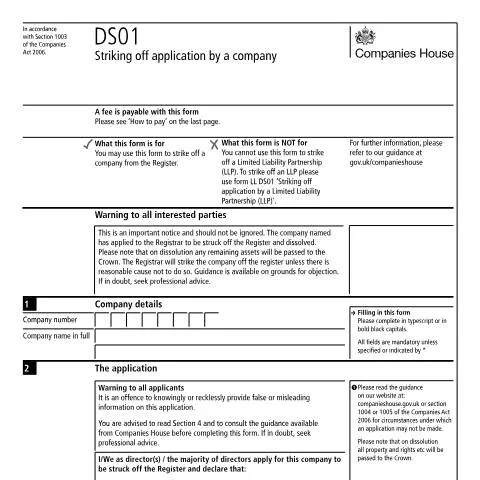
When Directors Choose the Final Exit: Navigating Company Dissolution Through DS01
The moment arrives when directors realise their company has reached the end of its commercial journey. Perhaps trading has ceased permanently, assets have been distributed, and maintaining the corporate structure no longer serves any purpose. Rather than allowing the entity to drift into administrative limbo, the DS01 form provides a formal pathway for voluntary dissolution—a deliberate striking off from Companies House register that brings legal certainty to what might otherwise remain an ambiguous corporate status.
This voluntary dissolution mechanism, grounded in Section 1003 of the Companies Act 2006, represents more than administrative housekeeping. It triggers irreversible legal consequences: all remaining company property transfers to the Crown, corporate obligations crystallise, and the legal entity ceases to exist entirely. The DS01 application initiates a structured process where directors formally request removal from the register, but success depends on meeting strict eligibility criteria and navigating complex notification requirements.
Unlike other Companies House procedures that merely update records, striking off represents a point of no return. Once completed, resurrection requires costly restoration proceedings, making the initial DS01 submission a decision demanding careful consideration of timing, compliance obligations, and potential objections from interested parties.
The Legal Architecture: Understanding Section 1003 Powers and Prohibitions
The DS01 application operates within a framework of statutory permissions and absolute prohibitions defined by the Companies Act 2006. Directors cannot simply decide to wind up whenever convenient—sections 1004 and 1005 establish circumstances that categorically prevent striking off applications.
A company remains ineligible for voluntary dissolution if it has traded or carried on business within three months preceding the application. This prohibition extends beyond obvious commercial activity to encompass any corporate actions: disposing of assets for value, making payments to creditors, or fulfilling contractual obligations. The three-month dormancy requirement ensures that active enterprises cannot use striking off to avoid ongoing responsibilities.
Further prohibitions apply when companies have changed names within the preceding three months, are subject to insolvency proceedings, or face outstanding legal actions. Directors must also declare that they have not received formal notices of intention to appoint administrators or liquidators. These restrictions protect creditors and other stakeholders from premature dissolution that might prejudice their interests.
| Prohibition Category | Specific Circumstances | Minimum Waiting Period |
|---|---|---|
| Trading Activity | Any business transactions, asset disposals, debt payments | 3 months from cessation |
| Corporate Changes | Name changes, registered office moves | 3 months from change |
| Insolvency Procedures | Winding up petitions, administration applications | Until proceedings concluded |
| Legal Actions | Outstanding court cases, formal disputes | Until resolution or withdrawal |
The statutory declarations within DS01 require directors to confirm compliance with these prohibitions. Knowingly false declarations constitute criminal offences, with potential penalties including imprisonment. This legal weight emphasises that striking off applications demand thorough preparation and honest assessment of corporate circumstances.
Directorial Authentication: The Mathematics of Corporate Consensus
The DS01 form establishes specific authentication requirements that vary according to board composition. Unlike many Companies House filings that permit single-director submission, striking off demands mathematical consensus reflecting the gravity of dissolution decisions.
Companies with a sole director require only that individual's authentication, but multi-director boards face more complex requirements. Where exactly two directors exist, both must authenticate the application—no exceptions permit single-director submission even with board resolutions or written consent from the absent colleague.
Boards exceeding two directors operate under majority rule: more than half the serving directors must authenticate the DS01. For a six-director board, four signatures become mandatory; a seven-director board requires four authentication sections. This mathematical requirement cannot be satisfied through proxies, powers of attorney, or alternative authorisation methods.
Each authentication section demands full legal names matching Companies House records exactly, alongside handwritten signatures and dates. Directors must sign personally—electronic signatures, stamps, or representative signing invalidate the authentication. The date format follows DD/MM/YYYY convention, and all authentication dates should align closely to demonstrate contemporaneous decision-making rather than sequential persuasion.
Authentication timing carries practical implications beyond mere formality. The seven-day notification period begins from the application date, not individual signature dates. Directors signing across extended periods risk creating notification complications and potential compliance breaches.
The Seven-Day Notification Cascade: Managing Stakeholder Communications
Perhaps the most operationally challenging aspect of DS01 submission involves the mandatory notification requirements embedded in sections 1006 and 1007 of the Companies Act. Directors must distribute application copies to specified parties within seven days of making the application—a timeline that demands advance preparation and systematic execution.
The notification list extends far beyond obvious stakeholders. Creditors include not only trade suppliers and lenders but also HMRC for outstanding tax obligations, pension scheme administrators, and any parties holding security interests. Employee notification encompasses current staff, recent leavers with outstanding entitlements, and recognised trade unions where applicable.
Shareholders receive automatic notification rights regardless of shareholding size or class. This includes holders of preference shares, deferred shares, and any beneficial owners operating through nominee arrangements. Directors must also notify their colleagues—a requirement that seems obvious but becomes complex where some directors oppose the dissolution or remain uncontactable.
Professional advisors, including auditors, solicitors managing ongoing matters, and insurance brokers handling live policies, also qualify for notification. The breadth of this requirement means directors should compile comprehensive stakeholder lists well before contemplating DS01 submission.
Failure to notify constitutes a criminal offence with substantial penalties: up to twelve months imprisonment for English and Welsh companies, six months for Scottish and Northern Irish entities. These penalties apply per failure, meaning inadequate notification of multiple parties multiplies potential liability.
Proof of notification becomes crucial given these criminal sanctions. Directors should retain postal receipts, recorded delivery confirmations, or email delivery reports. Hand-delivered copies require signed acknowledgements from recipients. The burden of proving compliance rests entirely with directors, making meticulous record-keeping essential.
Dynamic Notification Obligations
The seven-day notification requirement operates dynamically throughout the striking off process. If additional parties become notifiable after initial DS01 submission—perhaps new creditors emerge or employment relationships commence—directors must notify these parties within seven days of the change occurring.
This continuing obligation persists until Companies House finally determines the application or directors withdraw it using form DS02. The extended timeline, potentially spanning several months, requires ongoing stakeholder monitoring and responsive notification management.
Crown Property Transfer: Understanding Asset Dissolution Mechanics
The DS01 process culminates in automatic property transfer to the Crown—a consequence that directors often underestimate until too late. Upon successful striking off, all company assets, regardless of value or nature, vest immediately in the Crown without compensation or recovery rights for former shareholders or directors.
This transfer operates by legal operation rather than physical handover. Bank accounts, intellectual property rights, equipment, stock, and property interests all pass to the Crown simultaneously with dissolution. The Crown typically liquidates these assets through the Government Legal Department, though recovery procedures exist for assets inadvertently transferred.
Directors seeking to preserve asset value must complete distributions before DS01 submission. However, asset distributions within the three-month dormancy period may invalidate striking off eligibility, creating timing complexities that demand careful planning. Distributions must comply with company law requirements regarding creditor protection and statutory reserves.
Intellectual property presents particular complications. Trade marks, patents, copyrights, and domain names registered in the company name transfer to the Crown, potentially disrupting business continuations under different corporate vehicles. Directors planning to continue trading through new entities should transfer intellectual property before the three-month dormancy period begins.
| Asset Category | Transfer Mechanism | Recovery Possibility |
|---|---|---|
| Bank Balances | Automatic vesting | Crown disclaimer if under £500 |
| Physical Assets | Legal title transfer | Restoration proceedings required |
| Intellectual Property | Registry notification | Complex assignment procedures |
| Contractual Rights | Assignment to Crown | Third-party consent often required |
Objection Mechanisms: When Stakeholders Challenge Dissolution
The striking off process incorporates built-in challenge mechanisms allowing interested parties to object before dissolution becomes final. Companies House publishes DS01 applications in the London Gazette, providing public notice and opportunity for objections during a minimum two-month consideration period.
Objections typically arise from creditors seeking debt recovery, employees claiming outstanding entitlements, or shareholders disputing asset distributions. HMRC frequently objects where tax obligations remain unresolved, even for seemingly minor amounts. Pension scheme administrators may object to protect member interests, particularly where employer contribution obligations persist.
Valid objections suspend the striking off process indefinitely. Companies House will not proceed with dissolution while substantive objections remain unresolved, regardless of directors' preferences or timeline pressures. This protective mechanism ensures that dissolution cannot prejudice legitimate stakeholder interests through procedural shortcuts.
Objectors must demonstrate reasonable cause for preventing dissolution—typically financial interests that dissolution would prejudice. Mere opposition or business relationship concerns insufficient to sustain objections. However, the threshold for reasonable cause remains deliberately low, favouring stakeholder protection over administrative efficiency.
Directors facing objections have limited options. They cannot override objections unilaterally or appeal directly to Companies House. Instead, they must address underlying concerns through negotiation, payment, or legal resolution. Alternatively, directors may withdraw the DS01 application using form DS02 and pursue alternative dissolution methods such as members' voluntary liquidation.
Strategic Timing Considerations
Understanding objection mechanisms influences optimal DS01 timing. Directors aware of potential objectors may prefer addressing concerns before application rather than managing public objection processes. Pre-application creditor settlements, employee payment clearances, and stakeholder communications can eliminate objection risks while maintaining process control.
Conversely, directors confident in their compliance position may proceed with DS01 submission, using the gazette publication period to flush out hidden claims or obligations. This approach provides legal certainty about outstanding liabilities while maintaining striking off as the preferred dissolution method.
Practical Completion: Fee Structures and Submission Mechanics
DS01 submission requires payment of statutory fees set by Companies House regulations. Current fee levels reflect cost recovery principles rather than revenue generation, but directors must budget for these charges when planning dissolution timing. Fee payment methods include online card payments for electronic submissions, cheques for postal applications, and direct bank transfers for bulk filings.
Electronic submission through the Companies House WebFiling service offers speed and convenience advantages over postal alternatives. Online applications receive immediate acknowledgement, automated validation checking, and faster processing timelines. However, electronic submission requires all authenticating directors to possess WebFiling credentials and digital signature capabilities.
Postal submissions provide alternative routes for directors uncomfortable with electronic processes or lacking digital infrastructure. Paper DS01 forms require careful completion using black ink or typescript, with original signatures from all authenticating directors. Photocopied signatures or electronic printouts of digital signatures invalidate paper applications.
Processing timelines vary significantly between submission methods and seasonal workload fluctuations. Electronic applications typically receive initial processing within 48 hours, while postal submissions may face week-long delays during busy periods. However, both routes ultimately converge on identical gazette publication and objection consideration processes.
Directors should retain submission confirmations and payment receipts as evidence of compliance with statutory requirements. These records become particularly important if objections arise or subsequent legal challenges question dissolution validity.
Withdrawal Procedures and Form DS02
Companies discovering ineligibility for striking off after DS01 submission must withdraw applications promptly using form DS02. Withdrawal becomes mandatory where circumstances arise that would have prevented initial application—such as recommencing trading, receiving legal claims, or identifying notification failures.
Form DS02 requires similar directorial authentication to DS01, emphasising that withdrawal decisions demand equivalent consensus to original applications. Withdrawal fees apply separately from initial DS01 charges, creating additional costs for companies discovering compliance issues post-submission.
Voluntary withdrawal preserves future striking off eligibility once disqualifying circumstances resolve. Directors may resubmit DS01 applications after addressing underlying issues, though fresh three-month dormancy periods and notification requirements apply to subsequent attempts.