When Overseas Giants Land: Navigating UK Establishment Registration for Foreign Companies
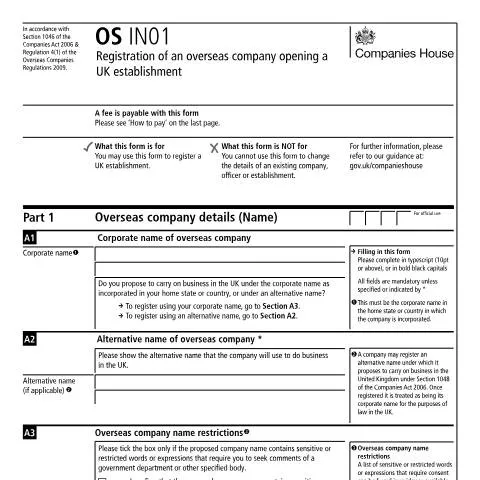
Every year, thousands of overseas companies set their sights on the UK market, from Silicon Valley tech firms establishing London offices to European manufacturers opening distribution centres in Manchester. Yet many stumble at the first hurdle: the OS IN01 form, the gateway document that transforms a foreign entity into a legitimate UK establishment. This isn't simply about paperwork—it's about creating a legal bridge between jurisdictions, with profound implications for tax obligations, regulatory compliance, and commercial credibility.
The OS IN01 represents a unique intersection in UK company law, where overseas company regulations meet domestic establishment requirements. Unlike forming a UK subsidiary, which creates an entirely new legal entity, registering a UK establishment maintains the parent company's identity while extending its operational reach. This distinction shapes everything from the information required on the form to the ongoing obligations that follow registration.
Decoding the Legal Architecture: What Makes OS IN01 Different
The OS IN01 operates under Section 1046 of the Companies Act 2006 and the Overseas Companies Regulations 2009, creating a regulatory framework distinct from standard UK company formation. Where a typical Companies House incorporation focuses on creating new legal personality, the OS IN01 concerns itself with extending existing corporate identity across borders.
This fundamental difference explains why the form demands extensive detail about the parent company's home jurisdiction. Companies House isn't just registering a new entity—it's creating a comprehensive record of how an overseas company will operate within UK legal boundaries while maintaining its foreign character.
The Three-Tier Structure
The OS IN01 follows a logical progression through three distinct phases:
- Company Identity (Part 1-2): Establishing who the overseas company is, where it comes from, and how it operates in its home jurisdiction
- Constitutional Framework (Part 3): Documenting the legal foundation upon which the company operates
- UK Operational Structure: Defining how the company will function within the UK establishment
Each section builds upon the previous one, creating a comprehensive picture that allows Companies House to assess compliance with UK regulatory requirements while respecting the company's overseas legal structure.
The Critical Choice: Corporate Name versus Alternative Trading Identity
Section A1 through A3 presents overseas companies with a strategic decision that reverberates through their entire UK operation. The choice between using the corporate name as incorporated in the home state or registering an alternative name under Section 1048 of the Companies Act 2006 carries significant implications.
Operating under the corporate name maintains consistency across jurisdictions, simplifying brand recognition and legal documentation. However, this approach may prove problematic if the overseas name conflicts with UK naming conventions, contains restricted words, or simply doesn't resonate with UK audiences.
Alternative Name Considerations
When companies opt for an alternative name, they gain flexibility but assume additional responsibilities. The alternative name becomes the company's legal identity for UK purposes, requiring consistent use across all UK documentation, contracts, and regulatory filings. This creates a dual identity that must be carefully managed to avoid confusion or legal complications.
| Approach | Advantages | Considerations |
|---|---|---|
| Corporate Name | Global consistency, simplified documentation | May require sensitive word approval, limited UK market appeal |
| Alternative Name | UK market optimisation, regulatory compliance | Dual identity management, additional legal complexity |
Navigating Sensitive Words and Regulatory Approval
The seemingly innocuous checkbox in Section A3 conceals a complex regulatory landscape. Sensitive or restricted words encompass far more than obvious terms like "Royal" or "Government." The restriction extends to sector-specific terminology, geographical references, and professional designations that could mislead the public about the company's status, location, or capabilities.
Companies proposing names containing such terms must secure approval from relevant government departments or specified bodies before submitting the OS IN01. This process can extend registration timelines significantly, particularly for companies in regulated sectors like finance, healthcare, or education.
The Approval Process
Securing sensitive word approval requires direct engagement with the relevant authority, submission of supporting documentation demonstrating legitimate use, and often payment of additional fees. The response must be attached to the OS IN01 as evidence of compliance, making this a critical path dependency in the registration process.
Financial Institution Designation and Its Consequences
Section B2's binary question about credit or financial institution status carries profound regulatory implications. This designation triggers enhanced scrutiny from Companies House and creates ongoing obligations under UK financial services regulation, even for establishments primarily focused on non-financial activities.
The definition extends beyond traditional banks to encompass investment firms, insurance companies, payment service providers, and even some fintech companies. Incorrect classification can result in regulatory non-compliance, while over-classification may impose unnecessary regulatory burden on the UK establishment.
Regulatory Cascade Effects
Financial institution designation activates additional reporting requirements, potentially subjects the establishment to Financial Conduct Authority oversight, and may trigger specific disclosure obligations in subsequent filings. Companies must carefully evaluate their UK activities against regulatory definitions rather than relying on home jurisdiction classifications.
Constitutional Documentation: The Foundation of Legal Recognition
Part 3 represents perhaps the most technically complex aspect of OS IN01 completion. The requirement for certified copies of constitutional documents with certified translations creates multiple layers of authentication that companies frequently underestimate.
Certification requirements specify that documents must be authenticated by specific individuals: the company secretary, a director, permanent representative, or various insolvency practitioners. This limitation often catches overseas companies off-guard, particularly when their home jurisdiction uses different corporate structures or titles.
Translation Complexities
Certified translation requirements extend beyond simple language conversion to encompass legal concept translation. Constitutional documents often contain jurisdiction-specific legal terms that lack direct English equivalents, requiring translators with legal expertise in both jurisdictions. The authenticating individual must confirm not just accuracy but legal equivalence of concepts.
Previous Establishment Registration and Form Routing
Section B1's inquiry about previous UK establishment registration creates a crucial fork in the completion process. Companies with existing UK establishments must provide the registration number and proceed directly to Part 5, bypassing much of the detailed company information sections.
However, this shortcut comes with a critical caveat: original UK establishment particulars must be filed up to date. Companies cannot use existing registration as a shortcut while maintaining outdated information about their primary establishment. This requirement often necessitates parallel filing of update forms for existing establishments.
Multi-Establishment Strategy
Companies operating multiple UK establishments must maintain consistency across all registrations while ensuring each establishment's specific activities and locations are accurately reflected. This creates a complex web of cross-references that requires careful coordination to avoid regulatory discrepancies.
Accounting Requirements and Disclosure Obligations
Sections B4 and B5 establish the foundation for ongoing UK disclosure obligations by documenting the parent company's home jurisdiction accounting requirements. This information determines whether the UK establishment inherits disclosure obligations or operates under modified requirements.
Companies required to prepare, audit, and disclose accounts under parent law must provide detailed information about accounting periods and disclosure timelines. This creates a bridge between home jurisdiction accounting standards and UK disclosure expectations, often requiring ongoing reconciliation of different regulatory calendars.
| Disclosure Status | Required Documentation | Ongoing Obligations |
|---|---|---|
| Accounts disclosed in parent jurisdiction | Latest disclosed accounts with certified translation | Annual filing of parent company accounts |
| No disclosure requirement in parent jurisdiction | Confirmation statement only | Modified UK-specific disclosure obligations |
The Translation Challenge
Accounting document translation presents unique challenges as financial terminology, accounting standards, and presentation formats vary significantly between jurisdictions. Companies must ensure translations accurately convey not just figures but the underlying accounting principles and regulatory context.
Fee Structure and Payment Mechanics
The OS IN01 carries a standard fee payable to Companies House, but the total cost of establishment registration often exceeds this basic charge. Companies requiring sensitive word approval face additional fees to relevant government departments. Translation and certification costs can multiply expenses significantly, particularly for companies with complex constitutional structures.
Payment timing proves critical as Companies House will not process applications without accompanying fees. Electronic filing through the Companies House WebFiling service offers immediate payment confirmation, while postal submissions create timing uncertainties that can delay registration.
Hidden Cost Considerations
Beyond direct filing fees, companies must budget for legal review, translation services, document certification, and potential resubmission costs if initial applications contain errors. Professional assistance often proves economical given the complexity of requirements and consequences of mistakes.
Post-Registration Obligations and Compliance Maintenance
OS IN01 registration marks the beginning, not the end, of UK establishment compliance obligations. Registered establishments must file annual returns, maintain registered office addresses, and ensure UK disclosure obligations remain current with parent company developments.
Changes to parent company structure, constitutional documents, or activities trigger update requirements that must be filed within specified timeframes. Failure to maintain current information can result in penalties and potentially compromise the establishment's good standing with Companies House.
The establishment also becomes subject to UK statutory requirements regarding business names, registered office provisions, and document disclosure that may differ significantly from home jurisdiction practices. This creates an ongoing compliance obligation that requires active management rather than passive maintenance.
Understanding these post-registration implications before completing the OS IN01 enables companies to establish appropriate compliance frameworks from day one, avoiding reactive scrambles to address regulatory requirements after they arise. The form represents not just a registration document but a commitment to ongoing UK regulatory engagement that shapes the establishment's entire operational framework.
Documentation Requirements and Supporting Evidence
The OS IN01 form requires extensive supporting documentation to verify the overseas company's legitimacy and establish its right to operate in the UK. Companies House maintains strict requirements for document authenticity, and failure to provide adequate supporting evidence will result in application rejection.
The constitutional documents must be submitted in their original language alongside certified English translations. For companies incorporated in non-English speaking jurisdictions, all translations must be completed by qualified translators or notarised by relevant authorities. The translation requirement extends beyond mere linguistic conversion—technical legal terminology must accurately reflect UK legal concepts where applicable.
Certificate of incorporation or equivalent founding documents form the cornerstone of your application. These must be recent copies (typically issued within six months of application) and bear official seals or stamps from the home jurisdiction's registrar. Some jurisdictions issue digital certificates with unique verification codes—Companies House accepts these provided the verification process can be independently confirmed.
Memorandum and articles of association, or equivalent constitutional documents, must demonstrate the company's capacity to establish UK operations. Pay particular attention to any restrictions on overseas activities or requirements for shareholder approval for international expansion. If your home jurisdiction uses different terminology (such as "bylaws" or "statutes"), ensure the English translation clarifies the document's legal function.
Recent financial statements may be required depending on the company's size and the nature of intended UK activities. While not always mandatory for the initial registration, having audited accounts available can expedite processing, particularly for companies planning substantial UK operations or seeking to demonstrate financial standing to potential partners.
Power of attorney documentation becomes crucial when the application is submitted by representatives rather than directors. The power must specifically authorise UK establishment registration and should be executed according to both home jurisdiction requirements and UK recognition standards. Some jurisdictions require consular authentication or apostille certification for powers of attorney to be recognised in the UK.
Director identification documents must include passport copies and proof of residential address for all individuals who will be listed as UK establishment representatives. Address verification typically requires utility bills, bank statements, or council tax bills dated within three months. For directors residing outside the UK, equivalent official documents from their home jurisdiction are acceptable, though some may require notarisation.
Ongoing Compliance and Reporting Obligations
Registration marks only the beginning of your UK compliance journey. Overseas companies with UK establishments face ongoing reporting obligations that mirror, and in some cases exceed, those imposed on domestic UK companies. Understanding these requirements from the outset helps avoid inadvertent breaches that could result in penalties or enforcement action.
Annual returns must be filed using form OS AA01 within 21 days of each anniversary of your initial registration. This return updates Companies House on any changes to the overseas company's constitution, directors, or UK establishment details. The filing deadline is absolute—late submissions incur automatic penalties starting at £150, escalating based on delay duration.
Accounting document filing requirements vary significantly based on company size and structure. Large overseas companies (meeting specific turnover, balance sheet, or employee thresholds) must file full accounts prepared according to international accounting standards or UK GAAP. Medium and small companies may qualify for abbreviated accounts, but size determination follows complex criteria that consider both UK establishment and worldwide company metrics.
The accounting reference date often differs from your home jurisdiction's financial year-end. While you can align these dates for administrative convenience, any change requires formal notification to Companies House using prescribed procedures. Consider the implications for group consolidation and tax reporting when making this decision.
Change notifications extend beyond annual returns to immediate reporting requirements. Director appointments, resignations, or changes in personal details must be notified within 14 days using form OS AP01. Similarly, changes to the overseas company's constitution, name, or registered office require prompt notification using form OS CH01.
Registered office obligations demand particular attention. The UK establishment must maintain a registered office address throughout its existence—this cannot be a PO Box and must be capable of receiving official correspondence during normal business hours. Many overseas companies engage professional registered office providers, but ultimate responsibility for compliance remains with the company.
Document inspection rights mean certain records must be available for public inspection at the registered office. These include copies of constitutional documents, lists of directors and secretaries, and accounting records relevant to UK activities. The inspection regime balances transparency with commercial sensitivity, but companies must understand which documents require disclosure.
Dormancy considerations apply to UK establishments that cease active trading while maintaining registration. A company can apply for dormant status if it has no significant accounting transactions, potentially reducing filing requirements. However, dormancy rules are technical, and incorrect application can result in penalties for non-compliance with active company obligations.
Tax Implications and HMRC Coordination
UK establishment registration creates potential tax obligations that require careful coordination with HMRC alongside Companies House compliance. The interaction between corporate registration and tax liability often surprises overseas companies, particularly those assuming limited UK activities automatically limit tax exposure.
Corporation tax liability hinges on UK permanent establishment status, which differs from Companies House registration criteria. While registering a UK establishment doesn't automatically create corporation tax liability, it may constitute evidence of permanent establishment depending on activity scope and duration. HMRC applies specific tests considering factors like decision-making authority, contract conclusion, and business continuity.
Tax residence determination becomes complex for overseas companies with UK establishments. Companies incorporated overseas generally remain non-UK resident for tax purposes, but central management and control exercised from the UK can trigger UK tax residence. This distinction affects not only direct tax liability but also compliance obligations and available reliefs.
Double taxation treaty benefits often provide relief where both home jurisdiction and UK tax apply to the same profits. However, treaty access requires specific procedures and documentation. Companies should identify applicable treaties early and understand claiming procedures, as retrospective claims face limitations and administrative hurdles.
VAT registration requirements operate independently of Companies House registration but may be triggered by UK establishment activities. The VAT registration threshold applies to UK taxable supplies, regardless of whether the supplier is UK-incorporated. Distance selling rules, digital services provisions, and construction industry requirements can create VAT obligations even for companies with limited UK physical presence.
PAYE obligations arise where the UK establishment employs staff or provides benefits to employees working in the UK. This includes seconded employees from the overseas parent company and local UK hires. PAYE registration must occur before the first payment, and real-time information (RTI) reporting applies from day one of operations.
Transfer pricing rules affect transactions between the UK establishment and other parts of the overseas company. HMRC requires arm's length pricing for intra-company charges, including management fees, royalties, and cost allocations. Documentation requirements vary by transaction value and complexity, but contemporaneous records prove essential for any subsequent enquiry.
Making Tax Digital (MTD) requirements may apply to UK establishment activities, particularly for VAT-registered businesses and those within the corporation tax MTD scope. Digital record-keeping and quarterly reporting represent significant operational changes for companies accustomed to different reporting cycles in their home jurisdiction.
Controlled Foreign Company (CFC) rules potentially affect UK tax residents with interests in the overseas company, though these primarily impact shareholders rather than the company itself. However, understanding CFC implications helps when advising UK-resident stakeholders or structuring UK operations to minimise unintended tax consequences.