Understanding the UK Establishment Representative Framework
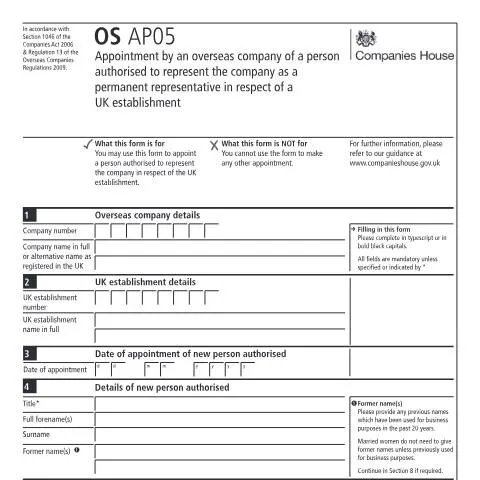
When overseas companies operate through UK establishments, the regulatory landscape demands clear accountability and representation. The OS AP05 form serves as the formal mechanism for appointing a permanent representative who will act as the primary liaison between the overseas entity and UK authorities. This appointment isn't merely administrative – it establishes a crucial legal bridge that ensures compliance with UK corporate governance requirements whilst maintaining the overseas company's operational flexibility.
Under Section 1046 of the Companies Act 2006 and Regulation 13 of the Overseas Companies Regulations 2009, overseas companies must designate individuals with specific authority to represent their UK establishments. This representative becomes the focal point for regulatory communications, legal notices, and administrative correspondence, creating a tangible presence for what might otherwise remain an abstract overseas entity.
Eligibility Criteria and Appointment Scenarios
The appointment process through OS AP05 applies to overseas companies that have already established a registered presence in the UK through Companies House. The form cannot be used for initial company registration or other types of appointments – its scope is specifically limited to permanent representative appointments for existing UK establishments.
Pre-requisites for Filing
Before completing OS AP05, the overseas company must possess both a UK company number and a UK establishment number. These identifiers demonstrate that the preliminary registration requirements have been satisfied. The appointment typically occurs when:
- The original permanent representative resigns or becomes unavailable
- The company requires additional or replacement representation due to expanded UK operations
- Regulatory changes necessitate updated representative arrangements
- The existing representative's authority requires modification or clarification
The appointed individual must be capable of acting with the specified authority level – either unlimited or limited – and may be authorised to act alone or jointly with other designated persons.
Navigating the Authority Structure and Limitations
Section 6 of the OS AP05 form requires careful consideration of the representative's scope of authority. This isn't a perfunctory administrative detail but a substantive legal determination that affects how the representative can engage with UK authorities, third parties, and regulatory bodies.
Authority Classifications
| Authority Type | Scope | Typical Applications |
|---|---|---|
| Unlimited Authority | Full representation rights across all establishment matters | Senior executives, managing directors of UK operations |
| Limited Authority | Specific defined areas requiring detailed description | Compliance officers, legal representatives for particular matters |
| Joint Authority | Requires collaboration with named co-representatives | Financial matters requiring dual approval, regulatory submissions |
When selecting limited authority, the description must be sufficiently detailed to enable third parties to understand the representative's scope. Vague terms like "general business matters" may lead to rejection or requests for clarification from Companies House.
Joint Representation Considerations
Companies opting for joint representation must name all individuals who share the representative function. This arrangement often reflects internal governance requirements where significant decisions require multiple approvals, or where different representatives handle distinct operational areas.
Address Requirements and Privacy Protection Mechanisms
The OS AP05 form distinguishes between service addresses and usual residential addresses, reflecting the balance between public transparency and individual privacy. This dual-address system acknowledges that representatives may prefer to separate their public corporate identity from their personal residence details.
Service Address Specifications
The service address appears on the public record and serves as the official contact point for all establishment-related correspondence. This address can be:
- The representative's residential address if privacy isn't a concern
- A business address or registered office
- A professional service address provided by legal or corporate service providers
Companies House emphasises that service addresses must be genuine locations where correspondence can be reliably delivered and received. PO Box numbers, while not explicitly prohibited for service addresses, should be avoided as they may complicate urgent communications.
Residential Address Protection
Section 5a requires the representative's usual residential address, which remains confidential and doesn't appear on the public record. However, Regulation 25 of the Overseas Companies Regulations 2009 provides additional protection for individuals facing security risks or requiring enhanced privacy.
Representatives seeking higher protection must tick the designated box and submit their OS AP05 to a different postal address: The Registrar of Companies, PO Box 4082, Cardiff, CF14 3WE. This protection prevents disclosure of residential addresses to credit reference agencies and provides additional confidentiality measures.
Completing Personal Details and Historical Information
Section 4 requires comprehensive personal details that establish the representative's identity and professional background. The former names requirement extends to any business-related name changes within the past 20 years, creating a traceable professional history.
Name Documentation Standards
The form specifically notes that married women need not provide former names unless those names were used for business purposes. This distinction recognises that personal name changes through marriage differ from professional or business-related name variations that might affect commercial dealings.
For individuals with extensive name histories, Section 8 provides additional space for former names. This comprehensive approach ensures that the public record accurately reflects the representative's professional identity, facilitating verification by third parties who may have dealt with the individual under different names.
Professional Background Considerations
While the form doesn't explicitly require professional qualifications, the appointment implies that the representative possesses appropriate expertise to fulfil their designated role. Overseas companies typically select individuals with:
- Legal or corporate governance experience
- Familiarity with UK regulatory requirements
- Professional standing that enhances the company's credibility
- Practical availability to respond to regulatory communications
Submission Procedures and Processing Timelines
Companies House provides multiple submission channels for OS AP05 forms, each with distinct characteristics and processing implications. The choice of submission method can affect processing speed, confirmation procedures, and follow-up communications.
Postal Submission Routes
The standard postal addresses vary by jurisdiction within the UK, reflecting Companies House's regional structure:
| Jurisdiction | Primary Address | Alternative Options |
|---|---|---|
| England and Wales | Crown Way, Cardiff, Wales, CF14 3UZ | DX 33050 Cardiff |
| Scotland | Edinburgh Quay 2, 139 Fountainbridge, Edinburgh, EH3 9FF | DX ED235 Edinburgh 1, LP-4 Edinburgh 2 |
| Northern Ireland | The Linenhall, 32-38 Linenhall Street, Belfast, BT2 8BG | DX 481 N.R. Belfast 1 |
The DX (Document Exchange) and LP (Legal Post) options provide alternative delivery methods that may offer enhanced security or tracking capabilities, particularly valuable for time-sensitive appointments.
Processing and Confirmation
Companies House typically processes OS AP05 forms within standard timeframes, though processing speeds can vary based on form completeness, seasonal volumes, and any required clarifications. The appointment becomes effective from the date specified in Section 3, regardless of processing delays, provided the form is ultimately accepted.
Confirmation of appointment updates the public record, making the new representative information immediately accessible through Companies House searches. This transparency enables third parties to verify current representation arrangements and direct communications appropriately.
Authority Validation and Signature Requirements
Section 7 establishes the critical signature requirements that validate the appointment. The form may only be signed by individuals with appropriate authority within the overseas company structure: directors, secretaries, or existing permanent representatives.
Signature Authority Framework
This signature restriction ensures that appointments reflect genuine corporate decisions rather than unauthorised actions. The signatory effectively certifies that:
- The appointment has proper corporate approval
- The designated individual has consented to the appointment
- The authority specifications accurately reflect intended arrangements
- All provided information is current and accurate
Companies operating with complex governance structures may need to verify signatory authority before submission, particularly where overseas corporate hierarchies differ from UK norms.
Corporate Resolution Considerations
While OS AP05 doesn't require supporting corporate resolutions, prudent companies often maintain internal documentation authorising the appointment. This documentation becomes valuable if questions arise about the appointment's validity or the representative's authority scope.
Post-Appointment Obligations and Ongoing Compliance
The OS AP05 appointment establishes ongoing obligations that extend beyond the initial filing. The permanent representative becomes the primary conduit for regulatory communications, requiring sustained attention to correspondence and compliance obligations.
Communication Management
Once appointed, the permanent representative receives official communications from various UK authorities, including:
- Companies House annual return requirements and filing reminders
- HMRC notifications regarding tax obligations and assessments
- Regulatory authorities relevant to the establishment's business activities
- Legal notices and formal communications from third parties
The representative's response obligations depend on their designated authority level. Those with unlimited authority typically bear full responsibility for regulatory compliance, while limited authority representatives must ensure appropriate escalation to authorised decision-makers.
Amendment and Termination Procedures
Changes to representative arrangements require additional filings with Companies House. These might include authority modifications, address updates, or appointment terminations. The establishment must maintain continuous representation, making succession planning essential for operational continuity.
Representatives seeking to resign must ensure proper succession arrangements, as gaps in representation can compromise the establishment's regulatory standing and potentially trigger compliance issues with ongoing filing obligations.
Documentation Requirements and Supporting Evidence
The OS AP05 form requires substantial supporting documentation to validate both the overseas company's legitimacy and the appointed representative's capacity to act on its behalf. Companies House maintains strict verification standards to prevent fraudulent appointments and ensure regulatory compliance across all UK establishments.
Primary documentation must include certified copies of the overseas company's constitutional documents, such as articles of incorporation, memorandum of association, or equivalent founding instruments recognised in the jurisdiction of incorporation. These documents must be translated into English by a certified translator if originally prepared in another language, with translation certificates attached to confirm accuracy and completeness.
The appointed representative's identification package requires multiple verification layers. A current passport or national identity card serves as primary identification, supplemented by proof of residential address through recent utility bills, council tax statements, or bank correspondence dated within the preceding three months. Companies House may request additional identity verification if the representative holds citizenship or residence in certain jurisdictions subject to enhanced due diligence requirements.
Corporate representatives face more complex documentation requirements. Limited companies must provide their certificate of incorporation, current filed accounts, and a board resolution authorising the individual signatory to act on behalf of the representative entity. LLPs require similar incorporation certificates plus designated member confirmations, whilst other business structures need equivalent constitutional documents recognised under UK law.
Authorisation documentation represents a critical compliance element often overlooked by applicants. The overseas company must provide either a board resolution, power of attorney, or equivalent legal instrument explicitly authorising the named representative to act in all UK regulatory matters. This authorisation must specify the scope of authority, including Companies House filings, correspondence receipt, and statutory compliance responsibilities. Generic authorisation letters lacking specific UK establishment references frequently cause application delays or rejections.
Financial institutions and regulated entities may require additional documentation demonstrating the representative's professional standing. This could include professional indemnity insurance certificates, regulatory licences from relevant UK authorities, or membership confirmations from recognised professional bodies. Companies House reserves the right to request supplementary evidence where the overseas company operates in sensitive sectors or maintains significant UK commercial activities.
Translation requirements extend beyond constitutional documents to include any foreign-language authorisation instruments, board resolutions, or legal opinions supporting the application. Certified translations must include translator credentials, professional registration numbers, and sworn statements confirming translation accuracy. Machine translations or informal interpretations are not acceptable for regulatory purposes.
Regulatory Implications and Ongoing Compliance Obligations
Appointing a permanent representative through OS AP05 triggers a cascade of ongoing regulatory obligations that extend far beyond the initial filing requirement. The representative assumes legal responsibility for ensuring the overseas company maintains continuous compliance with UK corporate law, creating potential personal liability exposure that many appointees underestimate.
Annual return obligations become the representative's direct responsibility, requiring accurate maintenance of company information and timely submission of confirmation statements. The representative must monitor changes in company structure, share capital, registered office addresses, and director appointments in the home jurisdiction, then reflect these modifications in UK filings within prescribed timeframes. Failure to maintain current information can result in penalty notices, prosecution proceedings, or involuntary company dissolution.
Statutory registers present another compliance dimension requiring ongoing attention. The representative must ensure UK-accessible copies of member registers, director records, and significant control information remain current and available for public inspection during normal business hours. Companies House increasingly scrutinises register maintenance, particularly for overseas companies with complex ownership structures or beneficial ownership arrangements requiring People with Significant Control (PSC) disclosure.
Tax implications flow automatically from permanent representative appointment, potentially creating unexpected obligations for both the overseas company and the appointed individual or entity. HMRC may treat the UK establishment as having a sufficient commercial presence to trigger corporation tax residence, particularly where the representative exercises substantial decision-making authority or manages significant business activities within the UK territory.
Employment law considerations arise where the overseas company engages UK-based staff or contractors through its appointed representative. The representative may become jointly liable for employment obligations, including PAYE deductions, National Insurance contributions, workplace pension auto-enrolment, and compliance with employment rights legislation. Professional advice becomes essential where employment relationships cross international boundaries or involve complex secondment arrangements.
Data protection compliance under UK GDPR and the Data Protection Act 2018 creates additional obligations for representatives handling personal information on behalf of overseas companies. The representative may qualify as a data processor or joint controller, requiring appropriate technical and organisational measures to protect personal data, maintain processing records, and respond to data subject access requests within statutory timeframes.
Sector-specific regulations may impose additional compliance burdens depending on the overseas company's business activities. Financial services entities face FCA authorisation requirements, whilst companies handling controlled goods encounter export licensing obligations. Representatives must maintain awareness of evolving regulatory landscapes affecting their appointed companies' UK operations.
Cessation procedures require careful planning to avoid regulatory breaches or personal liability continuation. Representatives cannot simply resign without ensuring proper succession arrangements or formal dissolution procedures where the UK establishment ceases operations. Companies House requires specific notifications and clearance confirmations before accepting representative resignations, particularly where outstanding compliance issues remain unresolved.
Common Application Pitfalls and Processing Delays
OS AP05 applications frequently encounter processing delays or rejection due to recurring errors that applicants can readily avoid through careful preparation and attention to regulatory requirements. Understanding these common pitfalls enables overseas companies to submit complete applications that progress smoothly through Companies House validation procedures.
Incomplete authorisation documentation represents the most frequent cause of application rejection. Many overseas companies provide generic powers of attorney or board resolutions lacking specific reference to UK regulatory responsibilities or Companies House obligations. The authorisation must explicitly grant authority to act as permanent representative, receive official correspondence, and make regulatory filings on the company's behalf. Vague or limited authorisations prompt automatic rejection letters requiring resubmission with corrected documentation.
Identity verification failures often stem from using expired identification documents or providing unclear photocopies that prevent proper verification. Companies House requires high-quality, colour copies of identification documents showing all security features and personal details clearly. Passport copies must include the signature page and any relevant visa stamps, whilst driving licences need both front and back images. Poor quality scans or black-and-white copies frequently trigger requests for replacement documentation.
Address verification problems arise when representatives provide commercial addresses without demonstrating legitimate occupancy rights or use temporary addresses that cannot be verified through standard databases. Companies House cross-references provided addresses against multiple verification sources, rejecting applications where addresses appear invalid, temporary, or associated with mail forwarding services. Representatives must demonstrate genuine residential or business connections to their stated addresses.
Translation certificate omissions cause significant delays where overseas companies submit foreign-language documents without proper certification. Each translated document requires an accompanying certificate from a qualified translator, including their professional credentials, registration details, and sworn statement confirming translation accuracy. Missing certificates prompt automatic rejection regardless of translation quality.
Corporate representative complications emerge when limited companies or other entities serve as permanent representatives without providing complete incorporation and authorisation documentation. The representative entity must demonstrate its own good standing, provide current filed accounts, and show explicit board authorisation for the individual signatory. Complex corporate structures require additional documentation establishing the authorisation chain from ultimate beneficial owners to the signing representative.
Fee payment errors, whilst seemingly straightforward, create processing delays when applicants use incorrect payment methods or submit insufficient amounts. Companies House accepts specific payment types for OS AP05 applications, and fee structures may vary based on application timing or company characteristics. Payment processing failures require complete resubmission, potentially affecting the representative appointment's effective date.
Timing coordination problems occur when overseas companies submit OS AP05 applications without considering related regulatory deadlines or company formation timescales. Representatives cannot act on behalf of companies until formal appointment confirmation, creating gaps in regulatory compliance where appointments are delayed. Strategic timing becomes crucial for companies facing imminent filing deadlines or requiring immediate UK commercial activities.
Name consistency issues arise where the overseas company's name appears differently across various documents or differs from its intended UK trading name. Companies House requires exact name matching across all submitted documentation, rejecting applications where discrepancies suggest potential identity confusion or fraudulent activity. Companies must resolve name variations before submission or provide legal opinions explaining legitimate differences.
Jurisdiction recognition problems occasionally affect companies incorporated in territories with limited UK recognition or complex legal systems. Companies House maintains lists of recognised jurisdictions and may require additional legal opinions or governmental confirmations for entities from certain territories. Early consultation with Companies House can clarify specific requirements for unusual jurisdictions before formal application submission.