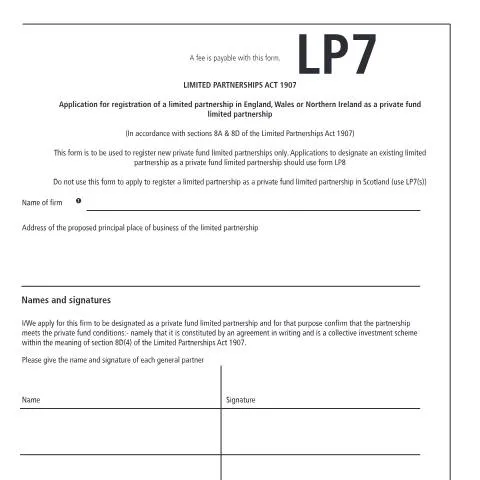
Setting Up Your Private Fund Limited Partnership: Understanding the LP7 Registration Process
For investment managers and fund operators looking to establish a private fund limited partnership in England, Wales or Northern Ireland, the LP7 form represents the gateway to a sophisticated investment vehicle structure. This application process, governed by sections 8A and 8D of the Limited Partnerships Act 1907, creates a specific type of partnership designed exclusively for collective investment schemes operating under strict regulatory parameters.
The private fund limited partnership structure offers distinct advantages for investment funds, combining the operational flexibility of a limited partnership with enhanced regulatory recognition. Unlike standard limited partnerships, these entities must meet specific private fund conditions, including written partnership agreements and qualification as collective investment schemes under statutory definitions.
Statutory Requirements and Partnership Composition Framework
The LP7 application hinges on demonstrating compliance with the private fund conditions outlined in section 8D(4) of the Limited Partnerships Act 1907. Your partnership must be constituted by a written agreement and function as a collective investment scheme, creating a legal framework that distinguishes it from ordinary commercial partnerships.
General Partner Obligations and Responsibilities
Each general partner carries unlimited liability for partnership debts and obligations, making their selection crucial for fund operations. The LP7 form requires comprehensive details for all general partners, including full names and signatures confirming their acceptance of these responsibilities. General partners typically handle day-to-day fund management, investment decisions, and regulatory compliance.
The form mandates that every general partner must personally sign the application, creating joint responsibility for the accuracy of submitted information. This signature requirement extends beyond mere formality—it establishes legal accountability for the partnership's structure and operations from the outset.
Limited Partner Structure and Investment Framework
Limited partners provide capital contributions while maintaining liability protection, with their exposure typically capped at their investment amount. The LP7 application requires identification of all initial limited partners, though the partnership may subsequently admit additional investors according to its partnership agreement terms.
Limited partners cannot participate in management activities without risking their protected status, creating a clear operational hierarchy within the fund structure. This separation proves particularly valuable for institutional investors seeking exposure to alternative investments while maintaining regulatory compliance.
Name Selection and Regulatory Compliance Standards
Choosing an appropriate partnership name involves more than branding considerations—section 8B of the Limited Partnerships Act 1907 mandates specific name endings for private fund limited partnerships. These requirements ensure public recognition of the entity's legal status and investor protection features.
| Partnership Type | Required Name Ending | Alternative Acceptable Endings |
|---|---|---|
| Private Fund Limited Partnership | Limited Partnership | LP, L.P. |
| Investment Limited Partnership | Investment Limited Partnership | Investment LP, ILP |
The chosen name must not conflict with existing registered entities or suggest activities beyond the partnership's intended scope. Companies House maintains comprehensive name availability checking systems, though preliminary searches cannot guarantee final approval until formal application review.
Principal Place of Business Considerations
The partnership's principal place of business address serves multiple regulatory functions, including service of legal documents, regulatory correspondence, and public record maintenance. This address must reflect genuine business operations rather than mere postal convenience, as Companies House may request evidence of actual business activity at the stated location.
Foreign fund managers often establish UK service addresses through professional service providers, ensuring compliance with residence requirements while maintaining operational flexibility. The chosen address becomes part of the public record, influencing investor perceptions and regulatory accessibility.
Application Submission Mechanics and Processing Timelines
The LP7 form submission requires careful coordination of multiple elements, from partnership documentation to fee payment arrangements. Applications submitted to the Registrar of Companies undergo systematic review processes designed to verify compliance with statutory requirements and partnership law provisions.
Fee Structure and Payment Processing
Registration fees accompany every LP7 application, with amounts varying based on processing speed requirements and submission methods. Standard processing typically takes several weeks, while expedited services may be available for time-sensitive fund launches requiring accelerated registration timelines.
Payment methods must comply with Companies House requirements, often including bank transfers, company cheques, or approved electronic payment systems. Personal cheques from individuals typically receive rejection, emphasising the commercial nature of these registration processes.
Document Verification and Compliance Checking
Companies House staff examine submitted applications for completeness, accuracy, and legal compliance before approving registrations. This review process includes verification of partnership agreement provisions, confirmation of private fund conditions, and assessment of name availability and appropriateness.
Incomplete applications receive rejection with detailed explanations of deficiencies requiring correction. Common issues include missing signatures, inadequate partnership agreement provisions, or failure to demonstrate collective investment scheme status under applicable regulations.
Geographic Scope and Scottish Partnership Distinctions
The LP7 form applies exclusively to partnerships seeking registration in England, Wales, or Northern Ireland, reflecting the distinct legal systems operating across the United Kingdom. Scottish limited partnerships require separate LP7(s) applications, acknowledging fundamental differences in partnership law between Scottish and English legal traditions.
These jurisdictional distinctions extend beyond administrative convenience—they reflect substantive legal differences affecting partnership operations, investor rights, and regulatory compliance obligations. Fund managers must carefully consider jurisdiction selection based on operational requirements, investor preferences, and regulatory implications.
Cross-Border Investment Considerations
International fund managers establishing UK private fund limited partnerships often navigate complex regulatory frameworks spanning multiple jurisdictions. The partnership's UK registration creates specific compliance obligations while potentially triggering additional requirements in managers' home jurisdictions or investor domiciles.
These considerations frequently influence partnership structure decisions, including general partner selection, limited partner admission criteria, and operational procedures designed to optimise regulatory compliance across relevant jurisdictions.
Partnership Agreement Integration and Statutory Compliance
The written partnership agreement referenced in LP7 applications forms the constitutional foundation for fund operations, establishing governance structures, profit distribution mechanisms, and investor rights frameworks. This agreement must demonstrate collective investment scheme characteristics while maintaining partnership law compliance.
Investment Strategy and Fund Objectives
Partnership agreements typically outline specific investment strategies, target asset classes, and risk management frameworks guiding fund operations. These provisions must align with collective investment scheme definitions while providing sufficient flexibility for evolving market opportunities and investor requirements.
The agreement's investment provisions influence regulatory classification, tax treatment, and investor suitability assessments, making careful drafting essential for successful fund operations. Professional legal advice typically proves invaluable for navigating these complex requirements effectively.
Governance and Decision-Making Frameworks
Effective partnership agreements establish clear governance structures defining general partner authority, limited partner rights, and decision-making procedures for significant fund matters. These provisions must balance operational efficiency with investor protection, creating frameworks suitable for institutional investment participation.
Advisory committee structures, investor consent requirements, and conflict resolution mechanisms represent common governance elements requiring careful consideration during partnership agreement development. These provisions significantly influence fund marketability and investor acceptance across diverse institutional investor categories.
Post-Registration Obligations and Ongoing Compliance Requirements
Successful LP7 registration creates ongoing obligations extending well beyond initial application approval. Private fund limited partnerships must maintain accurate public records, submit required filings, and comply with evolving regulatory requirements throughout their operational lifespans.
Annual confirmation statements, partnership changes notifications, and regulatory correspondence management represent routine compliance activities requiring systematic attention. Failure to maintain proper filings may result in penalties, registration suspension, or involuntary dissolution proceedings.
Partnership Modification and LP8 Designations
Existing limited partnerships seeking private fund designation must use LP8 applications rather than LP7 forms, reflecting different regulatory pathways for established entities. This distinction prevents confusion while ensuring appropriate review processes for varying partnership circumstances.
Partnership modifications affecting fundamental structure, investment strategy, or partner composition may require additional filings or regulatory notifications beyond routine annual requirements. Professional advice often proves essential for navigating these complex compliance landscapes effectively.
The LP7 registration process represents a crucial step in establishing sophisticated investment vehicles capable of accessing institutional capital markets while maintaining operational flexibility. Success requires careful attention to statutory requirements, comprehensive documentation, and ongoing compliance management throughout the partnership's operational lifespan.
Documentation Requirements and Supporting Evidence
The LP7 application demands comprehensive documentation that validates your fund structure and regulatory compliance. Beyond the basic application form, you'll need to prepare a substantial evidence package that demonstrates your fund's legitimacy and operational readiness.
Your partnership agreement represents the cornerstone document. This must detail the fund's investment strategy, partner rights and obligations, profit-sharing arrangements, and management structure. The agreement should explicitly reference your status as a private fund limited partnership and include provisions for regulatory compliance. Companies House requires either the full agreement or substantial extracts covering key operational clauses—redacted versions may be acceptable where commercially sensitive information is involved, but core structural elements must remain visible.
Certificate of incorporation for your general partner entity is mandatory, along with evidence of its authorisation to conduct investment business. If your general partner holds FCA authorisation, include the relevant permissions notice or regulatory status confirmation. For overseas general partners, equivalent regulatory documentation from their home jurisdiction is required, often accompanied by certified translations where documents aren't in English.
Financial services compliance documentation varies significantly based on your fund's scope and investor base. If marketing to UK retail investors, you'll need detailed prospectus materials and risk warnings compliant with FCA rules. Professional investor funds may require less extensive disclosure but must still demonstrate appropriate investor categorisation procedures. Documentation should evidence your compliance with the Alternative Investment Fund Managers Directive (AIFMD) where applicable, including depositary arrangements and risk management procedures.
Anti-money laundering (AML) procedures documentation is increasingly scrutinised. Your submission should include customer due diligence policies, source of funds verification procedures, and ongoing monitoring frameworks. These documents must align with the Money Laundering, Terrorist Financing and Transfer of Funds Regulations 2017, demonstrating robust systems for identifying beneficial ownership and conducting enhanced due diligence on politically exposed persons.
Tax documentation requirements depend on your fund's intended tax treatment. If claiming transparency for UK tax purposes, include legal opinions or professional advice confirming your structure meets HMRC's criteria. Offshore funds seeking UK reporting fund status should include preliminary HMRC correspondence or professional tax advice confirming eligibility. Documentation of your intended distribution policy and calculation methodologies for reportable income is often required.
Regulatory Compliance and Ongoing Obligations
Registration as a private fund limited partnership triggers a comprehensive regulatory framework extending far beyond the initial LP7 submission. Understanding these ongoing obligations is crucial for maintaining compliant operations and avoiding potential sanctions or deregistration.
Annual return obligations commence immediately upon registration, with your first return due within 12 months of incorporation. The annual return must confirm current partner details, registered office address, and principal business activities. Changes to partnership composition require prompt notification through specific forms—typically within 14 days of any partner admission or withdrawal. Failure to maintain current records can result in administrative penalties and potential strike-off proceedings.
Financial reporting requirements vary based on your fund's size and activities. Large private fund limited partnerships may fall within the scope of statutory audit requirements, necessitating appointment of qualified auditors and preparation of detailed financial statements. Even where audit exemptions apply, maintaining comprehensive accounting records is mandatory, with specific requirements for fund accounting that differ from standard partnership bookkeeping.
FCA compliance obligations often represent the most complex ongoing requirement. Authorised fund managers must maintain current permissions, submit regular regulatory returns, and ensure ongoing compliance with conduct of business rules. Client money and asset protection requirements demand sophisticated operational procedures, including proper segregation of fund assets and appropriate custody arrangements. Regular compliance monitoring and internal audit procedures become essential operational requirements.
Data protection compliance under UK GDPR requires ongoing attention, particularly given the sensitive financial information typically processed by investment funds. Privacy notices must be maintained and updated, data subject rights procedures implemented, and data processing activities regularly reviewed. Cross-border data transfers to overseas service providers or investors require appropriate safeguards, often including standard contractual clauses or adequacy decisions.
Tax compliance extends beyond initial registration, with ongoing obligations potentially including corporation tax returns, VAT registrations, and compliance with various anti-avoidance provisions. The corporate interest restriction rules may apply to highly leveraged fund structures, requiring detailed calculations and potential restrictions on tax deductions. Changes to tax legislation can significantly impact fund operations, necessitating regular professional review of tax positions.
Common Pitfalls and Application Rejection Factors
LP7 applications face rejection for numerous reasons, many of which are entirely preventable through careful preparation and professional guidance. Understanding these common failure points can significantly improve your application's success prospects and avoid costly delays or resubmissions.
Name-related rejections represent a frequent stumbling block, often arising from insufficient research of existing registrations or trademark conflicts. The partnership name must comply with Companies House naming conventions, avoid restricted words without appropriate consent, and not be too similar to existing registered entities. Names suggesting government connection or using protected titles like "Royal" or "British" require specific permissions that can add months to the registration process. International fund names should be checked against overseas trademark registers to avoid future conflicts.
Inadequate general partner documentation causes numerous rejections, particularly where the general partner's corporate status or regulatory permissions are unclear. Companies House requires clear evidence that your general partner has appropriate corporate powers to act in this capacity—standard articles of association may not suffice, potentially requiring specific amendments or board resolutions. Foreign general partners face additional scrutiny, with requirements for certified translations, apostilled documents, and evidence of good standing in their home jurisdiction.
Registered office complications frequently derail applications, especially where nominees or virtual offices are involved. The registered office must be a genuine business address in England, Wales, Scotland, or Northern Ireland—post office boxes and residential addresses are generally unacceptable. Service providers offering registered office services must be properly authorised, and their terms of engagement should be clearly documented. Changes to registered office during the application process can cause significant delays and may require application resubmission.
Partnership agreement deficiencies represent a sophisticated rejection category, often involving technical legal issues that escape non-specialist review. The agreement must properly establish the limited partnership structure, with clear distinctions between general and limited partners' rights and obligations. Inconsistencies between the partnership agreement and application form details will trigger rejection—particularly regarding profit-sharing arrangements, management responsibilities, or partner contribution requirements.
Regulatory compliance gaps cause increasingly frequent rejections as Companies House scrutiny intensifies. Applications lacking proper FCA permissions documentation, incomplete AML procedures, or inadequate evidence of professional investor targeting face automatic rejection. The regulatory landscape changes frequently—permissions valid at application drafting may expire during processing, requiring updated documentation and potential delays.
Financial services compliance issues represent a complex rejection category, particularly for funds with overseas elements or novel investment strategies. Cross-border regulatory coordination requirements often cause delays, especially where multiple jurisdictions' rules apply simultaneously. Brexit-related changes continue to affect fund registration, with new requirements for overseas funds marketing into the UK and additional compliance burdens for previously straightforward structures.
Technical form completion errors remain surprisingly common despite digital application systems. Inconsistent partner details between different sections, incorrect fee calculations, or missing mandatory declarations will trigger automatic rejection. Electronic signature requirements demand careful attention—improper digital signatures or unsigned declarations cannot be corrected without complete resubmission. Professional review of completed applications before submission represents essential quality assurance that can prevent months of unnecessary delays.