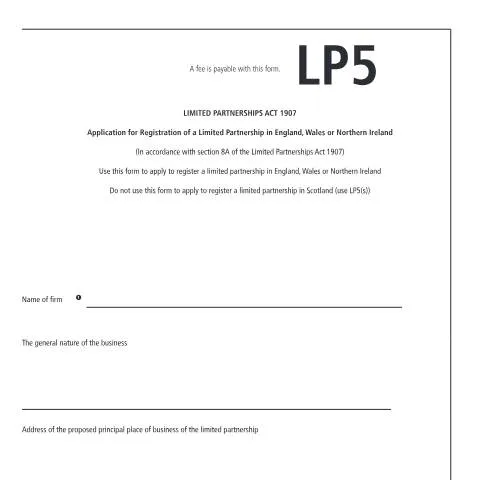
When Business Partnerships Need Official Recognition: The LP5 Registration Process
The formation of a limited partnership represents a significant milestone for businesses seeking a specific legal structure that combines active management with passive investment. In England, Wales, and Northern Ireland, this process begins with form LP5, a document that transforms a business arrangement into a legally recognised entity under the Limited Partnerships Act 1907. Unlike general partnerships that operate without formal registration, limited partnerships must navigate this compulsory registration process to gain their distinctive legal status and the protections it affords both general and limited partners.
The LP5 application serves as the gateway for establishing partnerships where some members contribute capital without participating in day-to-day management, whilst others take full responsibility for business operations. This structure proves particularly valuable for investment ventures, property developments, and professional services where silent partners seek limited liability protection whilst active partners maintain operational control.
Understanding the Limited Partnership Structure Through LP5 Requirements
The LP5 form demands precise information about the partnership's fundamental characteristics, beginning with the firm name that must comply with section 8B of the Limited Partnerships Act 1907. This naming requirement mandates specific endings such as "Limited Partnership" or "LP" to distinguish these entities from other business structures. The chosen name cannot be identical to existing registered partnerships or companies, and must not suggest inappropriate business activities or mislead the public about the partnership's nature.
The general nature of business section requires applicants to describe their intended commercial activities in clear, specific terms. Vague descriptions like "general trading" or "business activities" typically face rejection. Instead, Companies House expects detailed explanations such as "property development and investment," "renewable energy project development," or "private equity investment management." This specificity helps determine regulatory compliance requirements and ensures appropriate classification within official registers.
Partnership duration presents another crucial element, as applicants must specify whether the partnership operates for a fixed term or continues indefinitely. Fixed-term partnerships commonly align with specific projects or investment cycles, whilst indefinite partnerships suit ongoing business operations. This choice affects dissolution procedures and partner withdrawal rights, making accurate completion essential for future operational flexibility.
| Partnership Element | LP5 Requirement | Common Considerations |
|---|---|---|
| Name ending | Must include "Limited Partnership" or "LP" | Check availability through Companies House WebCHeck service |
| Business description | Specific commercial activities | Avoid generic terms; be precise about intended operations |
| Duration | Fixed term or indefinite | Consider project timelines and exit strategies |
| Principal place | UK address required | Cannot be PO Box; must be physical location |
Partner Classifications and Capital Contribution Documentation
The LP5 form distinguishes between general partners and limited partners, each carrying distinct responsibilities and protections under law. General partners assume unlimited liability for partnership debts and obligations whilst maintaining full management authority. They can be individuals or corporate entities, but must provide personal signatures on the LP5 application, demonstrating their commitment to unlimited liability exposure.
Limited partners contribute capital but cannot participate in management without risking their liability protection. The form requires precise documentation of each limited partner's contribution, specifying whether provided as cash, property, services, or other valuable consideration. Cash contributions need straightforward monetary amounts, whilst property contributions require professional valuations to establish fair market value at the time of partnership formation.
Corporate limited partners face additional complexity, as their authorised representatives must sign the LP5 form with clear indication of their authority to bind the corporation. This typically requires board resolutions or power of attorney documentation, though these supporting documents don't accompany the LP5 submission. Instead, partnerships must retain these records for potential Companies House inspection or third-party due diligence requests.
Contribution Valuation and Documentation Standards
Non-cash contributions present particular challenges for LP5 completion, as partnerships must establish defensible valuations for property, intellectual property, or service contributions. Professional valuations from qualified appraisers provide the strongest foundation, particularly for property or equipment contributions exceeding £10,000. Service contributions require careful documentation of the work performed and its market value, often necessitating expert testimony or comparable market analysis.
The timing of contributions also matters significantly, as the LP5 form captures the partnership's initial capital structure. Partners planning phased contributions over time must either document only initial amounts or structure their partnership agreement to accommodate future capital calls. This decision affects the partnership's borrowing capacity and partner voting rights, making careful consideration essential during LP5 preparation.
Geographic Limitations and Scottish Partnership Distinctions
Form LP5 explicitly excludes Scottish limited partnerships, which require the separate LP5(s) form due to Scotland's distinct legal system governing partnerships. This geographical limitation extends beyond simple administrative convenience, reflecting fundamental differences in partnership law between Scottish and English legal traditions. Partnerships operating across these jurisdictions face complex choices about registration location, as this decision affects applicable law, dispute resolution procedures, and regulatory oversight.
The principal place of business requirement on LP5 must specify a physical UK address where partnership operations occur or documents are accessible. This cannot be a PO Box or accommodation address, though registered office service providers offer acceptable alternatives for partnerships without permanent premises. The chosen address receives official correspondence from Companies House and appears on public records, making location selection strategically important for partnerships seeking specific jurisdictional advantages or client accessibility.
Northern Ireland partnerships using LP5 operate under the same legal framework as English and Welsh partnerships, despite Northern Ireland's separate court system. This unified approach simplifies cross-border operations within Great Britain whilst maintaining distinct procedures for international partnerships establishing UK presence through limited partnership structures.
Private Fund Limited Partnership Exclusions and Alternative Routes
The LP5 form explicitly excludes private fund limited partnerships, which require the specialised LP7 application process. This distinction reflects the enhanced regulatory framework governing investment funds under the Alternative Investment Fund Managers Directive and associated UK regulations. Private fund limited partnerships face additional disclosure requirements, investor protection measures, and operational restrictions that standard limited partnerships avoid.
Partnerships uncertain about their classification should carefully review their intended activities before selecting forms. Investment management, fund administration, and collective investment schemes typically require LP7 registration, whilst property investment partnerships, trading ventures, and professional service partnerships use LP5. Misclassification leads to registration delays and potential regulatory complications, making professional advice valuable for complex business models.
Investment Structure Considerations
Standard limited partnerships registered through LP5 cannot market investment opportunities to the general public or operate as collective investment schemes without additional authorisation. This limitation affects fundraising strategies and investor communications, particularly for partnerships seeking multiple limited partners or planning future capital expansions. Understanding these constraints during LP5 preparation prevents costly restructuring requirements as businesses develop.
Submission Procedures and Companies House Processing
Completed LP5 forms require submission to the Registrar of Companies along with the prescribed registration fee, currently set by Companies House fee schedules. Online submission through the Companies House WebFiling service offers the fastest processing, typically completing registration within 8-10 working days during normal periods. Postal submissions extend processing times to 15-20 working days, though complex applications may require additional review periods.
The presenter's reference section allows applicants to include internal tracking numbers or professional service provider references, facilitating follow-up communications and record-keeping. This optional field proves particularly valuable for legal firms or accountants managing multiple partnership registrations simultaneously, enabling efficient client matter organisation and progress monitoring.
Payment methods vary by submission channel, with online applications accepting debit cards, credit cards, and Companies House payment accounts. Postal submissions require cheques payable to "Companies House" or postal orders, with cash payments strictly prohibited for security reasons. Payment processing delays can extend overall registration timelines, making electronic submission preferable for time-sensitive applications.
Post-Submission Communications and Corrections
Companies House issues registration confirmations once LP5 processing completes successfully, providing the official partnership number and registration date. This documentation enables bank account opening, contract execution, and regulatory filings requiring proof of legal existence. Partners should retain multiple copies, as replacement certificates require separate applications and additional fees.
Registration rejections typically cite naming conflicts, incomplete information, or fee payment problems. Companies House provides specific rejection reasons enabling targeted corrections, though new LP5 submissions require fresh fee payments. Common rejection causes include insufficient business activity descriptions, missing partner signatures, or principal place addresses that cannot receive official correspondence.
Ongoing Compliance and Partnership Management After Registration
Successful LP5 registration creates ongoing reporting obligations that partnerships must maintain throughout their operational lifespan. Annual returns, partner change notifications, and principal place updates require timely submission to maintain good standing with Companies House. These obligations continue regardless of partnership activity levels, making compliance monitoring essential for dormant or temporarily inactive partnerships.
Partner changes present particular complexity, as limited partner additions, withdrawals, or contribution modifications require formal notification to Companies House. General partner changes carry additional scrutiny, as these modifications affect the partnership's management structure and liability allocation. Understanding these requirements during initial LP5 completion helps partnerships plan for future operational flexibility and growth opportunities.
The public nature of limited partnership records means LP5 information becomes accessible through Companies House searches, affecting privacy considerations for partners preferring confidential business arrangements. This transparency supports creditor protection and regulatory oversight whilst potentially exposing competitive intelligence or personal financial information to public scrutiny.
Understanding Limited Partnership Structure and Legal Framework
Limited partnerships in the UK operate under a distinct legal framework that differs significantly from general partnerships and limited liability partnerships. Established under the Limited Partnerships Act 1907, this business structure comprises at least one general partner with unlimited liability and one limited partner whose liability is restricted to their capital contribution. This fundamental distinction shapes every aspect of the LP5 registration process and ongoing compliance obligations.
The general partner assumes full responsibility for the partnership's management, debts, and legal obligations. They cannot limit their liability through the partnership agreement or any other mechanism. Conversely, limited partners function more as investors—they contribute capital but cannot participate in day-to-day management without risking the loss of their limited liability status. This prohibition extends beyond operational decisions to include activities such as signing contracts on behalf of the partnership, hiring employees, or making strategic business decisions.
Companies House maintains the official register of limited partnerships, assigning each a unique registration number upon successful application. This registration creates a legal entity separate from its partners, though it lacks the corporate veil protection of a limited company. The partnership must display its registered name and registration number on all business correspondence, invoices, and official documents.
Recent legislative changes have introduced additional transparency requirements for limited partnerships. The Economic Crime and Corporate Transparency Act 2023 expanded disclosure obligations, particularly for partnerships with connections to overseas entities or complex ownership structures. These changes affect both new registrations and existing partnerships, requiring enhanced due diligence and ongoing reporting responsibilities.
Limited partnerships cannot carry on business activities before registration completion. Any trading, contracting, or commercial activities undertaken prior to receiving the registration certificate may expose partners to personal liability and potential legal complications. This timing restriction often influences business planning and launch strategies, particularly for time-sensitive commercial opportunities.
The registered office address becomes the partnership's official correspondence address and must be located within the UK. This address appears on the public register and receives all official communications from Companies House, HMRC, and other regulatory bodies. Partners should ensure reliable mail handling arrangements, as missed correspondence can result in compliance failures and potential penalties.
Financial Considerations and Capital Requirements
Unlike limited companies, limited partnerships face no minimum capital requirements for registration. However, the LP5 form requires detailed disclosure of each limited partner's capital contribution, including the nature, timing, and valuation of their investment. These contributions can comprise cash, property, services, or other assets, but must be accurately valued and documented to avoid future disputes or compliance issues.
Capital contributions create the foundation for limited partners' liability protection. Their maximum exposure to partnership debts equals their committed contribution amount, provided they maintain their limited partner status. Any withdrawal of capital during the partnership's operation may increase their liability exposure, making careful capital planning essential from the outset.
The partnership agreement should specify capital contribution schedules, particularly for phased investments or conditional funding arrangements. Companies House requires confirmation that stated contributions have been made or are legally committed, with supporting documentation potentially requested during the registration review process. Vague or conditional contribution statements may delay approval or trigger additional information requests.
Foreign currency contributions require conversion to sterling using recognised exchange rates at the contribution date. Partnerships must maintain accurate records of exchange rates used and any subsequent currency fluctuations affecting contribution values. These records become particularly important for tax reporting and potential future valuations during partner changes or partnership dissolution.
Property contributions demand professional valuations to establish fair market value at the contribution date. The valuation methodology and supporting documentation should align with accepted industry standards, as Companies House may scrutinise unusual valuations or request additional evidence. Overvalued contributions can create legal complications and affect limited partners' liability calculations.
Service contributions present unique challenges, as their valuation requires careful documentation of the services' commercial value, delivery timeline, and measurable outcomes. Professional services, intellectual property, or ongoing commitments need detailed agreements specifying performance standards, delivery milestones, and valuation methodologies. Inadequately documented service contributions may face rejection during the registration process.
Tax implications of capital contributions vary depending on the contribution type and partners' individual circumstances. Cash contributions typically have no immediate tax consequences, but property transfers may trigger capital gains implications for the contributing partner. Professional tax advice becomes essential for complex contribution structures or high-value transfers.
Ongoing Compliance and Regulatory Obligations
Limited partnership registration initiates extensive ongoing compliance obligations extending far beyond the initial LP5 submission. Annual returns to Companies House become mandatory, requiring updated information about partners, registered office changes, and material alterations to the partnership structure. These returns carry strict deadlines, with late filing penalties escalating based on the delay duration.
Partner changes trigger immediate notification requirements to Companies House. New partner admissions, existing partner departures, or modifications to partner status (such as limited partners becoming general partners) require formal documentation within prescribed timeframes. These changes often necessitate amended partnership agreements and may affect the partnership's tax treatment or regulatory status.
The registered office address must remain current and accessible for official correspondence. Address changes require prompt notification to Companies House through prescribed forms, with the new address taking effect only after official confirmation. Partnerships maintaining multiple business locations must distinguish between their registered office (for official purposes) and operational addresses (for day-to-day activities).
Annual accounts filing obligations depend on the partnership's size and activities. While limited partnerships typically face less onerous accounting requirements than limited companies, certain partnerships must prepare and file annual accounts with Companies House. These requirements particularly apply to partnerships exceeding specified turnover, asset, or employee thresholds.
Anti-money laundering regulations impose additional compliance burdens on limited partnerships, particularly those operating in regulated sectors or with complex ownership structures. Partnerships must implement appropriate due diligence procedures, maintain beneficial ownership records, and report suspicious activities to relevant authorities. These obligations extend to ongoing monitoring of partner relationships and transaction patterns.
Data protection compliance becomes increasingly complex for partnerships handling personal information about partners, employees, customers, or suppliers. The UK GDPR and Data Protection Act 2018 require partnerships to implement appropriate technical and organisational measures, maintain processing records, and respond to data subject requests. Limited partners' restricted management involvement can complicate data protection governance arrangements.
Sector-specific regulations may impose additional licensing, reporting, or operational requirements on limited partnerships. Financial services, property investment, intellectual property licensing, and international trade activities often trigger specialised regulatory frameworks requiring ongoing compliance monitoring and periodic reporting to relevant authorities.
Dissolution procedures for limited partnerships involve formal processes through Companies House, including final accounts preparation, creditor notifications, and asset distribution according to the partnership agreement terms. The dissolution process can extend over several months, requiring careful coordination between partners and professional advisors to ensure complete regulatory compliance and proper closure of all partnership obligations.