When Your Public Company Needs to Become Private: The Strategic Decision Behind Form RR02
The transformation from public limited company (plc) to private limited company represents one of the most significant structural changes a business can undergo in the UK corporate landscape. Form RR02 serves as the gateway to this transformation, enabling established public companies to shed their plc status and embrace the more flexible, less regulated environment of private company status. This re-registration process typically occurs when companies find that the burdens of public company compliance outweigh the benefits of public market access, or when ownership structures have evolved to make private status more suitable.
The decision to re-register affects everything from governance requirements to financial reporting obligations, making this one of the most consequential forms processed by Companies House. Unlike routine filings, form RR02 triggers a fundamental change in the company's legal status, altering its relationship with shareholders, regulators, and the broader market.
The Legal Framework and Statutory Foundation
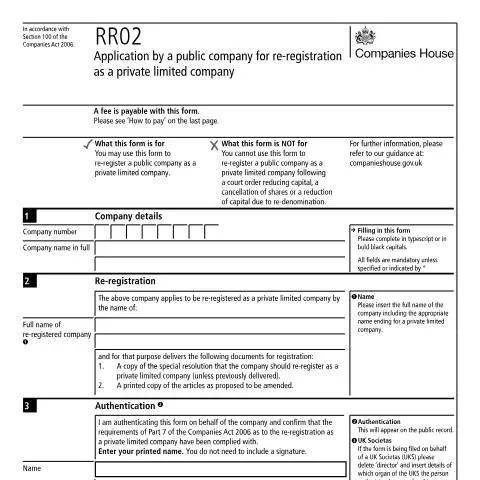
Form RR02 operates under the strict provisions of Section 100 of the Companies Act 2006, which establishes the statutory framework for public company re-registration. This section requires companies to meet specific conditions before re-registration can proceed, including the passing of a special resolution by shareholders and compliance with capital maintenance rules.
The Act distinguishes between standard re-registration applications and those following court-ordered capital reductions. Crucially, form RR02 cannot be used when re-registration follows a court order reducing capital, share cancellations, or capital reductions due to share re-denomination. These scenarios require separate procedures and different documentation, highlighting the precision required in UK corporate law.
Special Resolution Requirements
The cornerstone of any RR02 application is the special resolution passed by company shareholders. This resolution must explicitly state the intention to re-register as a private limited company and must achieve the required 75% majority of votes cast. The resolution's wording becomes particularly important as it forms part of the permanent company record and must clearly demonstrate shareholder consent to the fundamental change in company status.
Detailed Breakdown of Essential Documentation
Beyond the completed RR02 form itself, the re-registration process demands specific supporting documents that demonstrate compliance with statutory requirements. The documentation package serves as evidence that all legal prerequisites have been satisfied before Companies House can approve the status change.
| Document Type | Requirement | Purpose |
|---|---|---|
| Special Resolution Copy | Must be included unless previously filed | Proves shareholder approval for re-registration |
| Amended Articles of Association | Printed copy showing proposed amendments | Demonstrates removal of public company provisions |
| Form RR02 | Completed and authenticated | Formal application for status change |
| Fee Payment | £124 statutory fee | Processing charge for re-registration |
Articles of Association Amendments
The amended articles of association represent perhaps the most complex element of the documentation package. These must be carefully crafted to remove all references to public company status while ensuring the new articles comply with private company requirements. Key changes typically include removing provisions for share premium accounts, altering director appointment procedures, and eliminating requirements for annual general meetings where these exceed private company obligations.
Company Name Changes and Administrative Implications
A critical aspect often overlooked is that re-registration typically necessitates a company name change. Public limited companies using "plc" or "public limited company" in their name must adopt appropriate private company endings such as "Limited", "Ltd", "Cyfyngedig", or "Cyf" for Welsh companies.
The new company name must be available and comply with Companies House naming rules. This creates a potential complication where the desired private company name is already in use, requiring companies to consider alternative names before submitting form RR02. The timing becomes crucial as companies cannot reserve names indefinitely while preparing their re-registration documentation.
Cross-Border Considerations
For companies with international operations or subsidiaries, the name change cascades through various jurisdictions. Subsidiary companies, joint ventures, and contractual arrangements may all reference the parent company's public status, necessitating comprehensive review and potential amendments to numerous agreements across multiple jurisdictions.
Authentication Requirements and Authorised Signatories
Form RR02 requires authentication by specific categories of authorised individuals, reflecting the significance of the re-registration decision. The form may be authenticated by a company director, company secretary, person authorised under section 270 or 274 of the Companies Act 2006, or a Community Interest Company manager where applicable.
For UK Societas companies, special provisions apply requiring deletion of "director" references and insertion of details about which organ of the UKS the authorising person holds membership. This reflects the unique governance structure of European company forms operating under UK law.
Authentication Implications
The authentication requirement serves multiple purposes beyond simple authorisation. It creates personal accountability for the accuracy of the application and confirms that the authenticating party has authority to bind the company to this fundamental change. The printed name of the authenticator becomes part of the public record, creating transparency about who authorised the re-registration.
Processing Timeline and Companies House Procedures
Once submitted, form RR02 enters Companies House's processing system where it undergoes detailed scrutiny. The £124 statutory fee must accompany the application, and incomplete or incorrect submissions face return to the applicant, potentially causing significant delays in a time-sensitive re-registration process.
Companies House examines each application against the statutory requirements, verifying that all documentation is complete and that the proposed changes comply with company law. This includes checking that the special resolution meets legal requirements, that the amended articles are appropriate for a private company, and that the chosen company name is available and compliant.
Potential Complications and Rejection Scenarios
Several factors can lead to application rejection or delay. Inconsistent documentation where the special resolution doesn't align with the proposed articles represents a common issue. Similarly, if the company has outstanding compliance matters with Companies House, these may need resolution before re-registration can proceed.
The timing of submission can also create complications. If another company registers the desired private company name between application preparation and submission, the entire process may require restart with a different name, causing considerable delay and potential additional costs.
Post-Registration Obligations and Compliance Changes
Successful re-registration fundamentally alters the company's ongoing compliance obligations. Private companies benefit from reduced filing requirements, simplified share transfer procedures, and elimination of certain public company restrictions. However, this transition creates immediate action items for company management.
The company must update its statutory books to reflect the new status and name, notify banks and other financial institutions of the change, and review all contracts and agreements that reference the company's public status. Letterheads, websites, and marketing materials require updating to reflect the new private company name and status.
Shareholder Communication
Re-registration affects shareholder rights and protections, particularly regarding share transfers and company information access. Private companies can impose greater restrictions on share transfers and are not subject to the same disclosure requirements as public companies. Comprehensive shareholder communication ensures all parties understand how re-registration affects their investment and rights.
Strategic Considerations Beyond the Form
While form RR02 represents the mechanical process of re-registration, the decision to convert from public to private status reflects broader strategic considerations. Companies often pursue this change to reduce regulatory burden, enable more flexible decision-making, or align corporate structure with evolved ownership patterns.
The cost savings from reduced compliance requirements can be substantial, particularly for smaller public companies where the proportional burden of public company obligations has become excessive. However, re-registration also eliminates access to public capital markets, requiring companies to ensure adequate alternative funding sources are available for future growth.
Tax implications may also influence the re-registration decision, as private company status can enable certain tax planning opportunities not available to public companies. Professional advice becomes essential to navigate these complex considerations and ensure the re-registration achieves the intended strategic objectives while maintaining compliance with all applicable regulations.
Special Considerations for Listed Companies and Share Buybacks
If your public limited company has shares traded on any recognised investment exchange, including the London Stock Exchange's Main Market or AIM, the re-registration process becomes significantly more complex. You must first ensure all shares are delisted and that no public trading mechanisms remain active before submitting form RR02.
The delisting process typically requires advance notice to shareholders and the exchange itself—usually between 20 to 40 business days depending on the exchange's rules. During this period, you cannot proceed with re-registration, as Companies House will reject any RR02 application for a company whose shares remain publicly tradeable.
Share buyback programmes often accompany re-registration, particularly where the current shareholding structure includes numerous small investors acquired during the public phase. However, any buyback must comply with the Companies Act 2006 provisions on purchase of own shares. You'll need a special resolution (75% majority) specifically authorising the buyback, separate from the re-registration resolution.
The timing sequence matters critically: complete all buybacks before filing RR02, as the application must reflect the final post-buyback share structure. If you're conducting a selective buyback targeting specific shareholder groups, ensure this doesn't constitute unfair prejudice under section 994 of the Companies Act, as disgruntled shareholders could challenge the entire re-registration process.
For companies with employee share schemes (SAYE, SIP, or EMI schemes), you'll need to consider the impact on existing option holders and scheme participants. Some schemes may need to be wound up or converted, requiring separate notifications to HMRC's Share Schemes team and potentially triggering tax consequences for participants.
Post-Registration Compliance Changes and Ongoing Obligations
Once Companies House confirms your re-registration (typically within 8 to 15 working days of submitting a complete RR02 application), your company immediately operates under private company rules, but several administrative adjustments require prompt attention to maintain compliance.
Your company's constitutional documents need updating beyond the basic share capital changes. The articles of association should be reviewed to remove any provisions specific to public companies, such as requirements for annual general meetings (now optional for private companies) or specific notice periods that may be unnecessarily restrictive. While not mandatory, aligning your articles with private company best practices helps avoid confusion in future governance decisions.
Banking relationships require formal notification, as many commercial banking agreements contain specific terms relating to company status. Your bank may need to update account mandates and review any existing loan covenants that reference public company requirements. Some facilities agreements include clauses that treat a change from public to private status as a material adverse change, potentially triggering review or renegotiation of terms.
Insurance arrangements, particularly directors' and officers' liability policies, should be reviewed with your broker. Public company policies often include coverage for securities litigation and regulatory investigations that may not be relevant post-re-registration, potentially allowing for premium reductions. Conversely, ensure adequate cover remains for the types of commercial disputes more common among private companies.
Your company's statutory registers require updating to reflect the new status. The register of members should note the re-registration date, and any share certificates issued subsequently must omit the "plc" designation. If you maintain a branch register or use electronic registers, ensure all systems reflect the status change to avoid issuing documents with incorrect company identifiers.
Accounting and audit requirements may change depending on your company's size post-re-registration. Private companies can potentially qualify for audit exemptions if they meet the small company thresholds (turnover under £10.2 million and balance sheet total under £5.1 million), though this depends on your specific circumstances and shareholder agreements.
Tax Implications and HMRC Considerations
Re-registration from public to private company status can trigger several tax considerations that require careful planning, particularly around corporation tax, stamp duty, and potential capital gains implications for shareholders.
For corporation tax purposes, the re-registration itself doesn't constitute a disposal or acquisition, so no immediate corporation tax charge arises on the company. However, if the re-registration forms part of a broader restructuring involving asset transfers or share exchanges, these transactions may have tax consequences requiring advance clearance from HMRC.
The company's corporation tax rate remains unchanged by re-registration—both public and private companies pay the same rates. However, private companies have access to certain reliefs that weren't available as a plc, such as entrepreneurs' relief on qualifying business asset disposals, though this primarily benefits shareholders rather than the company itself.
Stamp duty considerations arise if the re-registration involves any share transfers or if new shares are issued as part of the process. The standard 0.5% stamp duty rate applies to most share transfers, but certain reliefs may be available for intra-group transfers or reconstructions that meet specific conditions under the Finance Act.
For shareholders, the re-registration may constitute a reorganisation for capital gains tax purposes, particularly if accompanied by share consolidations, subdivisions, or bonus issues. In most straightforward re-registrations where shareholders simply exchange plc shares for equivalent private company shares, no immediate capital gains liability arises, and the base cost transfers to the new shares.
However, if the re-registration involves cash payments to shareholders (perhaps through concurrent buybacks or special dividends), these may be treated as distributions for tax purposes. Shareholders should consider their individual tax positions, particularly if they're higher-rate taxpayers who may prefer capital gains treatment over dividend taxation.
VAT registration and obligations remain unaffected by the re-registration itself, though if you're restructuring business activities alongside the status change, review whether this impacts your VAT group registrations or partial exemption calculations.
Employment-related taxes continue unchanged, but if you're implementing new share incentive schemes post-re-registration, ensure these are properly registered with HMRC's Share Schemes team where required. Private companies have access to certain tax-advantaged schemes (like EMI options) that weren't available as a plc, potentially offering better employee incentive opportunities.