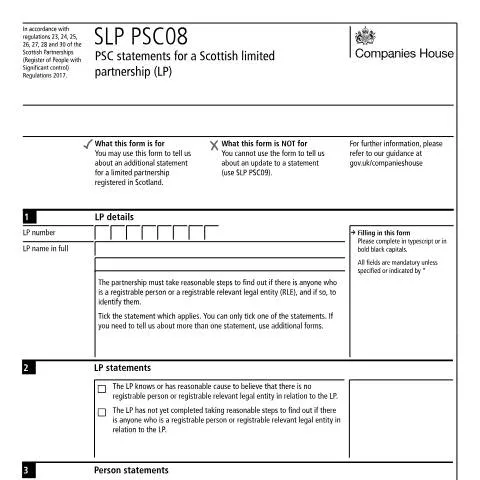
Navigating the SLP PSC08: A Key Document for Scottish Limited Partnerships
Understanding the intricacies of the SLP PSC08 is critical for any general partner managing a Scottish limited partnership (SLP). This document serves as a formal notice regarding persons with significant control (PSC) statements, ensuring compliance with regulations that govern transparency in ownership structures. As ownership complexities grow, the importance of this statement cannot be overstated.
What Constitutes a PSC Statement?
Before delving into the SLP PSC08, it's essential to grasp the concept of a PSC statement. A PSC is any individual or legal entity that holds significant control over a partnership. According to the Scottish Partnerships (Register of People with Significant Control) Regulations 2017, a significant control can manifest through various means, such as owning a certain percentage of shares or voting rights.
The SLP PSC08 form is specifically designed to notify Companies House about any updates or confirmations regarding these individuals or entities. It stands as a record that helps maintain the integrity of the public register.
Interrelationships with Other Documentation
In the realm of Scottish limited partnerships, the SLP PSC08 does not exist in isolation. It operates alongside various other forms and statements. For instance:
- SLP PSC09: This is used to update previously submitted PSC statements. Unlike the SLP PSC08, which simply gives notice of a PSC, the SLP PSC09 facilitates adjustments to existing data.
- Annual Confirmation Statement: This annual requirement also includes PSC information, ensuring that Companies House has up-to-date records.
- Regulation 10 and Regulation 11 Notices: These notices may trigger the need for an SLP PSC08 if the information provided does not comply with the regulations.
Understanding these connections ensures that partnerships remain compliant and that their records accurately reflect their ownership structures.
Step-by-Step Utilization of the SLP PSC08
Using the SLP PSC08 requires a structured approach. Here’s a practical guide:
- Identify Registrable Persons: The partnership must first ascertain who qualifies as a registrable person or relevant legal entity. This involves diligent investigation, as the duties to identify these parties are stringent.
- Select Appropriate Statements: On the form, tick only one statement that best represents the situation regarding registrable persons. This could include scenarios like having an unidentified registrable person or knowing there is a registrable person whose particulars are not confirmed.
- Document Verification: Ensure that the details of the partnership match those held on the public register. This includes the LP name and number. Discrepancies can lead to rejection of the form.
- Submission: Once completed, the form can either be uploaded directly to Companies House or sent via post. If opting for postal submission, ensure it reaches the correct address.
This structured approach minimizes the likelihood of errors and promotes efficient processing by Companies House.
Scope and Limitations of the SLP PSC08
The SLP PSC08 is not a catch-all solution. Its primary function is to provide notice regarding persons of significant control and doesn’t cover updates to existing statements, which is a common misconception. Furthermore, the following should be noted:
- The SLP PSC08 cannot replace the need for the annual confirmation statement. These are complementary but distinct requirements.
- It does not serve as a tool for informing Companies House about changes in the partnership structure; such changes may require distinct forms and notifications.
- The document is visible on the public register, meaning that the details disclosed can be accessed by anyone. This transparency is designed to uphold public trust but may also raise concerns over privacy.
Target Audience and Essential Scenarios
Primarily, the SLP PSC08 is directed towards general partners within Scottish limited partnerships. However, its relevance extends to:
- Accountants and Legal Advisors: Those aiding partnerships in compliance will find this document crucial for ensuring accurate reporting.
- New Partnerships: Newly formed partnerships must familiarize themselves with this document to ensure their compliance from the outset.
- Partnerships Undergoing Changes: Any partnership that experiences changes in ownership or control must recognize when to utilize the SLP PSC08 to communicate these updates.
Avoiding Common Misinterpretations
Misinterpretations of the SLP PSC08 can lead to compliance issues and unnecessary complications. Some key areas where misunderstandings often occur include:
- Purpose of the Document: Many believe the SLP PSC08 is a comprehensive update form, but it is strictly for giving notice of new statements, not changes to existing ones.
- Signature Requirements: Proper signatures are critical. The form must be signed by an authorized individual, typically a general partner. Incomplete signatures can delay processing.
- Public Record Implications: The visibility of submitted information may cause concern among partners who prefer discretion regarding ownership structures.
Key Terms to Understand for Effective Use
Grasping the relevant terminology associated with the SLP PSC08 is paramount for effective usage. Key terms include:
| Term | Description |
|---|---|
| Significant Control | An individual or entity with a significant controlling interest in the partnership. |
| Registrable Relevant Legal Entity (RLE) | A legal entity that meets the criteria for significant control but is not an individual. |
| General Partner | A partner with unlimited liability who manages the operations of the partnership. |
| PSC Statement | A declaration regarding the individuals or entities exercising significant control over the partnership. |
By familiarizing yourself with these terms, you can navigate the complexities of compliance with greater ease and confidence.
Final Considerations and Submission Guidelines
When preparing to submit the SLP PSC08, consideration of the following guidelines is advisable:
- Ensure all entries are formatted in bold black capitals, as specified. This not only adheres to submission standards but also enhances clarity.
- Keep a copy of the completed form for your records. Documentation is critical in case of future inquiries or audits by Companies House.
- If submitting electronically, follow the appropriate procedures outlined on the Companies House website for uploading documents.
The SLP PSC08 is a vital part of maintaining compliance and transparency within the framework of Scottish limited partnerships. Proper understanding and application of this document can facilitate smoother operations and adherence to regulatory expectations.
Understanding the Role of a Person of Significant Control (PSC) in Scottish Limited Partnerships
A Person of Significant Control (PSC) plays a crucial role in the governance and accountability of Scottish Limited Partnerships (SLPs). Under UK law, particularly the Companies Act 2006 and the Limited Liability Partnerships (Scotland) Act 2001, a PSC is defined as an individual who meets one or more of the following criteria: they hold more than 25% of the shares, have voting rights, or can exert significant influence over the partnership. Understanding the implications of being a PSC is vital, as this status carries responsibilities for compliance and transparency.
It’s important to note that the PSC register serves to enhance corporate governance by ensuring that SLPs disclose key individuals who control significant aspects of the business. For those involved in an SLP, this transparency is essential not only for legal compliance but also for maintaining trust with customers, investors, and regulatory bodies. If you are a PSC, you need to ensure all your personal details are accurately reflected in the PSC register. Failure to do so can lead to penalties and affect the partnership’s reputation.
Navigating the Challenges of Reporting Changes in PSC Information
Reporting changes to PSC information can often present challenges for Scottish Limited Partnerships, especially those undergoing restructuring or facing ownership changes. When a new PSC is appointed or existing PSC details change (such as a change of address), the SLP must report these changes through the PSC08 form within 14 days. This timeframe is critical to maintain compliance and avoid potential penalties.
Moreover, it is essential to have robust internal processes to ensure that the information provided is accurate and up to date. Regular reviews of the PSC register can facilitate this process. In addition to ensuring timely reporting, partnerships should also consider maintaining proper records of the decision-making process that led to the changes in PSCs, as this may be required in case of audits or inquiries from bodies like Companies House.
Should you face difficulties while making these declarations, seeking legal advice or consultancy can help clarify obligations and streamline the reporting process. It is also prudent to prepare for possible scrutiny from regulators, especially if changes align with complex ownership structures typical in multi-partner scenarios.
Consequences of Non-Compliance with PSC Reporting Obligations
Non-compliance with the PSC reporting obligations can have severe repercussions for Scottish Limited Partnerships. If an SLP fails to submit the PSC08 form or provides inaccurate information, Companies House may impose penalties. The penalties can escalate significantly depending on the nature of the infraction, with potential prosecution for continued failure to comply.
Beyond monetary penalties, non-compliance could lead to reputational damage. Investors, customers, and partners may lose confidence in a business that does not maintain transparency regarding its control structure. This could affect future financing opportunities or partnerships. For instance, banks and lending institutions are increasingly scrutinizing the ownership and control of businesses seeking credit.
This emphasizes the importance of not only meeting regulatory demands but also cultivating a culture of compliance within the partnership. Regular training sessions on PSC obligations for all partners and key staff can enhance understanding and adherence to the law.