Navigating the SQP PSC08: A Guide for Scottish Qualifying Partnerships
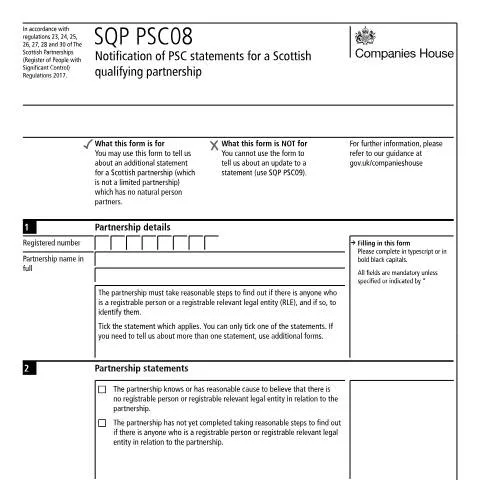
In the complex landscape of Scottish business regulations, the SQP PSC08 form provides critical guidelines for partnerships without natural person partners. Understanding this document's purpose and the procedures involved is essential for maintaining compliance with the Scottish Partnerships (Register of People with Significant Control) Regulations 2017. This guide dissects the SQP PSC08, detailing its significance, contextual usage, and procedural nuances.
The Crucial Role of PSC Statements
PSC statements serve as a mechanism for transparency in business ownership, particularly for partnerships not involving natural persons. The SQP PSC08 is specifically designed to notify Companies House about the entities that control or influence a Scottish qualifying partnership (SQP). Organizations must take diligent steps to establish the existence of any registrable persons or relevant legal entities (RLEs), which underscores the importance of identifying ownership structures accurately.
Understanding Registrable Persons and Relevant Legal Entities
To utilize the SQP PSC08 effectively, one must grasp the definitions of registrable persons and relevant legal entities:
- Registrable Person: This generally refers to individuals or entities that have significant control over the partnership, which may not be apparent at first glance.
- Relevant Legal Entity (RLE): An RLE is a corporate body that might play a significant role in controlling the partnership, necessitating disclosure.
Understanding these terms ensures that partnerships will not only comply with regulations but also avoid potential penalties associated with non-compliance.
Step-by-Step Procedure for Using SQP PSC08
Here, we outline a clear sequence of steps to follow when using the SQP PSC08 for effective communication with Companies House:
- Identify the Partnership Details: Ensure that the full name and registered number of the partnership are accurately noted. These must match the information in the public register.
- Determine the Applicable Statements: The form requires a selection between statements regarding registrable persons or RLEs. Choose carefully, as only one statement can be ticked.
- Conduct Due Diligence: The partnership must take reasonable steps to ascertain the presence of any registrable persons or RLEs. This involves thorough investigations and possibly consultations.
- Sign the Document: The form mandates a signature from an authorized partner, affirming that all information provided is accurate and complete.
- Submission: Decide whether to upload the form electronically or send it by post to the correct Companies House address.
By rigorously following these steps, partnerships can ensure compliance while minimizing the risk of errors that could lead to penalties or information being rejected.
Key Statements and Their Implications
The SQP PSC08 form contains several statements that partnerships need to be aware of, each of which carries specific implications:
| Statement | Description |
|---|---|
| Identified Registrable Person | The partnership has identified a registrable person, but particulars are not confirmed. |
| Unidentified Registrable Person | The partnership believes a registrable person exists, but has not identified them. |
| No Registrable Person | The partnership believes that no registrable person or RLE exists. |
Each of these statements requires careful consideration, as misinformation can lead to complications down the line.
Situations Necessitating the Use of SQP PSC08
There are specific scenarios where the SQP PSC08 becomes indispensable:
- Formation of New Partnerships: When creating a new Scottish qualifying partnership and confirming that it does not have natural person partners.
- Changes in Ownership Structure: Situations where a partnership undergoes changes in its ownership or control structures demand the use of this form.
- Compliance Updates: When fulfilling the duty to investigate and provide updates about registrable persons or RLEs.
These situations illustrate the necessity for partnerships to remain proactive in their compliance efforts, thereby ensuring transparency and legal adherence.
Articulating with Other Related Documents
The SQP PSC08 does not function in a vacuum; it interacts with various other documents and regulations:
- SQP PSC09: Used for updates regarding statements previously disclosed, as opposed to new notifications.
- Regulation Notices: Compliance with Regulation 10 and Regulation 11 notices may necessitate the use of the SQP PSC08 for accurate record-keeping.
Understanding these relationships helps partnerships maintain comprehensive records and adhere to regulatory requirements seamlessly.
The Importance of Accuracy and Compliance
Completing the SQP PSC08 accurately is more than an administrative task; it is a legal obligation. The information provided on this form will become part of the public record, making transparency essential:
- Failure to comply with submission requirements can result in penalties, including fines or restrictions on business operations.
- Incorrect information might lead to the rejection of the form, requiring resubmission and causing unnecessary delays.
Therefore, partnerships should prioritize thoroughness and clarity when dealing with this document.
Final Thoughts on Utilizing the SQP PSC08
Utilizing the SQP PSC08 effectively requires a nuanced understanding of its purpose, implications, and the broader regulatory framework surrounding Scottish partnerships. Each step, from identifying registrable persons to ensuring compliance with related regulations, plays a vital role in maintaining corporate governance and transparency. As business landscapes evolve, staying informed and compliant with regulations such as the SQP PSC08 will remain a cornerstone of responsible partnership management.
Understanding the Role of PSC Statements in Scottish Qualifying Partnerships
In Scotland, the governance of partnerships, particularly those classified as Scottish qualifying partnerships (SQPs), is intricately linked to the requirements surrounding Persons of Significant Control (PSC) statements. The PSC regime aims to enhance transparency in business ownership, holding companies accountable to disclose information about individuals who hold significant control over them.
For SQPs, the PSC statement is vital not just for compliance, but also for maintaining trust with clients, suppliers, and regulatory bodies. The statement must include details such as the name, date of birth, nationality, and the nature of control for each PSC. This ensures that the partnership operates within the framework of good governance. Failure to submit a PSC08 form can lead to penalties and reputational damage, making it essential to grasp the nuances of these requirements.
Moreover, all SQPs must ensure they keep their PSC registers up to date, reflecting any changes in control or ownership. This is not a one-time obligation; it is a continuous duty that exists as long as the SQP remains active. Any changes must be reported to Companies House within a specific timeframe to avoid compliance issues.
Filing Procedures for PSC08: Key Steps and Considerations
When you are preparing to file a PSC08 for your Scottish qualifying partnership, it’s crucial to follow a methodical approach to ensure compliance and avoid any potential pitfalls. Here’s a detailed guide on the key steps involved in the filing process:
- Gather Necessary Information: Start by collecting all relevant details about your partnership and the individuals deemed as Persons of Significant Control. This includes their full names, addresses, and the specifics of their control (such as voting rights, rights to appoint or remove directors, etc.). Be meticulous, as any inaccuracies can lead to complications.
- Complete the PSC08 Form: The PSC08 form can be obtained from the Companies House website. Fill in the necessary details accurately. Ensure to check the guidance notes provided on the form to avoid common errors.
- Submission Method: Decide whether to file the form online or via post. Online submissions are generally processed more quickly and allow for instant acknowledgments. If filing by post, consider using a service that provides proof of postage.
- Keep Records: Maintain a copy of the submitted PSC08 form and any correspondence related to it. This record is invaluable for future reference and compliance checks.
- Review and Update Regularly: Make it a habit to review your PSC statements periodically. This ensures that any significant changes in control or ownership are captured without delay. Regular updates are not only good practice but are also a legal requirement under the current framework.
Consequences of Non-Compliance: Risks and Remedies
Failure to submit a PSC08 form can expose your Scottish qualifying partnership to several risks, both financial and operational. Understanding these consequences can help underscore the importance of compliance.
First and foremost, non-compliance can result in financial penalties. Companies House imposes fines for late filings, which can escalate if the breach persists. Beyond monetary repercussions, there may be significant reputational damage. Trust is a cornerstone in business relationships, and failing to disclose PSC information can lead to questions about transparency and ethics.
Operationally, partnerships may find their ability to conduct business hindered. Financial institutions often require evidence of compliance before approving loans or credit. Additionally, your partnership could face challenges in bidding for contracts, especially with public sector organisations that prioritize transparency and integrity among suppliers.
However, if you find yourself in a position of non-compliance, addressing the issue as swiftly as possible is crucial. Take the following remedial actions:
- File the Outstanding PSC08 Form: Even if late, submitting the form promptly can mitigate some risks. Include an explanation of the circumstances surrounding the delay.
- Consult with Professional Advisors: Engaging with legal or financial advisors can provide insights on how to manage compliance going forward and may help negotiate with Companies House if needed.
- Implement Regular Compliance Checks: Establishing a routine for compliance checks can help ensure that all obligations are met moving forward. This includes not only PSC statements but also other regulatory requirements that may affect your partnership.