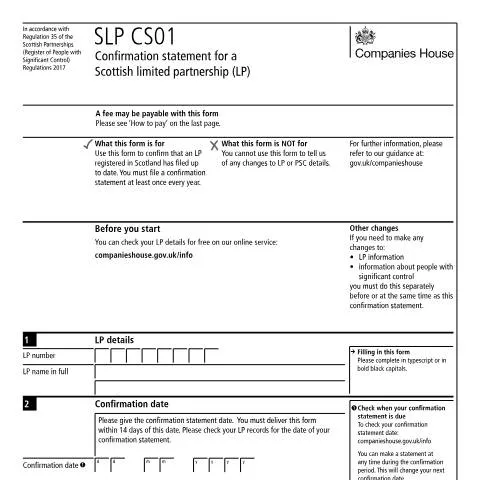
The Annual Compliance Ritual for Scottish Limited Partnerships
Every Scottish limited partnership (SLP) operating in the UK faces a mandatory annual checkpoint that determines whether it remains in good standing with Companies House. The Confirmation statement for a Scottish limited partnership (SLP CS01) represents far more than a simple administrative formality—it serves as the statutory mechanism through which partnerships demonstrate ongoing compliance with the Scottish Partnerships (Register of People with Significant Control) Regulations 2017.
Unlike standard limited companies that file their confirmation statements under different regulations, Scottish limited partnerships operate within a distinct legal framework that reflects Scotland's unique partnership law heritage. This creates specific obligations that general partners must navigate carefully, particularly regarding the confirmation of people with significant control (PSC) information and the timing of submissions.
The form's deceptively simple appearance masks complex compliance requirements. While the document itself spans just two pages, the underlying obligations extend far beyond what meets the eye, encompassing everything from PSC register maintenance to the coordination of multiple filing requirements within tight deadlines.
Understanding the Scottish Partnership Compliance Landscape
Scottish limited partnerships occupy a unique position in UK business structures, combining elements of both partnership and corporate law. The SLP CS01 form operates within Regulation 35 of the Scottish Partnerships (Register of People with Significant Control) Regulations 2017, which established specific requirements for transparency and accountability that differ markedly from those governing English partnerships or standard limited companies.
The confirmation statement mechanism serves multiple regulatory purposes simultaneously. It confirms that the partnership has maintained accurate PSC records, validates that all required information has been filed with Companies House, and provides a regular checkpoint for regulatory compliance. This multifaceted role explains why the form cannot be used to notify changes—it purely confirms the current state of compliance rather than updating information.
The Regulatory Framework Context
The 2017 regulations introduced significant transparency requirements for Scottish partnerships, aligning them more closely with corporate disclosure standards while respecting the fundamental nature of partnership structures. This means that SLPs must maintain detailed records of individuals with significant control while preserving the flexibility that makes partnership structures attractive to many businesses.
The confirmation statement requirement reflects broader UK government initiatives to enhance business transparency and combat money laundering. For Scottish partnerships, this creates a particular compliance burden because they must satisfy both partnership-specific requirements and the broader PSC regime that applies across different business structures.
Who Bears Responsibility for Filing
The authentication requirements for SLP CS01 forms reflect the hierarchical structure inherent in limited partnerships. Only a general partner possesses the authority to submit the confirmation statement, acknowledging their unlimited liability and management responsibility within the partnership structure.
This restriction carries significant practical implications. In partnerships where multiple general partners exist, any one of them may authenticate the form, but the responsibility ultimately rests with all general partners collectively. Limited partners, despite their financial interest in the partnership, have no authority to file confirmation statements—a restriction that reflects their passive role in partnership management.
Complex Ownership Structures
Many Scottish limited partnerships involve intricate ownership arrangements, particularly those used in private equity or property investment contexts. Where corporate entities serve as general partners, the authorised representatives of those entities bear responsibility for ensuring compliance. This can create coordination challenges, especially in international partnerships where different time zones and corporate procedures may complicate timely filing.
The form's authentication section requires the printed name of the person submitting the statement, creating a clear audit trail. Unlike many Companies House forms that accept electronic signatures, the SLP CS01 relies on this simpler authentication method, though electronic filing remains possible through Companies House's online services.
Decoding the Confirmation Period and Timing Requirements
The confirmation statement operates on a rolling annual cycle that begins from the partnership's registration date rather than following the standard tax year or calendar year. This creates a unique compliance calendar for each SLP that general partners must track independently.
The form requires completion of the "confirmation date"—a specific date within the confirmation period ending on or before the anniversary of the previous confirmation statement. Partnerships enjoy flexibility in choosing this date, but once selected, they have precisely 14 days to deliver the form to Companies House. This tight deadline leaves little room for administrative delays or postal uncertainties.
| Timing Element | Requirement | Consequences of Delay |
|---|---|---|
| Confirmation Period | 12 months from last confirmation or registration | Partnership may be struck off |
| Submission Deadline | Within 14 days of confirmation date | Late filing penalties apply |
| Fee Payment | £110 for first statement in 12-month period | Form may be rejected if unpaid |
Strategic Date Selection
Sophisticated partnerships often coordinate their confirmation dates with other compliance obligations, such as annual PSC register reviews or tax filing deadlines. Early submission within the confirmation period can provide administrative advantages, particularly for partnerships with complex structures requiring extensive verification processes.
The flexibility to file at any time during the confirmation period allows partnerships to spread their compliance workload throughout the year rather than creating bottlenecks around registration anniversaries. However, this flexibility comes with the responsibility to track multiple overlapping deadlines carefully.
The Critical Pre-Filing Requirements
Before completing the SLP CS01, partnerships must ensure their Companies House records accurately reflect current reality. The form explicitly states that it cannot be used to notify changes—all updates must be filed separately before or simultaneously with the confirmation statement.
This requirement creates a two-stage compliance process. First, partnerships must review their current Companies House records against their internal registers, identifying any discrepancies in partnership details, registered office addresses, or PSC information. Second, they must file appropriate change notifications using the correct forms before proceeding with the confirmation statement.
PSC Register Alignment
The most complex aspect of pre-filing preparation involves ensuring PSC register accuracy. Scottish partnerships must maintain detailed records of individuals with significant control, including their personal details, nature of control, and dates of any changes. The confirmation statement effectively certifies that these records have been properly maintained and that all required notifications have been filed.
Common areas requiring attention include changes in PSC addresses, alterations to the nature or extent of control, and additions or removals of individuals from the PSC register. Each change requires separate notification using specific forms, and failure to update these records before filing the confirmation statement can invalidate the entire submission.
Navigating the Form's Essential Components
The SLP CS01's apparent simplicity masks several critical completion requirements. The form demands precise partnership identification details, including the full registered name and partnership number exactly as they appear on the Companies House register. Even minor variations in spelling or formatting can result in form rejection.
The confirmation date entry requires particular attention to formatting. The form specifies a dd/mm/yyyy format, and this date must fall within the current confirmation period. General partners should verify this date against their partnership's filing history before committing to it, as errors can create confusion about future filing deadlines.
The Confirmation Declaration
The form's central declaration references regulation 35(1)(a) of the Scottish Partnerships (Register of People with Significant Control) Regulations 2017, creating a legally binding statement about compliance. This declaration confirms that all required information has been delivered or is being delivered simultaneously with the statement.
The phrase "being delivered at the same time" provides crucial flexibility for partnerships filing multiple forms simultaneously. However, it also creates responsibility for ensuring that all related filings are properly coordinated and submitted together to avoid compliance gaps.
Fee Structure and Payment Mechanics
The SLP CS01 operates under a unique fee structure that differs from standard Companies House confirmation statements. Partnerships must pay £110 for their first confirmation statement in each 12-month period starting from their registration date. Additional statements within the same period—which might occur if partnerships choose to file early in subsequent confirmation periods—require no additional fee.
This fee structure encourages annual compliance while avoiding penalties for partnerships that choose to file early or make multiple submissions for legitimate business reasons. However, it requires careful tracking of payment history to avoid unnecessary fees or form rejections due to missing payments.
Payment Methods and Processing
Companies House accepts payment through traditional methods including cheques and postal orders made payable to 'Companies House'. Electronic submission through the online portal typically allows for immediate payment processing using debit or credit cards, providing faster confirmation of successful filing.
The fee structure's annual reset creates opportunities for cash flow management, particularly for partnerships with multiple entities requiring confirmation statements. Strategic timing of submissions can help spread compliance costs across different accounting periods while maintaining regulatory compliance.
Consequences of Non-Compliance and Recovery Procedures
Failure to file confirmation statements on time exposes Scottish limited partnerships to significant regulatory consequences. Companies House possesses powers to strike partnerships off the register for non-compliance, effectively terminating their legal existence and creating severe consequences for partners, creditors, and other stakeholders.
The striking-off process typically involves multiple warning stages, but partnerships should not rely on these safeguards. Once struck off, restoration requires court proceedings that involve substantial costs, legal complexity, and potential personal liability for partners who continued trading after dissolution.
Late Filing Penalties and Enforcement
Late filing attracts automatic penalties that escalate based on the delay period. These penalties apply regardless of whether the partnership conducted any business during the relevant period, reflecting the regulatory importance of maintaining accurate public records.
Beyond financial penalties, late filing can trigger enhanced scrutiny from other regulatory bodies. Tax authorities, for example, may investigate partnerships with poor compliance records more thoroughly, while banks and other financial institutions may restrict services to partnerships with adverse Companies House records.
Recovery from compliance failures requires prompt action. Partnerships discovering missed deadlines should file outstanding confirmation statements immediately while seeking professional advice about potential consequences and mitigation strategies.
The public nature of Companies House records means that compliance failures become visible to potential partners, lenders, and customers. This reputational impact often exceeds the direct financial costs of penalties, making prevention far preferable to remediation.
Statutory Filing Obligations Beyond the Confirmation Statement
While the SLP CS01 represents your primary annual filing requirement with Companies House, Scottish limited partnerships must navigate several additional statutory obligations that intersect with confirmation statement compliance. Understanding these parallel requirements helps ensure comprehensive regulatory adherence and prevents inadvertent breaches that could compromise your partnership's standing.
The Partnership Agreement filing requirement under section 8A of the Limited Partnerships Act 1907 demands particular attention. Any amendments to your partnership agreement must be notified to Companies House within specified timeframes, and failure to update these changes can create discrepancies when completing your CS01. For instance, if profit-sharing arrangements change mid-year but aren't properly filed, your confirmation statement may inadvertently confirm outdated partnership terms.
Scottish limited partnerships engaged in regulated activities face additional complexity through sector-specific reporting requirements. Financial services partnerships must maintain concurrent compliance with Financial Conduct Authority (FCA) reporting, while partnerships involved in anti-money laundering regulated sectors must ensure their confirmation statement data aligns with suspicious activity reporting obligations. The timing of these various filings can create administrative challenges, particularly where different regulators require updates at different intervals.
Tax reporting obligations present another critical intersection. While HMRC's Partnership Tax Return (SA800) operates on the standard 6 April to 5 April tax year, your confirmation statement operates on your incorporation anniversary date. This misalignment can create confusion when confirming partnership details that may differ between tax periods. For example, if a partner's address changes in February, this might appear in your January confirmation statement but not affect the current tax year's partnership return until the following April.
Beneficial ownership disclosure requirements under the People with Significant Control (PSC) regime add further complexity. Scottish limited partnerships must identify and maintain current information about individuals who ultimately own or control the partnership. These PSC details form part of your confirmation statement, but changes must be filed separately within 14 days of becoming aware of them. This creates potential timing mismatches where PSC information changes between your annual confirmation statement filings.
The European Economic Interest Grouping (EEIG) considerations apply to Scottish limited partnerships with cross-border activities within the EU. Post-Brexit regulatory changes have modified reporting requirements, and partnerships maintaining EU business relationships may need to confirm additional details about their international operations. These requirements can affect how you complete certain sections of the CS01, particularly regarding the nature of business activities and registered office arrangements.
Common Filing Errors and Prevention Strategies
Despite the CS01's relatively straightforward format, Scottish limited partnerships frequently encounter specific filing errors that can trigger Companies House rejection or compliance queries. Understanding these common pitfalls enables proactive prevention and smoother annual filing processes.
Partner classification errors represent the most frequent mistake in SLP confirmation statements. The distinction between general partners (who manage the partnership and have unlimited liability) and limited partners (who typically provide capital but cannot participate in management) must be accurately reflected. Many partnerships incorrectly classify partners when ownership structures change, particularly during investment rounds where new limited partners join or when management responsibilities shift between existing partners.
A particularly subtle error involves corporate partner representation. When a corporate entity serves as a general partner, the confirmation statement must specify which individual(s) within that corporate entity hold management authority. Simply listing the corporate name without identifying the authorised representatives can trigger rejection. This becomes especially complex with multi-tiered corporate structures where the managing corporate partner is itself controlled by another entity.
Address inconsistencies create frequent compliance issues, particularly with the registered office requirement. Scottish limited partnerships must maintain their registered office in Scotland, but partnerships operating across multiple UK jurisdictions sometimes inadvertently list English or Welsh addresses. Even minor formatting differences—such as including or omitting postal codes, or using abbreviated versus full county names—can cause system rejections.
The nature of business description field generates numerous errors through overly generic or inappropriately specific descriptions. Companies House expects concise but accurate descriptions that reflect your actual business activities. Descriptions like "general commercial activities" often trigger queries, while overly detailed technical descriptions may not align with standard industry classifications. The key lies in balancing specificity with clarity, using terminology that regulatory bodies readily understand.
Timing-related errors frequently occur around the filing deadline. Many partnerships attempt last-minute submissions without realising that bank holidays, weekend processing limitations, or system maintenance can affect filing acceptance. Additionally, partnerships sometimes miscalculate their filing deadline by confusing their incorporation anniversary with their first confirmation statement due date, which typically falls 12 months plus one day after incorporation.
Prevention strategies should focus on systematic record-keeping throughout the year. Maintaining a dedicated partnership compliance calendar that tracks not only your confirmation statement deadline but also any interim changes requiring separate filings helps prevent information discrepancies. Regular quarterly reviews of partner details, business activities, and registered office arrangements can identify potential issues well before your annual filing deadline.
Professional verification processes prove particularly valuable for complex partnership structures. Having qualified personnel review your CS01 submission before filing can catch technical errors that automated systems might miss. This is especially important for partnerships with frequently changing ownership structures or those operating in highly regulated sectors where accuracy is paramount.
Post-Filing Compliance and Ongoing Obligations
Successful submission of your SLP CS01 confirmation statement initiates a new compliance period with specific ongoing obligations that extend well beyond the annual filing requirement. Understanding these post-filing responsibilities ensures continuous regulatory compliance and prepares your partnership for the subsequent year's requirements.
Change notification requirements become immediately active following your confirmation statement acceptance. Any changes to the information confirmed in your CS01 must be notified to Companies House within specified timeframes, typically 14 days for most categories of change. This creates a dynamic compliance obligation where your partnership must actively monitor and report changes rather than waiting for the next annual filing cycle.
Particularly critical are changes to general partner details, which can significantly impact your partnership's legal status and operational capacity. If a general partner resigns, is removed, or becomes incapacitated, immediate notification becomes essential not only for Companies House compliance but also for maintaining your partnership's ability to conduct business legally. The timing of such notifications can affect creditor relationships, banking arrangements, and contractual obligations with third parties.
Registered office maintenance requires ongoing attention throughout the compliance year. Your registered office must remain accessible for official correspondence, and any temporary closures (such as during office relocations or extended holiday periods) must be managed carefully to ensure statutory documents can be delivered. Companies House correspondence returned as undeliverable can trigger compliance investigations and potential penalties.
The annual account filing obligation, while separate from your confirmation statement, creates important compliance interdependencies. Scottish limited partnerships must file annual accounts with Companies House, typically within nine months of their accounting reference date. The information in these accounts should align with details confirmed in your CS01, and discrepancies can trigger regulatory queries or investigations.
Public record implications extend throughout the post-filing period. Once filed, your confirmation statement information becomes part of the public record, accessible through Companies House searches. This public availability affects various aspects of your business relationships, from supplier credit assessments to partner due diligence processes. Understanding how this public information might be used by third parties helps inform strategic decisions about business structure and operational arrangements.
Monitoring requirements include tracking regulatory changes that might affect future filings. Government policy changes, new regulatory requirements, or modifications to Companies House procedures can impact how you complete subsequent confirmation statements. Establishing systems to monitor these regulatory developments ensures your partnership remains prepared for evolving compliance requirements.
Documentation retention becomes crucial during the post-filing period. Companies House may request supporting documentation for information included in your confirmation statement, and partnerships should maintain comprehensive records of all changes, decisions, and supporting evidence throughout the compliance year. This documentation proves essential not only for regulatory compliance but also for internal governance and potential dispute resolution.
The preparation cycle for the subsequent year's filing should begin immediately after successful CS01 submission. Establishing systematic processes for tracking changes, maintaining current records, and preparing next year's submission helps prevent the rushed preparation that often leads to filing errors or missed deadlines. This forward-looking approach transforms confirmation statement compliance from an annual burden into a managed business process that supports broader partnership governance objectives.