Understanding the Notice of Statement of Affairs in Administration for Scottish Companies
In the intricate world of corporate governance, understanding the procedures regarding company administration is vital, particularly for Scottish companies undergoing financial distress. The document known as the Notice of Statement of Affairs in Administration, referenced as AM02 (Scot), serves as a crucial touchpoint in this process. It embodies the necessary information required by Companies House and outlines the company's financial status during administration. This guide will provide a comprehensive understanding of its components, significance, and practical application.Key Terminology: Demystifying Administration
Before delving deeper into the specifics of the AM02 document, it's essential to clarify some terminology surrounding company administration.What is Administration?
Administration occurs when a company cannot pay its debts. In this scenario, an administrator is appointed to manage the company’s affairs, aiming to rescue it or achieve the best possible outcome for creditors.What is a Statement of Affairs?
The Statement of Affairs is a formal document detailing a company's assets, liabilities, and equity. It provides a snapshot of the company's financial state at a given date, crucial for evaluating how the administration process will unfold.Why is the AM02 Document Important?
The AM02 form encapsulates the required notice of this statement and ensures compliance with the Insolvency (Scotland) (Company Voluntary Arrangements and Administration) Rules 2018 and the Insolvency Act 1986.Decoding the AM02 Form Structure
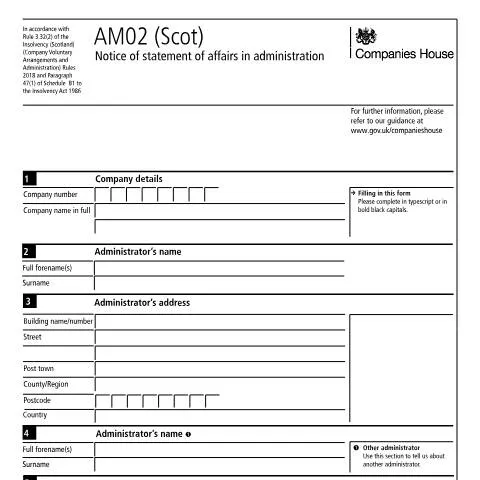
Understanding the structure of the AM02 form will streamline its utilization and ensure that all necessary information is captured accurately. Below is a breakdown of the key sections included in the form:- Company Details: In this section, provide the full name of the company and its unique company number, ensuring consistency with the public register.
- Administrator’s Information: Details regarding the appointed administrator(s) must be filled in, including their full names, addresses, and any other administrators involved in the process.
- Date of the Statement: This is critical as the date establishes the context of the financial standing being reported.
- Attachments: Mention any accompanying documents such as the Statement of Affairs and Statement of Concurrence where applicable.
- Signature: The administrator(s) must sign and date the AM02 form to validate the information provided.
Common Misinterpretations of the AM02 Notice
Navigating the complexities of insolvency paperwork can often lead to misunderstandings. Here are some prevalent misinterpretations concerning the AM02:Assuming All Information is Private
One critical error is the assumption that the AM02 form is confidential. All submitted information becomes part of the public record, meaning creditors and other interested parties can access it.Overlooking the Significance of Accurate Data
Another common pitfall is the neglect of accuracy in the data entered. Any discrepancies between the information on the AM02 and what is held on the public record can lead to delays or rejection of the document.Neglecting Required Attachments
Completing the AM02 without the required attachments, like the Statement of Affairs, can render the submission invalid. Always cross-reference the checklist provided on the form to avoid such oversights.Step-by-Step: Utilizing the AM02 Form Effectively
Implementing the AM02 form into your administrative process requires careful execution. Here’s a practical guide to ensure a seamless approach:1. Preparation of the Statement of Affairs
Before filling out the AM02, ensure that your Statement of Affairs is prepared. This document should encompass all assets, liabilities, and an evaluation of the company’s financial standing.2. Complete the AM02 Form
Use clear typescript or bold black capitals to complete the form. Pay particular attention to:- Company details matching the public register.
- Correct spelling of the administrator's names and addresses.
3. Attach Required Documents
Ensure all necessary documents are attached, including the complete Statement of Affairs and any other documentation relevant to the administration process.4. Signature and Date Verification
The final step involves signing and dating the form. This action marks the formal acknowledgment and validation of the submitted information by the administrator.5. Submission to Companies House
The AM02 can be submitted to any Companies House address, but for prompt processing, utilize the recommended address: The Registrar of Companies, Companies House, Fourth floor, Edinburgh Quay 2, 139 Fountainbridge, Edinburgh, Scotland, EH3 9FF.Interlinking with Other Insolvency Documents
The AM02 does not function in isolation. It is part of a broader framework of insolvency documentation. Understanding how it interrelates with other forms is vital for successful administration.Key Related Documents
Here’s a comparison of the AM02 with other key documents in the insolvency process:| Document | Purpose | Relation to AM02 |
|---|---|---|
| Statement of Affairs | Provides a detailed overview of the company's financial state. | Attached to the AM02 as a supporting document. |
| Statement of Concurrence | Confirms that creditors agree with the administrator's proposal. | May be referenced in the AM02 if applicable. |
| Administrator's Report | Sums up the progress of the administration process. | While not directly linked, it provides context for the AM02. |
Administrative Considerations and Best Practices
In navigating the submission of the AM02, it's essential to adhere to best practices to ensure compliance and avoid unnecessary complications.Maintaining Comprehensive Records
Keep meticulous records of all documents submitted to Companies House, including timestamps of when you sent the AM02. This practice is crucial for tracking submissions and managing any potential discrepancies.Communicating with Stakeholders
Transparency is key. Always keep creditors informed regarding the administration process, particularly if the situation changes. Maintaining open lines of communication helps build trust and may facilitate smoother negotiations.Seeking Professional Advice
In many cases, the intricacies surrounding insolvency procedures can be overwhelming. Engaging the services of a solicitor or an insolvency practitioner can provide valuable insights and ensure compliance with all legal obligations.Navigating Challenges: A Proactive Approach
In the realm of company administration, challenges are often unavoidable. Here are strategies to proactively address them:Addressing Delays
If you encounter delays in processing the AM02, follow up with Companies House to ascertain the reason. Being proactive can help minimize the impact of such delays on the administration process.Responding to Queries
Should Companies House reach out with questions about your submission, respond promptly. Clear and timely communication can prevent further complications.Adjusting to Changes in Regulations
Stay informed about changes in insolvency laws and regulations that could impact how you manage the administration process. Regularly check the Companies House website for updates and guidance.Final Thoughts on the AM02 in the Context of Company Administration
The Notice of Statement of Affairs in Administration, AM02 (Scot), is more than just a form; it’s a tool that facilitates the structured handling of a company’s financial distress. By understanding its components, common pitfalls, and interrelations with other forms, administrators can navigate the complexities of the insolvency process with greater confidence. In the realm of corporate governance, knowledge is power, particularly when navigating challenging financial waters. The AM02 document is a critical artefact in this journey, guiding companies and administrators through the essential steps of disclosure and compliance during administration.Understanding the Statement of Affairs in Administration
The Statement of Affairs is a critical document that outlines the financial position of a company undergoing administration in Scotland. This document must provide a detailed view of the company's assets, liabilities, and overall financial situation. It serves as a vital tool for administrators, creditors, and stakeholders to assess the viability of the company during the administration process.
When preparing the Statement of Affairs, it is essential to ensure accuracy and clarity. The administrator must include all assets, which can range from tangible assets like property and equipment to intangible assets like patents or trademarks. Liabilities must encompass all financial obligations, including secured debts, unsecured debts, and any contingent liabilities. Proper categorization is crucial as it directly impacts the recovery prospects for creditors.
Furthermore, the document should also include the estimated realizable value of each asset and a valuation of the liabilities. This aspect is where administrators often need to exercise their professional judgment. Engaging a qualified valuer can provide a more accurate assessment of asset values, particularly for complex or unusual items. The administrators must ensure that all disclosures are compliant with the requirements set out in the Statement of Affairs template, adhering to the standards outlined by the Insolvency Service.
Filing and Distribution of the Statement of Affairs
Once the Statement of Affairs has been completed, it is imperative to file it with the appropriate bodies to comply with legal requirements. In Scotland, this typically involves submitting the document to the Accountant in Bankruptcy (AiB). The AiB is responsible for overseeing the administration process and ensuring compliance with relevant laws and regulations.
The filing must occur within a specified timeframe following the appointment of the administrator, often within 7 days. Late submissions can lead to complications, including potential fines or further scrutiny from creditors. Therefore, timely filing is of utmost importance.
Moreover, the administrator is also responsible for distributing copies of the Statement of Affairs to all relevant stakeholders, including creditors and the company's directors. This distribution helps maintain transparency throughout the administration process and ensures that all parties are informed of the company's financial position.
It is also worth noting that while the Statement of Affairs is primarily a financial document, it should also contain narrative sections that explain the circumstances leading to the administration. This background information can be critical for creditors, as it may provide insight into possible recovery strategies or the prospects of the business being rescued or returned to solvency.
Common Challenges in Preparing the AM02 (Scot) Form
Completing the AM02 (Scot) form is not without its challenges. Administrators often encounter issues related to incomplete or inaccurate financial information. Companies facing administration may have disorganized financial records, making it difficult to compile a comprehensive Statement of Affairs. In such cases, administrators may need to invest additional time and resources in forensic accounting to uncover the necessary information.
Another challenge is valuing assets accurately in the current market conditions. Market fluctuations can significantly impact the realizable value of assets, necessitating a careful assessment of timing and market trends. For example, if a company owns real estate, changes in the property market can affect how much the asset can be sold for, hence impacting the overall recovery plan for creditors.
Additionally, understanding the legal implications of the Statement of Affairs is crucial. The administrators must be aware of their duties and responsibilities under the Insolvency Act 1986 and other relevant legislation. Missteps in this area can lead to penalties or personal liability for the administrator, particularly if they fail to disclose critical information or misrepresent the company's financial position.
To mitigate these challenges, administrators may consider seeking professional legal and financial advice, especially for complex cases or when dealing with numerous creditors. Collaborating with experienced professionals can provide valuable insights and ensure compliance with all legal requirements.