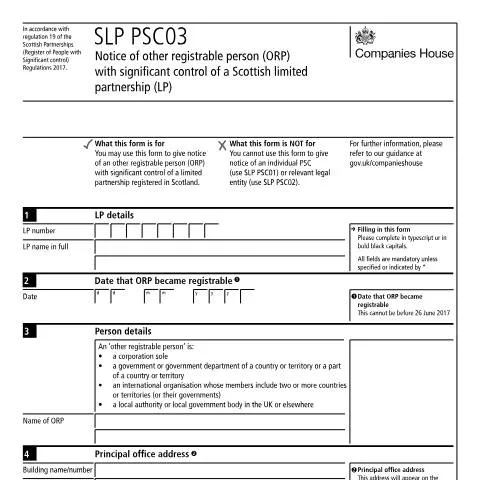
Navigating the SLP PSC03: A Comprehensive Guide to Reporting Significant Control in Scottish Limited Partnerships
The landscape of business governance in the UK has evolved significantly, especially with the introduction of regulations aimed at enhancing transparency. Among these developments is the requirement for Scottish limited partnerships (SLPs) to notify Companies House of any persons or entities that hold significant control. The SLP PSC03 form serves as the official document for reporting these 'other registrable persons' (ORPs) with significant control. This guide aims to demystify the SLP PSC03, detailing its practical application and significance in maintaining compliance.
Understanding the Role of the SLP PSC03
The SLP PSC03 form is crucial for disclosing the identities of ORPs in a Scottish limited partnership that exert significant influence or control. But what exactly does 'significant control' entail?
Defining Significant Control
In the context of SLPs, significant control may manifest in several ways:
- Ownership of a certain percentage of surplus assets upon winding up the partnership.
- Control over voting rights within the partnership.
- The authority to appoint or remove a majority of the management team.
- Exercising significant influence over the partnership's operations.
Entities eligible to be ORPs include corporations, government bodies, international organizations, and local authorities. Understanding who qualifies is essential for accurate reporting.
Who Needs to File the SLP PSC03?
The obligation to complete the SLP PSC03 does not fall on every individual or entity. This form is specifically designed for cases where significant control resides with an entity rather than an individual. Situations that typically necessitate the use of the SLP PSC03 include:
- When a corporation holds a substantial stake in the SLP.
- Government departments exercising control over the partnership.
- Local authorities involved in the management or decision-making processes of the SLP.
Key Components of the SLP PSC03
Understanding the specific sections of the SLP PSC03 is vital for ensuring compliance. Let’s break down the main components of the form:
Section Overview
| Section | Description |
|---|---|
| Name of ORP | Enter the full name of the other registrable person. |
| Date that ORP Became Registrable | The date must not precede 26 June 2017. |
| Principal Office Address | This will appear publicly, so accuracy is crucial. |
| Nature of Control | Indicate how the ORP exerts significant control over the SLP. |
| Signature | Must be signed by a general partner on behalf of the SLP. |
This structured approach ensures that all necessary information is captured, allowing Companies House to maintain an accurate public register of individuals and entities with significant control.
Common Misinterpretations and Pitfalls
When navigating the filing process, misunderstandings can lead to non-compliance or inaccuracies. Here are some common issues:
Misunderstanding 'Other Registrable Persons'
It's crucial to distinguish between individual persons of significant control and other registrable persons. For individuals, the SLP PSC01 form should be used, while entities—like corporations or governmental bodies—should utilize the SLP PSC03. Filing the wrong form can lead to delays or rejections of your submission.
Incorrectly Reporting Control Levels
When indicating the level of control, it’s paramount to accurately assess whether the ORP holds:
- More than 25% but not exceeding 50%
- More than 50% but less than 75%
- 75% or more
Misreporting these figures could have legal consequences and impact your partnership’s standing.
Steps to Complete the SLP PSC03
Completing the SLP PSC03 can seem daunting, but a step-by-step approach can simplify the process.
Preparation of Information
Before initiating the form, gather the following:
- Name and address of the ORP
- Date the ORP became registrable
- Details concerning nature of control
Filling Out the Form
When completing the SLP PSC03, adhere to these guidelines:
- Use typescript or bold black capitals for clarity.
- Ensure all mandatory fields are completed.
- Review the details for accuracy before submission.
Post-Submission: What Comes Next?
Once you’ve successfully submitted the SLP PSC03, it’s important to stay on top of subsequent requirements:
Monitoring Changes
Any change in significant control must be reported promptly. Failure to do so can lead to penalties. This includes changes in ownership percentages or new individuals/entities gaining significant influence.
Accessing the Public Record
Remember that the principal office address and details of the ORP will be accessible on the public register. This transparency is crucial for maintaining trust among stakeholders.
Resources for Further Guidance
For more detailed instructions and support, Companies House provides a wealth of information online. Here are some essential resources:
- Companies House Guidance: Official manuals and guides for compliance.
- Email Support: Direct queries can be sent to [email protected].
- Official Website: Visit gov.uk/companieshouse for comprehensive resources and updates.
Importance of Compliance and Transparency in Business
Meeting the reporting requirements is not just a matter of legal compliance; it reflects the partnership's commitment to transparency and accountability. This fosters trust with stakeholders, from investors to clients, and enhances the overall reputation of the business in the market.
Engaging proactively with the SLP PSC03 filing process signals to all parties that the partnership is dedicated to good governance practices. As such, understanding and properly implementing the requirements of the SLP PSC03 is imperative for any Scottish limited partnership aiming to uphold regulatory standards and maintain stakeholder confidence.
Understanding Significant Control in Scottish Limited Partnerships
In the context of a Scottish Limited Partnership (SLP), significant control refers to the ability of individuals or entities to influence the decisions and operations of the partnership. This concept is particularly significant when it comes to regulatory compliance, as it impacts how partnerships are structured and reported. The need for transparency in ownership and control helps prevent illicit activities such as money laundering and tax evasion.
The Companies Act 2006 (as amended) provides the legal framework surrounding significant control in partnerships, which requires identifying persons with significant control (PSCs). For a partnership to be compliant, it must disclose individuals who hold more than 25% of the shares, voting rights, or have the right to appoint or remove a majority of the board of directors.
In instances where control is held via multiple layers of ownership, tracing back through entities can become complex. It’s essential to maintain accurate records of any changes in ownership or control, as updates must be communicated to Companies House in a timely manner to ensure compliance with the law. Missing this may result in penalties or other legal ramifications.
Filing Methods and Requirements for SLP PSC03
When it comes to filing the SLP PSC03 form, it is important to be aware of the methods available for submission and the specific details required. The form can typically be submitted online through the Companies House web filing system, or alternatively, it can be sent by post. Before choosing a filing method, consider the following:
- Online Filing: This is the fastest and most efficient way to submit the SLP PSC03 form. It allows for immediate confirmation of receipt and can expedite the processing time.
- Postal Submission: If you choose to submit your form via post, ensure you send it to the correct address and allow sufficient time for delivery and processing. It’s advisable to send your document via recorded delivery to have proof of posting.
Regardless of the submission method, the information required on the SLP PSC03 form includes:
- The name and address of the registrable person, detailing their capacity as a PSC.
- Details of how the registrable person meets the criteria for significant control.
- The date the person became registrable.
It is crucial to double-check all entries for accuracy before submission, as errors may result in the need for resubmission or lead to potential legal issues. Additionally, once the form is submitted, updates to ownership or control must be reported within 14 days, ensuring that the register remains current and accurate.
Exemptions and Special Cases for PSC Reporting
While the requirement to report persons with significant control is standard, there are certain exemptions and special cases that may apply. It is crucial to understand these exceptions to comply correctly with the law and avoid unnecessary reporting.
Some notable exemptions include:
- Registered Charities: If a Scottish Limited Partnership is established as a charity, it may be exempt from the PSC reporting requirements, provided it meets specific criteria set by the Charities Act.
- Non-Profit Organisations: Similar to charities, non-profit organizations that are not intended for profit might have different reporting obligations based on their structure and funding sources.
- Public Authorities: Partnerships that are primarily formed to carry out public functions may not need to report individual PSCs if they fall under government oversight.
In some instances, determining whether an individual qualifies as a PSC can be intricate, especially in cases involving trusts or complex corporate structures. If the ownership is held through a trust, the trustees may need to be reported as registrable persons if they have significant control. It’s advisable to consult legal guidance in such cases to comply accurately with the requirements.
Finally, it’s important to stay updated on any changes in legislation or guidance from Companies House regarding the definition of PSCs and the obligations of Scottish Limited Partnerships. The landscape of regulatory compliance can shift, and being informed helps ensure that your partnership remains in good standing.