When Corporate Giants and Government Bodies Enter the PSC Landscape
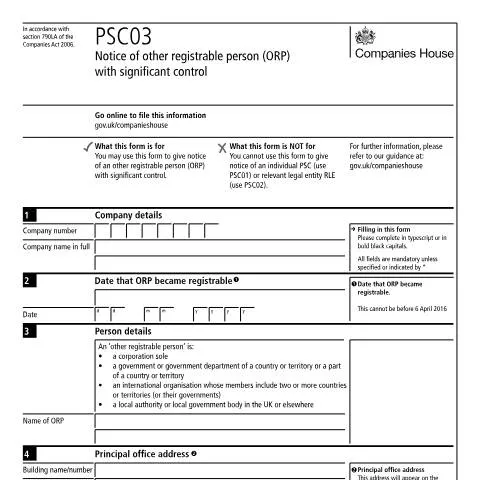
The world of persons with significant control extends far beyond individual shareholders and standard corporate entities. When a corporation sole, government department, or international organisation holds substantial influence over a UK company, the PSC03 notice becomes the designated pathway for transparency. This specialised form addresses a distinct category of registrable persons that traditional PSC documentation cannot accommodate, bridging the gap between corporate governance requirements and the unique nature of institutional control structures.
The other registrable person designation encompasses entities that wield significant control but fall outside conventional business structures. These range from corporation soles – legal entities consisting of a single person in an official capacity – to government departments exercising control through various mechanisms, and international organisations whose member states collectively influence UK corporate activities.
Decoding the Other Registrable Person Framework
Understanding what constitutes an other registrable person requires grasping the statutory definitions embedded within the Companies Act 2006. The PSC03 notice specifically targets four distinct categories of entities, each presenting unique characteristics in terms of legal structure and operational framework.
Corporation Sole: The Individual-Entity Hybrid
A corporation sole represents one of the most distinctive legal constructs in UK law, where a single person constitutes an entire legal entity by virtue of holding a particular office. Common examples include bishops in their diocesan capacity, the Crown in various governmental functions, and certain regulatory officials. When such entities exercise significant control over companies, their unique status necessitates the PSC03 pathway rather than individual PSC registration.
Governmental Control Mechanisms
Government departments and territorial administrations frequently hold substantial stakes in companies through various mechanisms. The PSC03 notice captures these arrangements, whether involving direct shareholdings, voting rights concentration, or appointment powers exercised by government departments of countries or territories. This encompasses not only UK governmental bodies but also foreign governmental entities operating within British corporate structures.
International Organisations and Multilateral Bodies
International organisations whose membership includes multiple countries or territories represent another crucial category. These entities, ranging from supranational institutions to multilateral development banks, often hold significant influence in UK companies through investment vehicles or partnership arrangements. The PSC03 notice ensures their control relationships receive appropriate disclosure and registration.
Local Authority Participation
Local authorities and local government bodies, whether UK-based or international, constitute the final category of other registrable persons. These entities frequently engage in commercial activities through subsidiary companies or joint ventures, requiring transparency about their controlling interests through the PSC03 mechanism.
Navigating the Complex Control Thresholds
The PSC03 notice employs sophisticated control measurement criteria that extend beyond simple shareholding percentages. Understanding these thresholds proves essential for accurate disclosure and compliance with statutory requirements.
| Control Type | Threshold Categories | Direct/Indirect Application |
|---|---|---|
| Share ownership | 25-50%, 50-75%, 75%+ | Both direct and indirect holdings counted |
| Voting rights | 25-50%, 50-75%, 75%+ | Includes proxy arrangements and trust holdings |
| Director appointment rights | Majority board control | Covers removal and appointment powers |
| Significant influence | Qualitative assessment | Applied when other thresholds don't capture control |
Indirect Control Through Intermediary Structures
The PSC03 notice recognises that other registrable persons often exercise control through intermediary structures rather than direct relationships. Two specific scenarios receive detailed attention: control exercised through firms and control exercised through trusts.
When an other registrable person has significant influence over a firm that isn't a legal person under its governing law, the notice captures how that firm's members subsequently influence the target company. This creates a chain of control relationships requiring careful documentation across multiple organisational layers.
Similarly, when other registrable persons exercise control over trusts whose trustees hold significant influence in companies, the PSC03 notice maps these complex relationships. The form distinguishes between the other registrable person's influence over the trust and the trustees' subsequent control over the company, ensuring comprehensive disclosure of the entire control chain.
Practical Implementation Across Varied Scenarios
The PSC03 notice serves diverse situations where institutional control relationships require formal recognition. Understanding these practical applications helps companies identify when this specific form becomes necessary rather than alternative PSC documentation.
Crown Estate and Royal Holdings
When Crown Estate or other royal holdings exercise significant control over companies, the corporation sole structure typically applies. The PSC03 notice captures these relationships while respecting the unique constitutional position of royal entities within UK corporate governance frameworks.
Foreign Government Investment Vehicles
International scenarios frequently arise where foreign government departments or sovereign wealth funds hold substantial interests in UK companies. The PSC03 notice provides the mechanism for disclosing these relationships while maintaining appropriate diplomatic and regulatory protocols.
Supranational Institution Participation
European institutions, despite Brexit, may retain legacy holdings or develop new investment relationships requiring PSC03 disclosure. Similarly, other international organisations such as development banks or multilateral investment funds utilise this pathway for transparency compliance.
Timing Requirements and Confirmation Protocols
The PSC03 notice incorporates specific timing requirements that reflect the unique challenges of obtaining confirmation from institutional entities. Unlike individual PSCs, other registrable persons may require extended periods for internal approval processes and formal confirmation of their status and particulars.
The confirmation date represents a critical element, requiring companies to document when they received verification of both the other registrable person's PSC status and all required particulars. When these confirmations arrive on different dates, companies must record the later date, ensuring comprehensive verification before submission.
The April 2016 Baseline
The form establishes 6 April 2016 as the earliest possible date for other registrable person status, aligning with the broader PSC regime implementation. This baseline prevents retrospective applications while ensuring historical control relationships receive appropriate recognition from the regime's commencement.
Authentication and Corporate Responsibility
The PSC03 notice requires authentication by authorised corporate officers, extending beyond traditional director signatures to accommodate various corporate structures and circumstances. The authentication framework recognises that companies may operate under diverse governance arrangements, particularly when other registrable persons themselves exercise control.
Authorised signatories include directors, company secretaries, persons authorised under sections 270 or 274 of the Companies Act 2006, and various insolvency practitioners. For Societas Europaea structures, specific adaptations acknowledge the different organ systems operating within European company frameworks.
Verification Responsibilities
Companies bear responsibility for obtaining confirmation from other registrable persons before submitting PSC03 notices. This requirement ensures accuracy while recognising the practical challenges of engaging with institutional entities that may have complex internal approval processes or diplomatic considerations affecting their disclosure capabilities.
Integration with Broader PSC Compliance Strategies
The PSC03 notice operates within a comprehensive regulatory framework requiring companies to maintain current and accurate records of all persons with significant control. Understanding how this form integrates with other PSC documentation helps companies develop effective compliance strategies.
Complementary Documentation Requirements
Companies must distinguish between individual PSCs requiring PSC01 notices, relevant legal entities needing PSC02 documentation, and other registrable persons utilising PSC03 forms. This categorisation ensures appropriate disclosure pathways while preventing confusion about which entities require which documentation approaches.
The principal office address requirement for other registrable persons creates public record entries that enable stakeholder verification and regulatory oversight. Unlike individual PSCs, these addresses typically reflect institutional headquarters or official governmental locations rather than private residential addresses.
Ongoing Compliance Monitoring
Other registrable persons may experience changes in their control relationships, legal status, or institutional arrangements that require updated PSC03 notices. Companies must monitor these relationships continuously, recognising that institutional changes often involve complex approval processes and extended timelines for implementation.
The governing law specification becomes particularly important for international other registrable persons, where changes in legal framework or jurisdictional arrangements may affect their status and control relationships. Companies must track these developments and update their PSC records accordingly to maintain compliance with UK transparency requirements.
Navigating Complex Ownership Structures and Indirect Control
The PSC03 form becomes particularly nuanced when dealing with complex corporate structures where control isn't immediately apparent. Indirect control through multiple layers of ownership often triggers PSC obligations that companies initially overlook. For instance, if Company A owns 60% of Company B, which in turn owns 30% of your company, Company A may qualify as a registrable person despite holding no direct shares in your entity.
When assessing voting rights across multiple share classes, you must aggregate all forms of influence. This includes ordinary shares, preference shares with voting rights, and any special voting arrangements documented in your articles of association. The 25% threshold applies to the total voting power, not individual share classes. Companies with complex capital structures often discover PSC obligations only after professional review reveals the cumulative effect of various shareholdings.
Trust arrangements add another layer of complexity requiring careful PSC03 consideration. Where individuals control your company through discretionary trusts, both the trustees and potential beneficiaries may qualify as registrable persons. Settlors of trusts frequently meet the "significant influence or control" test, particularly where they retain powers to direct trust activities or benefit distributions. The form requires you to identify the nature of control exercised through trust structures, specifying whether influence stems from trustee powers, beneficiary rights, or settlor reserved powers.
Partnership interests create additional PSC implications often overlooked in initial assessments. Where partnerships hold significant stakes in your company, you must look through to the individual partners' interests. Limited liability partnerships (LLPs) require similar analysis, with designated members potentially qualifying as registrable persons if their combined partnership interest exceeds relevant thresholds.
Companies House expects reasonable enquiries to identify indirect control relationships. This means requesting information from shareholders about their own ownership structures and any arrangements affecting their shares. Documentary evidence supporting your PSC determinations should include shareholder declarations, trust deeds, partnership agreements, and any voting or share transfer restrictions that might affect control calculations.
Managing PSC Changes and Ongoing Compliance Obligations
The PSC03 form represents just one element of ongoing PSC compliance that extends well beyond initial notifications. Subsequent changes to registrable persons trigger additional filing requirements that many companies handle inconsistently. When a PSC's circumstances change—such as increased shareholding, additional voting rights, or enhanced influence over company decisions—you must file updated information within 14 days of becoming aware of the change.
Companies often struggle with the "becoming aware" timing requirement. This doesn't necessarily coincide with formal notification from the PSC themselves. If board meetings, shareholder resolutions, or other company activities reveal PSC changes, your 14-day obligation begins from that awareness date, not from any subsequent PSC confirmation. Maintaining contemporaneous records of when you learned about PSC changes becomes crucial for compliance demonstration.
Ceased PSC notifications require equal attention to new registrations. When someone stops qualifying as a registrable person—through share disposals, reduced voting rights, or diminished influence—you must promptly update the PSC register and file appropriate notifications with Companies House. The timing of cessation often proves contentious, particularly where control changes result from complex transactions or gradual share transfers over time.
Regular PSC register reviews help identify compliance gaps before they become enforcement issues. Annual confirmation statements provide natural checkpoints for PSC accuracy, but waiting until year-end reviews risks missing interim changes requiring separate notifications. Many companies implement quarterly PSC reviews, particularly where ownership structures change frequently or where shareholders actively trade their interests.
Companies House's digital PSC register automatically updates public records when you file PSC03 forms and subsequent changes. However, discrepancies between your internal PSC register and Companies House records can arise through filing errors, system delays, or incomplete submissions. Regular reconciliation between your maintained PSC register and the public record helps identify and correct such discrepancies promptly.
Cross-border PSC considerations add complexity where registrable persons reside outside the UK or where control structures involve overseas entities. While the PSC regime applies regardless of residence, gathering required information from international PSCs may prove more challenging. Some overseas individuals lack familiar UK identifiers like National Insurance numbers, requiring alternative identification methods acceptable to Companies House.
Common PSC03 Errors and Enforcement Consequences
Filing PSC03 forms incorrectly generates significant compliance risks that extend beyond simple administrative inconvenience. Incomplete or inaccurate PSC information can result in civil penalties, enforcement action, and potential director disqualification proceedings. Companies House maintains increasingly sophisticated monitoring systems that flag inconsistent PSC filings, missing notifications, and patterns suggesting non-compliance.
The most frequent PSC03 errors involve incorrect nature of control selections. The form requires precise identification of how each PSC exercises control—through shareholding, voting rights, appointment powers, or significant influence. Selecting inappropriate control categories or failing to identify multiple control types for the same PSC creates regulatory discrepancies that may trigger enquiries. For example, someone holding 30% of shares and holding director appointment rights exercises control through both shareholding and board influence, requiring multiple selections on the form.
Date-related errors prove particularly problematic in PSC03 submissions. The "became registrable" date must reflect when the person first met PSC criteria, not when you discovered their status or when they provided required information. Backdating this field inappropriately or using incorrect effective dates can suggest deliberate non-compliance, even where the error stems from genuine confusion about timing requirements.
Many companies incorrectly handle PSC address requirements, particularly the distinction between service addresses and residential addresses. The PSC03 form requires residential addresses for individual PSCs, with service addresses being optional alternatives for correspondence. Using business addresses as residential addresses, or failing to distinguish between the two, creates compliance gaps that regulators notice during reviews.
Companies House's enforcement approach has evolved significantly, with increased focus on PSC compliance across all company sizes. Civil penalties for PSC failures can reach £5,000 per default, with separate penalties applying to companies and individual officers. More seriously, persistent PSC non-compliance contributes to patterns of regulatory failure that support director disqualification proceedings under the Company Directors Disqualification Act 1986.
Professional advice timing significantly impacts PSC compliance outcomes. Seeking guidance only after Companies House enquiries begin limits available options and may suggest reactive rather than proactive compliance approaches. Early professional involvement helps identify PSC obligations before they become overdue, structure complex ownership arrangements to clarify PSC status, and maintain ongoing compliance systems that prevent enforcement issues.
The regulatory landscape surrounding PSC requirements continues evolving, with periodic updates to guidance, form requirements, and enforcement priorities. Recent developments include enhanced verification requirements for certain PSC categories and increased scrutiny of complex trust arrangements. Companies maintaining current awareness of PSC regulatory changes through official Companies House guidance and professional updates position themselves better for sustained compliance success.