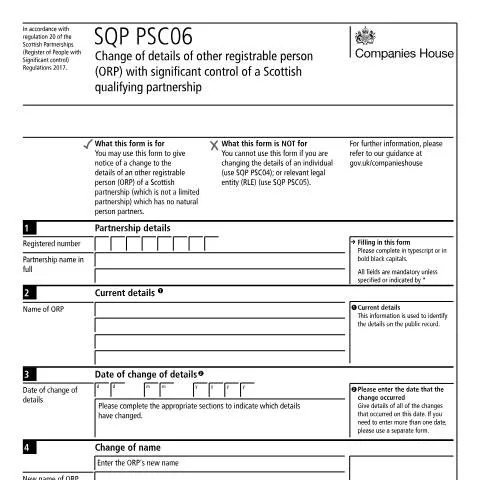
Understanding the SQP PSC06: Changing Significant Control Details in Scottish Partnerships
When it comes to managing a Scottish Qualifying Partnership (SQP), accurately maintaining records of individuals or entities that hold significant control is crucial. The SQP PSC06 form serves as a vital tool for notifying Companies House of any changes regarding other registrable persons (ORPs) that have significant control over a Scottish partnership. This article delves into the specifics of the SQP PSC06, clarifying its purpose, process, and related considerations.
Defining Key Terms: What is an Other Registrable Person?
Before diving into the specifics of the SQP PSC06 form, it’s essential to clarify what constitutes an Other Registrable Person (ORP). This term refers to legal entities that hold significant control over Scottish partnerships that are not limited partnerships and do not have natural person partners.
- Significant Control: This can take various forms, including holding a substantial share of assets, voting rights, or the ability to appoint or remove management.
- Scottish Qualifying Partnership: A type of partnership that qualifies under specific criteria set by the Companies Act applicable in Scotland.
Understanding these definitions is fundamental for anyone involved in the administration of an SQP, as it sets the stage for accurately reporting changes in control and ensuring compliance with legal obligations.
Scope and Limitations of the SQP PSC06 Form
The SQP PSC06 form has a clearly defined scope, which is essential for ensuring that it is used appropriately. This form is specifically designed for notifying changes regarding ORPs with significant control in an SQP.
What the SQP PSC06 Covers
When you use the SQP PSC06, you are allowed to report several types of changes, including:
- Change of Name: If an ORP changes its name, this must be reported.
- Change of Address: Any alteration in the principal office address of the ORP should be updated.
- Change of Control Details: This includes any changes in the nature of control, such as adjustments in voting rights or the ability to appoint management.
What the SQP PSC06 Does NOT Cover
Importantly, this form cannot be used for changes involving individual partners or for reporting relevant legal entities (RLEs). If the change concerns an individual partner, one must use the SQP PSC04 form. For relevant legal entities, the SQP PSC05 form is the appropriate choice.
Step-by-Step Process for Using the SQP PSC06 Form
To effectively navigate the process of updating details using the SQP PSC06 form, follow these steps:
1. Collect Necessary Information
Before filling out the form, ensure you have all required details:
- The name of the partnership and its registered number
- Details regarding the ORP that is changing
- The specific changes being made, including dates
2. Complete the Form Accurately
When filling out the SQP PSC06, it’s crucial to:
- Use typescript or bold black capitals for clarity.
- Complete all mandatory fields, ensuring that no relevant information is omitted.
3. Indicate Changes Clearly
Clearly specify the nature of the changes:
- For a name change, write the new name in the designated section.
- If changing control details, select the appropriate descriptions of the new nature of control.
4. Review and Sign
Once the form is filled out, review it to ensure all information is accurate and complete. The form must be signed by an authorized partner on behalf of the partnership.
5. Submit the Form
After completing and signing the form, it can be submitted to Companies House. Keep in mind specific submission requirements, including deadlines to remain compliant.
Common Hurdles and Misunderstandings
While filling out the SQP PSC06 form might seem straightforward, certain misunderstandings can lead to complications. Here are some common pitfalls:
Misinterpreting Significant Control
One common issue arises from a lack of clarity about what constitutes significant control. It is vital to correctly interpret the definitions provided in the form:
- Holding more than 25% of voting rights or assets qualifies as significant control.
- Ensure that any changes in these percentages are reported accurately.
Failure to Use the Correct Form
Submitting the wrong form can lead to delays and complications. Always verify which form is appropriate for your situation:
- Use SQP PSC04 for individual changes.
- Utilize SQP PSC05 for changes regarding RLEs.
Interconnections with Other Related Documents
In the realm of Scottish partnerships, understanding how the SQP PSC06 form interacts with other documents is crucial for effective administration. Here are some critical points of connection:
The Role of Other Forms
Alongside the SQP PSC06, other forms play key roles, particularly when changes involve individuals or legal entities:
- SQP PSC04: For notifying changes regarding individual partners.
- SQP PSC05: For changes related to other relevant legal entities.
Data Protection Considerations
All details provided must be compliant with the Data Protection Act 2018 and UK GDPR guidelines. This compliance ensures that personal data is processed and stored securely, protecting the rights of all individuals involved.
| Form | Use Case | Significant Control Definition |
|---|---|---|
| SQP PSC06 | Changes for Other Registrable Persons | Legal entity with significant control |
| SQP PSC04 | Changes for Individual Partners | Individual with significant control |
| SQP PSC05 | Changes for Relevant Legal Entities | Entity with significant control |
Best Practices for Maintaining Compliance
To ensure ongoing compliance and avoid potential pitfalls, consider the following best practices:
- Regularly Review Control Structures: Partnerships should frequently assess their control structures to ensure all details are accurate and up to date.
- Educate All Partners: Ensure that all partners understand the implications of significant control and the importance of reporting changes.
- Utilize Professional Guidance: Seek advice from legal or accounting professionals experienced in partnership law to navigate complexities.
By adhering to these practices, partnerships can foster an environment of transparency and compliance, minimizing risks associated with misreporting.
Final Thoughts: Navigating Changes in Partnership Control
Utilizing the SQP PSC06 effectively is key to maintaining accurate records of significant control within a Scottish Qualifying Partnership. Understanding the scope of the form, the procedure for reporting changes, and the interconnections with other documents can streamline the process. By being proactive and well-informed, partnerships can navigate changes with confidence, ensuring compliance with regulatory requirements while fostering a transparent operational environment. Remember, keeping your records current not only meets legal obligations but also supports the integrity of your partnership.
Understanding the Role of a Person with Significant Control (PSC) in a Scottish Qualifying Partnership
In the context of a Scottish Qualifying Partnership (SQP), the concept of a Person with Significant Control (PSC) is crucial. A PSC is generally defined as an individual or entity that holds significant influence or control over the partnership. This might include having more than 25% of the shares or voting rights, the right to appoint or remove a majority of the board of directors, or significant influence over the partnership’s operating and financial policies.
In Scotland, the PSC regime was introduced to promote transparency in company ownership and control. This means that every SQP must keep a register of its PSCs, detailing the identity of each individual or entity that holds significant control. This not only fosters good governance but also enhances public confidence in the business environment. It is the responsibility of the partnership to maintain and update this register regularly, particularly as changes occur.
Failure to comply with PSC regulations can lead to penalties including fines and legal action. Therefore, understanding who qualifies as a PSC, the legal obligations tied to this role, and the process of updating one's details when changes occur is essential for every SQP's compliance framework.
Step-by-Step Process for Notifying Changes in PSC Details
When a Scottish Qualifying Partnership needs to inform Companies House of changes in the details of a Person with Significant Control (using form PSC06), it's imperative to follow a structured approach to ensure that all necessary information is accurately provided. Here’s a detailed step-by-step guide:
Identify the Change: Determine the specific details that need to be updated. This could range from a change of address, change of name, or alterations in the level of control held by the PSC.
Gather Required Information: Prepare the necessary information to complete form PSC06. This typically includes:
- The current name of the PSC
- Their previous address (if applicable)
- The new address (if applicable)
- Details of the change in control (if applicable)
- The date of the change
Complete Form PSC06: Accurately fill out the PSC06 form. Each section must be carefully completed to avoid any delays or errors. Pay special attention to the clarity of the information provided, ensuring it aligns with the partnership’s records.
Submit Form: Once the form is completed, it should be submitted to Companies House. This can be done online or via post. Ensure you keep a copy of the submitted form for your records.
Update the Register of PSCs: Following the submission, it is essential to update the partnership's internal register of PSCs. This ensures that the internal records reflect the current situation and comply with legal requirements.
Monitor for Future Changes: After notifying Companies House, keep an eye on any future changes that might affect your PSCs. Regular audits of your register can help in maintaining compliance.
By methodically following these steps, you ensure timely and efficient updates to your partnership's PSC details, reducing the risk of penalties or compliance issues.
Consequences of Non-Compliance and Best Practices for SQPs
Failing to notify changes in PSC details can have serious implications for a Scottish Qualifying Partnership. Not only does it expose the partnership to regulatory scrutiny, but it can also lead to significant financial penalties and reputational damage. Below are some potential consequences:
Financial Penalties: Companies House has the authority to impose fines on partnerships that fail to keep their PSC details up to date. These penalties can accumulate if the oversight persists over an extended period.
Legal Action: In severe cases of non-compliance, legal action can be initiated against the partnership or its responsible officers. This can result in further legal costs and complications.
Reputation Damage: Non-compliance with PSC regulations can damage the credibility of the partnership within the business community and among potential clients or customers. Transparency is often a key consideration for stakeholders.
To mitigate these risks, Scottish Qualifying Partnerships should adopt the following best practices:
Regular Training: Ensure that all partners and key stakeholders are educated about PSC regulations and the importance of maintaining accurate records.
Implement Regular Audits: Conduct periodic audits of your PSC register to identify any discrepancies or outdated information that requires updating.
Designate Responsibility: Appoint a specific individual within the partnership to oversee compliance with PSC regulations. This helps to ensure accountability and streamline the process of notifying changes.
Stay Informed on Legislative Changes: Regulatory frameworks can evolve, so it’s crucial to stay abreast of any changes in legislation regarding PSCs. Subscribe to official updates or consult with legal professionals if necessary.
By adhering to these best practices, Scottish Qualifying Partnerships can ensure compliance, avoid penalties, and foster a culture of transparency and accountability within their operations.