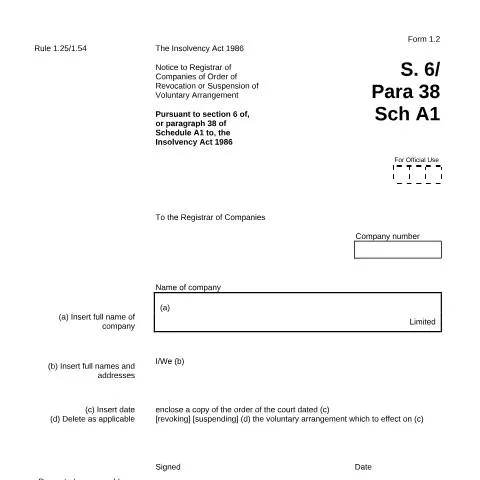
The Significance of Form 1.2 in Voluntary Arrangements
When a company faces financial distress, it may opt for a voluntary arrangement as a means to settle its debts with creditors. However, circumstances can change, leading to the need for a formal notice regarding the order, revocation, or suspension of this arrangement. The Give notice of order, revocation or suspension of voluntary arrangement (Form 1.2) plays a vital role in this process. This document not only serves as a communication tool between the company and the Registrar of Companies but also encapsulates important legal stipulations outlined in the Insolvency Act 1986.
Understanding the Context: Why Notice Matters
When navigating the complexities of corporate insolvency, understanding the implications of a voluntary arrangement is crucial. A voluntary arrangement allows companies to settle debts over an extended period, typically with the consent of creditors. However, should the arrangement require revocation or suspension, initiating this process correctly is essential. Form 1.2 documents this action formally and ensures compliance with legal requirements.
Key Situations Requiring Form 1.2
There are several scenarios where a company may find it necessary to file Form 1.2:
- Revocation of Voluntary Arrangement: This occurs when the court decides to terminate the arrangement before its completion.
- Suspension of Voluntary Arrangement: In certain cases, the arrangement may be temporarily halted, and this form notifies the Registrar accordingly.
- Updates in Company Status: If there are significant changes within the company that influence the voluntary arrangement, Form 1.2 ensures that the Registrar is informed.
Deciphering the Legal Framework
To effectively utilize Form 1.2, one must grasp the underlying legal framework. Under the provisions of the Insolvency Act 1986, sections related to voluntary arrangements delineate the procedural norms and conditions under which they operate. Specifically, section 6 and paragraph 38 of Schedule A1 provide the legal backbone for this notification process.
What Information Does Form 1.2 Require?
The submission of this form demands precise information to ensure clarity and compliance. The essential details include:
- Company Number: The unique identifier for the company registered with Companies House.
- Name of Company: The complete legal name of the entity seeking to revoke or suspend the voluntary arrangement.
- Order Copy: A certified copy of the court order dated appropriately must accompany Form 1.2.
- Signatures: The form must be signed by an authorized individual representing the company.
- Presenter’s Information: Name, address, and reference of the individual submitting the form for official recording.
A Step-by-Step Guide to Submitting Form 1.2
Filing Form 1.2 does not occur in isolation. It is part of a broader procedural context that involves several critical steps:
- Preparation: Gather all relevant documents, including the court order and any previous agreements pertaining to the voluntary arrangement.
- Completion: Fill out the form meticulously, ensuring all required fields are accurately populated.
- Verification: Double-check the documentation for any discrepancies or missing information.
- Submission: File the completed Form 1.2 with the Registrar of Companies, ensuring it is sent to the correct department.
Exploring the Consequences of Non-Compliance
Filing Form 1.2 is not simply a procedural formality; failure to comply with this notification can lead to severe consequences:
- Legal Repercussions: Companies that neglect to notify the Registrar may face legal action or penalties under the Insolvency Act.
- Impact on Creditors: Miscommunication regarding the status of a voluntary arrangement can lead to disputes with creditors, potentially jeopardizing future negotiations.
- Reputation Damage: Non-compliance can tarnish a company's reputation in the business community, affecting relationships with current and future stakeholders.
Interactions with Other Documents
Form 1.2 does not exist in a vacuum; it interacts with several other important documents and processes within the framework of insolvency:
- Creditors’ Voluntary Liquidation (CVL): In some cases, companies may transition from a voluntary arrangement to liquidation, in which case Form 1.2 must be considered along with liquidation documentation.
- Insolvency Practitioner Reports: If an insolvency practitioner is involved, their reports may supplement the information provided in Form 1.2.
- Company Resolutions: The board of directors may need to pass a resolution regarding the revocation or suspension, which should be documented appropriately.
Practical Examples of Form Utilization
Consider two hypothetical companies facing distinct challenges, illustrating the application of Form 1.2:
| Company Name | Scenario | Form 1.2 Role |
|---|---|---|
| Tech Innovations Ltd | Revocation due to a severe financial crisis | Notifies the Registrar of ongoing issues and court's decision to revoke the arrangement. |
| Green Solutions Ltd | Temporary suspension during a restructuring period | Informs the Registrar of the court's order to pause the arrangement while adjustments are made. |
Final Thoughts: The Importance of Adherence
In summary, understanding and correctly applying Form 1.2 is integral to navigating the complexities of voluntary arrangements. As companies face financial challenges, the need to comply with formalities is paramount, ensuring a smooth transition and safeguarding against potential pitfalls. Always consult legal and financial professionals to ensure that the process adheres to current regulations and reflects the company's best interests.
Understanding the Voluntary Arrangement Process
A Voluntary Arrangement (VA) is a formal agreement between an individual and their creditors to repay debts over a fixed period. It’s a key feature of bankruptcy alternatives in the UK, specifically designed for those who may be struggling financially yet wish to avoid the severe consequences of bankruptcy. Understanding the process of creating and maintaining a VA is critical for anyone considering this route.
To initiate a VA, you must appoint a licensed Insolvency Practitioner (IP). The IP will help draft a proposal outlining how much you can afford to repay and the timeline for doing so, typically between three to five years. Once the proposal is submitted, a meeting is called where creditors can approve or reject the proposed terms. A minimum of 75% of the creditors, by value of the debts, must agree for the arrangement to take effect.
Maintaining a VA requires strict adherence to the agreed repayment schedule. If you stray from the terms set forth, your creditors may petition for revocation of the arrangement. This underscores the importance of clear communication with your IP throughout the VA's duration, particularly in instances of unforeseen financial hardship.
Legal Implications of Revocation or Suspension
The revocation or suspension of a Voluntary Arrangement has significant legal implications for individuals. Under the Insolvency Act 1986, creditors may seek to terminate the arrangement if you fail to comply with its terms, such as missed repayments. Upon revocation, creditors have the right to pursue the full outstanding debt, which may result in bankruptcy proceedings against you.
Additionally, if a VA is suspended, it means that while there is a temporary halt to proceedings, it doesn't eliminate your obligations. Creditors could potentially still take legal action for recovery of debts during this period. It is vital to understand that any adverse decision made regarding a VA might affect your credit rating for up to six years, which can make securing future financing difficult.
If a debtor finds themselves in a situation where their VA is at risk of being revoked or suspended, it’s essential to consult legal advice swiftly. An experienced solicitor or insolvency practitioner can help navigate the complexities of insolvency law and possibly negotiate terms with creditors to salvage the arrangement.
Filing Form 1.2: Detailed Instructions
Form 1.2, known formally as the “Notice of Order, Revocation or Suspension of Voluntary Arrangement,” is a critical document in the administration of a VA. Properly filling out and filing this form is essential to ensure that all stakeholders are informed of the status of the arrangement. Here are some detailed instructions for completing and submitting Form 1.2:
1. Identify the Original Order: Clearly state the details of the original VA order including the date it was approved and the name of the Insolvency Practitioner involved.
2. Specify the Action: Indicate whether you're filing for an order, revocation, or suspension. This must be clearly defined as it sets the tone for all subsequent administrative actions.
3. Provide Justifications: If the filing involves revocation or suspension, you must provide comprehensive details outlining the reasons. Valid reasons might include ongoing defaults on payments, inability to maintain living expenses, or changes in financial circumstances.
4. Signature and Date: Ensure that the form is signed and dated by the Insolvency Practitioner. This not only confirms authenticity but is also a legal necessity for the form to be considered valid.
5. Submission: Submit the completed Form 1.2 to the relevant court and relevant creditors. Make sure to keep copies of all documents for your records. Verification of receipt can be obtained by ensuring that your solicitor retains proof of submission, especially if sent via post.
6. Additional Documentation: You may need to attach supporting documents that justify the need for revocation or suspension, which can include financial statements or correspondence with creditors.
The timely submission of Form 1.2 is crucial, especially considering the legal timeframes associated with insolvency proceedings. It’s advisable to consult with your IP before submission to ensure that the form is correctly filled and all necessary documentation is provided, thereby minimizing the risk of further complications.