Skip to content
Business

Understanding the CVA2 (Scot) Process for Companies

Official documentBusiness
PreviewDocument preview: Understanding the CVA2 (Scot) Process for Companies — Business
Official document

What would you like to do?

Complete the fields, sign, then download.

Understanding the Revocation or Suspension of a Voluntary Arrangement

When a Scottish company enters financial difficulties, a Company Voluntary Arrangement (CVA) may be put in place to allow the company to pay its debts over time. However, there may come a point where this arrangement needs to be revoked or suspended. The CVA2 (Scot) document is essential in navigating this process, serving as the official notice required to inform Companies House of such changes. This guide aims to dissect the contents of this notice, its implications, and the procedural steps involved.

The Relevance of the CVA2 (Scot) Notice

This notice becomes a critical document for various stakeholders involved, including company directors, insolvency practitioners, and creditors. The CVA2 (Scot) notice is necessary to comply with the Insolvency (Scotland) (Company Voluntary Arrangements and Administration) Rules 2018, specifically Rule 2.39(6), and is grounded in the authority of the Insolvency Act 1986. It must be understood that revocation or suspension can occur for various reasons:

  • Inadequate Compliance: If a company fails to adhere to the terms of the voluntary arrangement.
  • Creditors' Decisions: Creditors may elect to apply for revocation if they deem the arrangement unsatisfactory.
  • Legal Orders: A court may issue an order to suspend or revoke the CVA under specific circumstances.

Key Components of the CVA2 (Scot) Document

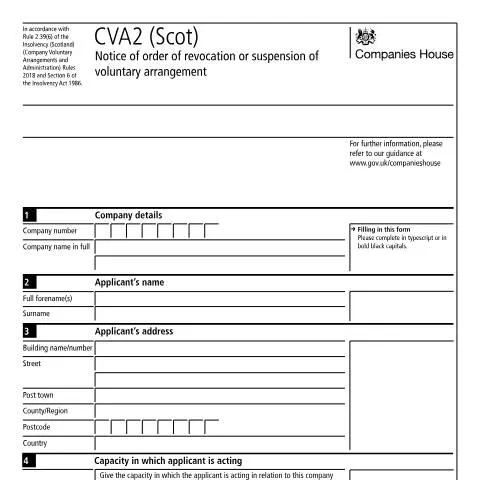
The CVA2 (Scot) document consists of several crucial elements that serve specific purposes:

  1. Company Information: Details such as the full company name and company number must be correctly filled out to match official records.
  2. Applicant's Details: The person submitting the notice must provide their full name and address. This information is vital for transparency.
  3. Revocation Order Details: Dates associated with the voluntary arrangement, as well as the court order, need to be specified.
  4. Signature Requirement: The notice must be signed by the nominee or the individual acting on behalf of the company to validate the submission.

Steps to Effectively Use the CVA2 (Scot) Notice

Utilizing the CVA2 (Scot) notice involves a few structured steps to ensure compliance with the legal requirements:

1. Gather Necessary Information

Before initiating the process, ensure you have all pertinent details at hand:

  • Full company name and number as recorded at Companies House.
  • Personal details of the applicant, including full name and address.
  • Exact dates of the voluntary arrangement's commencement and the associated court order.

2. Complete the Notice Form

When filling out the CVA2 (Scot), remember to do so in typescript or bold black capitals. Accuracy is paramount as any mismatch can lead to complications or delays.

3. Attach Required Documentation

One critical document that must accompany the CVA2 (Scot) is a copy of the court order related to the revocation or suspension. Failing to include this can result in the notice being returned.

4. Submit to Companies House

While forms can be sent to any Companies House address, it is recommended to direct submissions to the Edinburgh office for faster processing:

The Registrar of Companies, Companies House, Fourth Floor, Edinburgh Quay 2, 139 Fountainbridge, Edinburgh, Scotland, EH3 9FF

Who Is Directly Impacted by the CVA2 (Scot)?

The impact of the CVA2 (Scot) notice extends far beyond the immediate parties involved. Various stakeholders are affected, including:

  • Company Directors: They must understand the implications of revocation or suspension on the company’s operations and reputation.
  • Creditors: Creditors must be notified of any changes to the voluntary arrangement, as it may affect their ability to recover debts.
  • Insolvency Practitioners: They play a key role in managing the company’s affairs and must ensure compliance at every step.

Potential Challenges and Misinterpretations

While the CVA2 (Scot) process is designed to be straightforward, several challenges and common misinterpretations can arise:

1. Misalignment of Dates

One frequent issue is the incorrect entry of dates related to the voluntary arrangement or court order. This can lead to significant delays in processing and potential legal repercussions.

2. Signature Validation

It's essential that the notice is signed appropriately. A missing or incorrect signature can render the document invalid, necessitating resubmission.

3. Failure to Attach Documentation

As mentioned previously, the absence of the requisite court order will inevitably delay the process. It is crucial to double-check that all necessary documents are included before submission.

Consequences of Not Filing the CVA2 (Scot)

Neglecting to submit the CVA2 (Scot) when required can lead to severe consequences:

  • Legal Implications: Companies may face legal actions from creditors if they fail to communicate the status of the voluntary arrangement.
  • Financial Consequences: Continued inability to meet financial obligations may result in further insolvency proceedings.
  • Impact on Reputation: Failure to comply with the necessary regulations can damage a company's standing in the marketplace.

Further Guidance and Resources

For those navigating the complexities of the CVA2 (Scot) notice, additional resources can be invaluable. Companies House offers comprehensive guidance on their official website to assist with understanding and fulfilling the requirements:

  • Online Guidance: Detailed instructions regarding the CVA2 (Scot) can be found on the Companies House website.
  • Insolvency Practitioners: Engaging a qualified insolvency practitioner can provide clarity and facilitate the process.

Final Thoughts on the CVA2 (Scot) Notice

In summary, the CVA2 (Scot) document is a pivotal element in the landscape of corporate insolvency in Scotland. Understanding its nuances, requirements, and implications is key for any stakeholder involved in a voluntary arrangement. Whether you are a director, creditor, or insolvency practitioner, being well-versed in this content can significantly influence outcomes during times of financial uncertainty.

Understanding the Grounds for Revocation or Suspension of a CVA

When dealing with a Company Voluntary Arrangement (CVA), it’s crucial for stakeholders to understand the specific grounds on which a CVA can be revoked or suspended. The process is not arbitrary and is governed by specific circumstances outlined in the Insolvency Act 1986 and subsequent regulations. One primary ground for revocation is the failure of the company to comply with the terms of the arrangement. For instance, if a company consistently defaults on the agreed payments, creditors may seek to initiate a suspension or revocation. The arrangement must be adhered to diligently; otherwise, the supervisory role of the licensed insolvency practitioner can be challenged by the creditors. Another significant ground includes the situation where it becomes apparent that the arrangement was entered into fraudulently or was based on misleading information. If it is found that the financial statements presented during the CVA proposal were inaccurate or deceitful, the court may consider this sufficient cause for revocation. Additionally, if the company is found to have engaged in wrongful trading before entering the CVA, this can also lead to a suspension or revocation. Wrongful trading occurs when a company continues to trade knowing that it is unable to pay its debts. This not only jeopardises the CVA but can also lead to personal liability for directors under certain conditions, as articulated in the Insolvency Act 1986, sections 214-215. It’s important to note that the process of revocation or suspension adheres to strict timelines and must be initiated through the appropriate legal channels, usually involving an application to the court. The court will evaluate the grounds presented and determine whether the CVA should be revoked or suspended, keeping the welfare of creditors and the integrity of the insolvency process in mind.

Steps for Stakeholders Following a CVA Revocation or Suspension

In the unfortunate event that a CVA is revoked or suspended, it's imperative that stakeholders, including directors and creditors, take immediate action to mitigate impacts. First and foremost, directors should consult with their licensed insolvency practitioner. They can provide guidance on the company's immediate obligations, particularly concerning debts that may now become payable in full. Depending on the circumstances leading to the revocation, the insolvency practitioner can help assess whether there are alternative solutions, such as proceeding to a different insolvency process like administration or liquidation. Creditors should also discuss their positions. Upon a CVA's revocation, they regain the ability to pursue debts owed by the company. This could include initiating legal proceedings to recover moneys owed. Creditors must be careful, however, as their actions must comply with the relevant laws to avoid potential claims of harassment or pressure tactics against the debtor company. Another critical step involves communicating with employees. If the CVA is revoked, it may lead to job losses or changes in employment status. Clear communication can help manage morale and maintain transparency during this challenging time. Lastly, all parties should be aware of the potential need to report the new status of the company to Companies House. Depending on the financial situation and subsequent actions taken, it may also be necessary to submit a new set of financial statements reflecting the company's current standing post-CVA. The revocation of a CVA carries significant legal implications not just for the company, but also for its directors and creditors. Understanding these implications is essential for effective navigation through the aftermath of such a decision. For directors, revocation can lead to personal liability if it's determined that they engaged in wrongful trading or if they acted negligently in the management of the company. Should the court find evidence of misconduct, directors could face disqualification under the Company Directors Disqualification Act 1986, which could bar them from serving as a director of any company for a specified period. Moreover, if creditors' rights were adversely affected during the CVA, they may pursue claims against directors for mismanagement or breach of fiduciary duties. This underscores the importance of maintaining transparent and accurate records throughout the CVA process. On the other hand, creditors regain leverage over their debts once a CVA is revoked. However, they must approach recovery efforts judiciously. Legal action must be pursued within the relevant limitation periods, which typically is six years from the date of the default. Engaging with a solicitor who specializes in insolvency can help creditors understand their rights and the most efficient paths to recovery. Additionally, creditors must be cautious of the implications of the Insolvency Act 1986 regarding preferences, which dictate that if a company favours one creditor over others during insolvency proceedings, it may face further legal challenges. Therefore, creditors should be prepared for a potentially protracted recovery process, particularly if the company enters liquidation following a CVA revocation. In summary, while the revocation of a CVA can complicate matters significantly for both directors and creditors, understanding the legal landscape allows for informed decision-making and can aid in reaching a resolution that respects the rights and duties of all parties involved.

Frequently asked questions

What is a Company Voluntary Arrangement (CVA)?

A CVA is a formal agreement allowing a company to pay its debts over time while continuing operations.

When can a CVA be revoked or suspended?

A CVA can be revoked or suspended if the company fails to meet its obligations or if circumstances change significantly.

What is the purpose of the CVA2 (Scot) document?

The CVA2 (Scot) document serves as the official notice to Companies House regarding the revocation or suspension of a CVA.

What are the procedural steps involved in filing a CVA2 (Scot)?

The steps include preparing the notice, submitting it to Companies House, and ensuring compliance with relevant regulations.

Similar documents