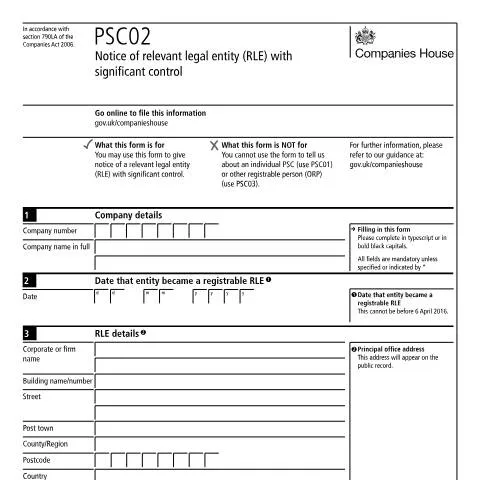
When Corporate Structures Meet Transparency Requirements: Understanding the PSC02 Notice
In the complex landscape of corporate ownership structures, where shell companies, holding entities, and international business arrangements create intricate webs of control, Companies House requires clear documentation of who ultimately pulls the strings. The PSC02 notice serves as the official mechanism for declaring when a relevant legal entity (RLE) – not an individual person – exercises significant control over a UK company.
This distinction matters enormously in practice. While most business owners are familiar with the concept of persons with significant control (PSCs), the reality is that corporate ownership often involves layers of legal entities, trusts, partnerships, and overseas corporations. The PSC02 specifically addresses these more complex arrangements, ensuring that regulatory transparency extends beyond simple individual ownership into the realm of corporate and institutional control structures.
The form's emergence stems from the UK's implementation of the Fourth Money Laundering Directive, which demanded greater transparency in beneficial ownership. Companies House recognised that many significant controllers are themselves legal entities rather than natural persons, necessitating a distinct reporting mechanism that captures the nuances of entity-based control.
Decoding the Relevant Legal Entity: What Qualifies and What Doesn't
Understanding precisely what constitutes a relevant legal entity forms the cornerstone of using PSC02 effectively. The form explicitly targets legal entities – corporations, limited partnerships, overseas companies, and similar structures that possess legal personality separate from their members or shareholders.
A relevant legal entity must meet specific criteria to warrant PSC02 notification. The entity must hold significant control over the reporting company through one of several defined routes: ownership of more than 25% of shares, control of more than 25% of voting rights, the right to appoint or remove directors, or the exercise of significant influence or control over the company's activities.
Crucially, the form cannot be used for individual persons (who require PSC01) or other registrable persons (requiring PSC03). This creates a clear tripartite system where different types of controlling parties follow distinct notification pathways. The distinction becomes particularly important when dealing with partnerships or trust arrangements, where the controlling entity's legal status determines the appropriate form.
| Type of Controller | Required Form | Key Characteristics |
|---|---|---|
| Individual person | PSC01 | Natural person with direct control |
| Relevant legal entity | PSC02 | Corporate entity, overseas company, limited partnership |
| Other registrable person | PSC03 | Unincorporated associations, general partnerships |
The 6 April 2016 threshold date represents when the PSC regime commenced, meaning no entity can be recorded as becoming a registrable RLE before this date, regardless of when they actually acquired control. This creates practical implications for companies with long-standing ownership structures that predate the regulatory framework.
Navigating the Control Thresholds and Their Practical Implications
The PSC02 form distinguishes between different levels of control through carefully defined percentage thresholds, each carrying distinct regulatory implications and disclosure requirements. These thresholds – more than 25% but not more than 50%, more than 50% but less than 75%, and 75% or more – reflect increasing degrees of control and influence.
The 25% threshold captures entities with substantial minority interests that nonetheless wield significant influence. This level often applies to strategic investors, private equity firms, or family holding companies that maintain meaningful control without absolute ownership. Companies must recognise that this threshold can be reached through indirect holdings, where the RLE controls intermediate entities that collectively hold the requisite percentage.
Reaching 50% control typically indicates operational control, where the RLE can influence major business decisions and potentially control board composition. This level often triggers additional regulatory considerations beyond PSC reporting, including consolidation requirements for accounting purposes and potential merger control implications.
The 75% threshold represents substantial control, often associated with parent-subsidiary relationships or situations where the RLE exercises near-complete dominance. At this level, the controlling entity typically enjoys special resolution powers under company law, enabling fundamental changes to the controlled company's structure.
Beyond percentage-based control, the form addresses qualitative control mechanisms. The right to appoint or remove directors represents a particularly powerful form of control that may exist regardless of share ownership percentages. This provision captures situations involving special voting arrangements, weighted voting rights, or contractual director appointment rights.
Complex Control Structures: Trusts, Partnerships, and Indirect Holdings
The PSC02 form's sophisticated approach to complex ownership structures becomes evident in its treatment of trust and partnership arrangements. These provisions recognise that modern corporate control often operates through multiple layers of legal arrangements, each requiring careful analysis to determine ultimate beneficial ownership.
When dealing with trust structures, the form requires detailed examination of how trustees exercise control on behalf of the trust. The RLE must demonstrate significant influence or control over the trust's activities, with the trustees then holding the specified control thresholds over the reporting company. This creates a two-stage analysis: first establishing the RLE's control over the trust, then documenting the trust's control over the company.
Trust-based control scenarios frequently arise in family business structures, where holding companies or investment vehicles are held in trust for family members. The form's requirements ensure that both the trust relationship and the ultimate controlling entity are properly disclosed, maintaining transparency while respecting legitimate privacy interests.
Partnership arrangements present similar complexity, particularly where the partnership lacks separate legal personality under its governing law. The form addresses situations where an RLE controls a partnership, and that partnership's members exercise control over the reporting company. This indirect control mechanism requires careful documentation of the relationship chain and percentage holdings at each level.
International structures add further complexity, as partnerships and similar arrangements may have different legal characteristics depending on their governing jurisdiction. The form's flexibility in addressing various legal forms and governing laws reflects the international nature of modern business ownership.
Indirect Holdings and Calculation Methods
Calculating indirect holdings requires aggregating control across multiple ownership layers, considering both direct shareholdings and indirect interests held through controlled entities. This calculation becomes particularly complex when dealing with circular shareholdings, cross-holdings, or situations where multiple entities in a group hold interests in the same target company.
The form's approach to indirect control reflects established company law principles while adapting them for transparency purposes. Companies must trace ownership through each intermediate layer, ensuring that ultimate control is properly attributed to the relevant legal entity rather than stopping at immediate shareholders.
Documentation Requirements and Principal Office Address Implications
The PSC02 form demands comprehensive documentation of the relevant legal entity's corporate details, with particular attention to the principal office address requirement. This address becomes part of the public record, creating transparency while potentially raising privacy and security considerations for the controlling entity.
The legal form and governing law requirements serve multiple regulatory purposes. They enable Companies House to understand the entity's legal characteristics, facilitate international cooperation in regulatory matters, and provide context for interpreting the entity's control rights and obligations. The form accommodates various international legal structures, recognising that controlling entities may be established under foreign jurisdictions with different corporate law frameworks.
Registration details, where applicable, create links to other regulatory registers and enable cross-referencing with overseas corporate registries. This interconnected approach supports international efforts to combat money laundering and ensure beneficial ownership transparency across jurisdictions.
Public Record Implications
Information submitted via PSC02 becomes part of Companies House's public register, accessible to anyone conducting company searches. This publicity serves legitimate transparency purposes but requires careful consideration of the information disclosed. The principal office address, in particular, may have security implications for the controlling entity.
Companies should consider whether the disclosed address adequately represents the entity's principal office while balancing transparency requirements with practical security considerations. The address must be genuine and current, as it may be used for official communications and regulatory correspondence.
Timing Obligations and the Confirmation Framework
The PSC02 form operates within strict timing frameworks that reflect both the dynamic nature of corporate control and regulatory demands for current information. The critical date concept – when the company had confirmation of the RLE's PSC status and all required particulars – creates a specific trigger point for notification obligations.
This confirmation requirement establishes a two-part test: the company must both recognise that the entity qualifies as a PSC and obtain complete information about the entity's particulars. The later of these two dates becomes the critical confirmation date, acknowledging that companies may become aware of control relationships before obtaining complete entity details.
The timing framework recognises practical realities in complex ownership structures, where establishing PSC status may require legal analysis and obtaining complete entity information may involve international inquiries. However, it places clear obligations on companies to pursue this information diligently and report promptly once confirmation is obtained.
| Timeline Element | Requirement | Practical Considerations |
|---|---|---|
| Entity becomes registrable RLE | Cannot be before 6 April 2016 | Reflects PSC regime commencement |
| Confirmation date | Later of PSC status confirmation and complete particulars | Triggers notification obligations |
| Filing deadline | Within prescribed period after confirmation | Must coordinate with broader PSC update requirements |
Ongoing Monitoring Obligations
Beyond initial notification, companies must maintain current PSC information as control structures evolve. Changes in the RLE's control percentage, modifications to trust or partnership arrangements, or alterations in the entity's corporate details may trigger update requirements using subsequent PSC02 filings or other appropriate forms.
This ongoing obligation requires companies to establish monitoring systems for tracking changes in complex ownership structures. Regular reviews of control arrangements, particularly in dynamic business environments, help ensure compliance with continuing disclosure obligations.
Authentication Requirements and Corporate Governance Integration
The PSC02 form's authentication requirements reflect Companies House's emphasis on accountability and accuracy in PSC reporting. The form may be signed by various corporate officers, including directors, company secretaries, or persons specifically authorised under the Companies Act 2006, creating flexibility while maintaining appropriate oversight.
For Societas Europaea structures, special provisions acknowledge the different governance arrangements applicable to these European corporate forms. The authentication requirements adapt to accommodate the SE's distinctive organ structure while maintaining equivalent accountability standards.
The requirement for confirmed particulars before filing creates a verification obligation that extends beyond simple form completion. Companies must actively confirm the accuracy of RLE details, potentially involving direct communication with the controlling entity or review of official corporate records from the entity's jurisdiction of incorporation.
This verification requirement integrates PSC compliance with broader corporate governance obligations. Directors and other authorising officers take responsibility not just for form accuracy but for the underlying due diligence that supports the disclosed information. This creates accountability that extends throughout the corporate structure to the controlling entity itself.
The authentication framework also supports regulatory enforcement by creating clear responsibility chains for PSC information accuracy. When compliance issues arise, Companies House can identify responsible officers and pursue appropriate regulatory responses, whether through administrative penalties or more formal enforcement actions.
Integration with existing corporate governance processes helps ensure that PSC compliance becomes part of routine corporate administration rather than an isolated compliance exercise. Regular board consideration of ownership structures, systematic review of control arrangements, and appropriate delegation of PSC responsibilities create sustainable compliance frameworks that adapt as businesses evolve.
Common Challenges and Error Prevention When Filing PSC02
Filing a PSC02 notice correctly requires careful attention to detail, as errors can lead to rejection by Companies House or potential compliance issues. Understanding the most frequent pitfalls helps ensure your submission proceeds smoothly and meets regulatory requirements.
Data Accuracy and Verification Requirements
One of the most critical aspects involves ensuring all entity information is precisely recorded. The legal name of the relevant legal entity must match exactly with official records from its jurisdiction of incorporation. This includes proper capitalisation, punctuation, and any special characters. For instance, if filing for a German GmbH, the exact designation including "Gesellschaft mit beschränkter Haftung" or its abbreviated form must be consistent with the German commercial register entry.
Address verification presents another common stumbling block. The registered office address must be current and complete, including postal codes formatted according to the entity's home jurisdiction. For European entities, this might involve understanding different addressing conventions—French addresses require specific département codes, whilst Dutch addresses follow a distinct postcode format.
Date formatting requires particular attention when dealing with international entities. Whilst UK forms typically use DD/MM/YYYY format, source documents from other jurisdictions may present dates differently. Always verify incorporation dates against official certificates or extracts from the relevant company registry to avoid discrepancies.
Timing and Deadline Management
The 14-day notification period begins from when the relevant legal entity first becomes a PSC, not from when the company becomes aware of this status. This distinction proves crucial for maintaining compliance, particularly in complex ownership structures where control changes may not be immediately apparent.
For newly incorporated companies, the PSC02 filing often coincides with other incorporation requirements. Managing these concurrent deadlines requires careful coordination, especially when dealing with international holding structures where obtaining certified documentation may take several days.
Companies should establish robust monitoring systems for ownership changes, particularly when shareholders include corporate entities that might themselves undergo restructuring. A subsidiary becoming a PSC through its parent company's acquisition elsewhere could trigger PSC02 requirements without direct notification to the UK company.
Documentation and Supporting Evidence
Whilst Companies House doesn't require supporting documentation to be filed with the PSC02, maintaining comprehensive records proves essential for regulatory compliance and potential future inquiries. This includes certified copies of incorporation certificates, constitutional documents, and ownership verification from the entity's home jurisdiction.
For entities incorporated in jurisdictions with different legal traditions, understanding equivalent corporate forms becomes important. A US LLC might qualify as a relevant legal entity, but its operating agreement and state filing requirements differ significantly from UK company law concepts. Similarly, partnerships in some jurisdictions possess legal personality whilst others don't, affecting their PSC eligibility.
When dealing with entities from countries with non-Latin alphabets, obtaining officially transliterated versions of names and addresses ensures consistency across all UK filings. Some jurisdictions provide official English translations of corporate documents, whilst others require certified translation services.
PSC02 in Complex Corporate Structures and Ownership Chains
Modern corporate arrangements often involve intricate ownership webs spanning multiple jurisdictions, creating sophisticated scenarios for PSC identification and reporting. Understanding how PSC02 applies within these structures requires careful analysis of both direct and indirect control mechanisms.
Multi-Tier Ownership Analysis
When assessing whether a legal entity qualifies as a PSC, companies must trace ownership chains through multiple levels of corporate hierarchy. A parent company incorporated in Ireland might hold 60% of shares in a Dutch holding company, which in turn owns 80% of a UK subsidiary. The Irish entity becomes a PSC of the UK company through this indirect route, triggering PSC02 requirements despite no direct relationship.
Calculating control percentages through ownership chains requires mathematical precision. If Company A owns 75% of Company B, and Company B owns 60% of the UK company, Company A's effective control stands at 45% (75% × 60%). However, if Company A also directly owns 30% of the UK company, its total control reaches 75%, clearly exceeding the PSC threshold.
Trust structures add another layer of complexity. When a relevant legal entity serves as trustee holding shares for beneficiaries, determining PSC status depends on the specific trust terms and the nature of the trustee's discretionary powers. Corporate trustees with significant discretion over share voting or dividend distribution might qualify as PSCs even without beneficial ownership.
Joint Venture and Partnership Considerations
Joint ventures involving multiple corporate entities create unique PSC scenarios. When two or more relevant legal entities jointly control a UK company through shareholders' agreements or voting arrangements, each entity might qualify as a PSC despite individually holding less than 25% ownership. The key test involves whether they can exercise significant influence or control as a group.
Partnership structures require careful evaluation of the partnership agreement terms. A limited partnership incorporated as a legal entity in Jersey might qualify as a PSC if it holds the requisite ownership or control rights. However, partnerships without legal personality in their home jurisdiction wouldn't trigger PSC02 requirements, even with substantial ownership stakes.
Cross-border mergers and acquisitions frequently trigger multiple PSC changes simultaneously. When a German AG acquires a French SA that previously controlled a UK subsidiary, the German entity becomes the new PSC whilst the French entity ceases to qualify. Managing these transitions requires coordinating PSC02 filings with corresponding PSC07 cessation notices.
Regulatory Coordination Across Jurisdictions
International corporate groups must navigate varying transparency requirements across different jurisdictions. The UK's PSC regime operates alongside similar beneficial ownership registers in other countries, each with distinct thresholds, definitions, and filing requirements. A corporate entity might simultaneously appear on registers in multiple countries due to its various subsidiaries and control relationships.
European Union member states implement the Fourth Anti-Money Laundering Directive through national legislation, creating broadly similar but not identical beneficial ownership requirements. Understanding these variations helps multinational groups maintain comprehensive compliance whilst avoiding unnecessary duplication of effort.
Some jurisdictions maintain reciprocal information-sharing agreements with the UK, potentially cross-referencing PSC data with their domestic registers. This interconnectedness emphasises the importance of consistent and accurate PSC02 filings, as discrepancies might trigger regulatory inquiries across multiple jurisdictions.
Ongoing Compliance and Maintenance of PSC Records
Successfully filing an initial PSC02 represents just the beginning of ongoing PSC compliance obligations. Companies must establish robust systems for monitoring changes in their PSC entities and maintaining accurate records throughout the corporate lifecycle.
Monitoring and Update Obligations
PSC entities undergo their own corporate changes that might affect their status or details on the UK company's register. When a relevant legal entity changes its name, registered office, or legal form, the UK company must file updated PSC02 information within the prescribed timeframe. This creates ongoing monitoring obligations extending beyond the company's immediate control.
Ownership percentages can fluctuate due to share issues, redemptions, or transfers within the PSC entity's own structure. A holding company might issue new shares to other investors, diluting its ownership of intermediate entities and potentially affecting its PSC status of UK subsidiaries further down the chain. Companies need systems to track these upstream changes and assess their PSC implications.
Corporate reorganisations within PSC entities require careful evaluation. When a PSC entity undergoes merger, demerger, or reconstruction, the UK company must determine whether the resulting entity continues to qualify as a PSC or whether new entities now meet the criteria. These changes might necessitate multiple filings—PSC07 to record cessation of the original PSC and PSC02 for any new qualifying entities.
Record-Keeping and Audit Trail Requirements
Companies must maintain comprehensive records supporting their PSC determinations, extending beyond the basic information filed with Companies House. This includes documentation evidencing the ownership calculations, constitutional documents of PSC entities, and correspondence relating to PSC identification and verification processes.
The statutory register of PSCs requires ongoing maintenance parallel to Companies House filings. Any changes notified through PSC02 or other PSC forms must be reflected in the company's own register within appropriate timeframes. This dual obligation ensures both public transparency through Companies House and internal record accuracy.
Professional advisers often recommend maintaining detailed PSC analysis files, particularly for complex ownership structures. These might include ownership charts, calculation worksheets, and legal opinions on borderline cases. Such documentation proves valuable during regulatory inquiries or when onboarding new advisers who need to understand the company's PSC position.
Integration with Anti-Money Laundering Procedures
PSC information serves crucial functions beyond Companies House compliance, particularly in anti-money laundering (AML) and due diligence contexts. Financial institutions and other regulated entities rely on PSC data when conducting customer due diligence, making accuracy essential for smooth business relationships.
The PSC register provides a starting point for beneficial ownership identification, but regulated entities often require additional verification and documentation. Companies should prepare supplementary materials explaining their ownership structures, particularly when PSC entities are incorporated in higher-risk jurisdictions or involve complex arrangements.
Regular review of PSC information helps identify potential red flags that might concern counterparties or regulators. Frequent changes in PSC entities, ownership through multiple high-risk jurisdictions, or complex trust arrangements might require additional explanation or documentation to satisfy AML requirements.
Companies operating in regulated sectors face enhanced scrutiny of their ownership structures. Financial services firms, for instance, must notify regulators of controller changes that might also trigger PSC obligations. Coordinating these parallel requirements ensures consistent information across all regulatory submissions whilst avoiding potential conflicts or discrepancies.