When Overseas Companies Must Update Their UK Registration Records
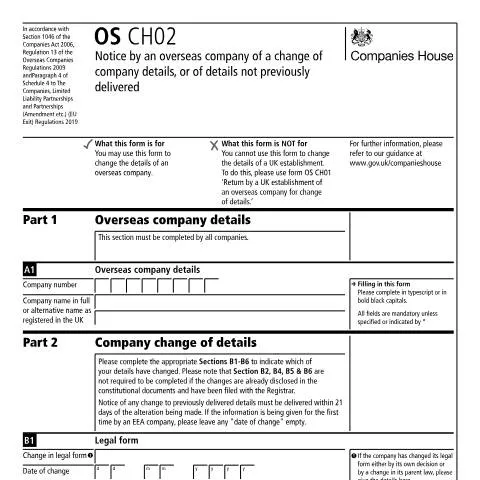
Overseas companies operating in the United Kingdom face a continuous obligation to maintain accurate records with Companies House. The OS CH02 form serves as the primary mechanism for these entities to report changes to their fundamental company details, ensuring their UK registration remains current and compliant with statutory requirements.
This notification process becomes particularly critical when overseas companies undergo structural changes in their home jurisdiction that affect their UK operations. Whether it's a change in legal form, alteration of registered office address, or modification of accounting obligations, the 21-day notification window creates a tight compliance framework that demands careful attention from company administrators.
The form operates under the authority of Section 1046 of the Companies Act 2006 and the Overseas Companies Regulations 2009, establishing it as a legally mandated reporting tool rather than an optional administrative convenience.
Distinguishing Company-Level Changes from Establishment-Specific Updates
A fundamental distinction exists between changes affecting the overseas company itself and those impacting its UK establishments. The OS CH02 form exclusively handles company-level modifications that occur in the entity's home jurisdiction and subsequently affect its UK registration status.
Companies frequently confuse this with the OS CH01 form, which specifically addresses changes to UK establishment details such as local office addresses, business activities, or personnel appointments. This separation reflects the regulatory framework's recognition that overseas companies operate through distinct legal layers: the parent entity governed by foreign law and its UK establishments subject to domestic requirements.
| Change Type | Appropriate Form | Typical Examples |
|---|---|---|
| Company-level changes | OS CH02 | Legal form conversion, home country registered office, accounting period changes |
| UK establishment changes | OS CH01 | Local office relocation, UK business activity modifications, personnel changes |
| Constitutional changes | May require both forms | Major restructuring affecting both parent company and UK operations |
The form's scope encompasses six primary categories of company changes: legal form alterations, principal place of business modifications, accounting requirement updates, objects changes, capital adjustments, and governing law variations. Each category triggers different reporting obligations and potential follow-up requirements.
Navigating the Critical 21-Day Compliance Window
The 21-day notification period begins from the date the alteration takes effect in the company's home jurisdiction, not from when the company becomes aware of the requirement to notify Companies House. This strict timeline creates particular challenges for companies with complex international structures or those undergoing rapid organisational changes.
For companies filing information for the first time—particularly relevant for EEA companies transitioning post-Brexit—the date of change field should be left empty, as these represent initial disclosures rather than modifications to previously filed information.
The timing becomes more complex when changes are already disclosed in constitutional documents previously filed with the Registrar. In such cases, Sections B2, B4, B5, and B6 may not require completion, provided the changes are adequately covered in the existing documentation. This exception requires careful legal assessment to ensure compliance while avoiding unnecessary duplication.
Companies operating across multiple jurisdictions often face the challenge of coordinating change notifications across different regulatory systems, each with distinct timelines and requirements.
Completing Each Section: Technical Requirements and Common Complications
The form's structure reflects the complexity of international corporate law, with each section addressing specific aspects of company operations that may change over time. Part 1 requires basic identification details that must precisely match the company's existing UK registration, including any alternative name under which it operates domestically.
Section B1 addresses legal form changes, which frequently occur when companies restructure in their home jurisdiction or when parent law modifications affect entity classification. These changes can have significant implications for UK tax treatment and regulatory obligations, making accurate reporting essential.
The registered office address section (B2) demands particular attention to formatting conventions. UK postal address standards apply even when reporting foreign addresses, requiring companies to adapt international address formats to domestic expectations while maintaining accuracy for their home jurisdiction records.
Accounting requirements (B3) present one of the form's most technically demanding sections. Companies must specify whether they remain subject to parent law accounting obligations and provide detailed information about accounting periods and disclosure requirements. The distinction between companies required to prepare accounts under parent law and those exempt creates different reporting pathways with varying compliance implications.
Capital and Objects: Reflecting Corporate Evolution
Changes to company objects (Section B4) typically accompany business expansion or strategic pivots. The form requires comprehensive disclosure of both previous and current objects, enabling Companies House to maintain accurate records of each entity's authorised activities within the UK market.
Capital modifications (Section B5) must reflect the company's issued capital in its home jurisdiction currency, with clear indication of any changes in capitalisation structure. This information proves crucial for creditor protection and regulatory oversight purposes.
The governing law section (B6) becomes particularly relevant in cases of corporate migration or jurisdictional restructuring, where companies may change their legal domicile while maintaining UK operations.
Managing Multi-Establishment Reporting Through Consolidated Returns
Companies operating multiple UK establishments face the choice between individual filings for each establishment or consolidated reporting through a single OS CH02 form. The Section B7 table accommodates this consolidated approach, requiring comprehensive listing of all affected UK establishments with their respective registration numbers.
This consolidation option provides administrative efficiency for large overseas companies while ensuring complete coverage of all UK operations. However, it requires careful coordination to ensure all establishment-specific implications of company-level changes are properly addressed.
The choice between individual and consolidated reporting often depends on the nature of changes and their differential impact across establishments. Companies should consider whether changes affect all establishments uniformly or require establishment-specific analysis and reporting.
Submission Pathways and Processing Considerations
Companies House accepts OS CH02 forms through multiple channels, with each offering distinct advantages depending on company circumstances and urgency requirements. The form may be submitted to any Companies House office across England and Wales, Scotland, or Northern Ireland, providing geographical flexibility for international entities.
Paper submissions require typescript or bold black capitals to ensure processing accuracy, while the form's mandatory field requirements mean incomplete submissions face automatic rejection and reprocessing delays. The checklist provided emphasises critical elements frequently overlooked during completion.
Processing times vary based on submission method and seasonal workload fluctuations, but the 21-day compliance window remains fixed regardless of administrative processing speeds. Companies should account for potential processing delays when planning submission timing, particularly during peak filing periods.
Public Record Implications and Transparency Requirements
All information submitted via OS CH02 becomes part of the public record, accessible through Companies House search facilities. This transparency requirement necessitates careful consideration of sensitive information disclosure and potential competitive implications of revealed changes.
The presenter information section allows companies to provide contact details for query resolution, though this remains optional. When provided, these details also become publicly accessible, requiring balance between administrative convenience and privacy considerations.
Post-Submission Monitoring and Compliance Verification
Following successful submission, companies should monitor their Companies House record to verify accurate processing and integration of reported changes. The public record update typically occurs within standard processing timeframes, but complex changes may require additional verification steps.
Companies House may request additional documentation or clarification for changes involving significant structural modifications or those raising regulatory concerns. Maintaining comprehensive supporting documentation facilitates prompt response to such requests and demonstrates compliance diligence.
The form's integration with broader UK regulatory frameworks means changes reported through OS CH02 may trigger additional obligations with other authorities, including HMRC for tax implications or sector-specific regulators for licensed activities.
Regular monitoring of regulatory updates and guidance changes ensures ongoing compliance with evolving requirements affecting overseas company operations in the UK market. The dynamic nature of international corporate law necessitates proactive compliance management rather than reactive response to regulatory changes.
Successful completion of OS CH02 submissions contributes to the broader regulatory objective of maintaining accurate, current information about overseas companies operating within UK jurisdiction, supporting market transparency and stakeholder protection while facilitating legitimate international business operations.
Navigating Complex Ownership Structures and Beneficial Ownership Reporting
When updating details for an overseas company through form OS CH02, one of the most intricate aspects involves managing complex ownership structures and ensuring compliance with beneficial ownership requirements. The PSC (People with Significant Control) register demands particular attention when changes affect the company's control structure.
If your overseas company has a multi-tiered ownership arrangement involving holding companies, trusts, or partnerships across different jurisdictions, each change must be carefully documented. For instance, when a parent company in one jurisdiction transfers shares to a subsidiary in another, this transaction may trigger multiple reporting obligations. The OS CH02 form requires you to specify not just the immediate shareholder changes, but also how these alterations affect the ultimate beneficial ownership chain.
Companies House maintains strict requirements for identifying individuals who ultimately own or control more than 25% of shares or voting rights. When filing OS CH02, you must consider whether changes to registered office addresses, company officers, or constitutional documents impact these control thresholds. A seemingly straightforward address change might actually signal a more fundamental shift in corporate structure that requires additional PSC notifications.
The complexity increases when dealing with trust arrangements or nominee structures. If your overseas company operates through trustees or nominees, any changes to these intermediary arrangements must be reflected accurately. The form requires clear identification of the ultimate beneficial owners, not just the immediate registered holders. This becomes particularly challenging when trust arrangements span multiple jurisdictions with different disclosure requirements.
Consider the scenario where an overseas company changes its registered office from one jurisdiction to another. This relocation might affect the company's tax residency status, which in turn could impact its UK reporting obligations. While the OS CH02 form handles the basic change notification, you may need to consider parallel filings with HMRC if the move affects the company's UK tax position or transfer pricing arrangements.
For companies with Employee Share Ownership Plans (ESOPs) or similar arrangements, changes to plan trustees or beneficiary structures require careful handling. The OS CH02 form must accurately reflect how these changes affect the overall control picture, particularly if employee ownership crosses the 25% threshold that triggers PSC reporting requirements.
Timing Considerations and Regulatory Coordination Across Jurisdictions
The timing of OS CH02 submissions requires strategic coordination, particularly when your overseas company operates across multiple regulatory environments. Companies House imposes specific deadlines for notifying changes, but these may not align with reporting requirements in your company's home jurisdiction or other territories where it operates.
Most changes must be notified to Companies House within 14 days of the change taking effect in the overseas company's home jurisdiction. However, this straightforward rule becomes complex when dealing with jurisdictions that have different concepts of when changes become "effective." Some jurisdictions consider changes effective upon filing with local authorities, while others require additional steps such as publication in official gazettes or registration with multiple agencies.
For example, if your company is incorporated in a jurisdiction where constitutional changes require court approval, the 14-day countdown begins when the court order becomes final, not when you initially file the application. Understanding these jurisdictional nuances prevents inadvertent compliance failures and potential penalties.
The situation becomes more intricate when coordinating with UK regulatory bodies beyond Companies House. If your overseas company has UK subsidiaries, changes reported via OS CH02 might trigger notification requirements with other regulators. Financial services companies may need to inform the Financial Conduct Authority (FCA) or Prudential Regulation Authority (PRA) about structural changes that affect their UK operations.
Companies with UK employees must consider whether changes affect their obligations under auto-enrolment pension schemes administered through The Pensions Regulator. A change in company structure or registered office might impact the designated employer responsibilities or require updates to existing pension arrangements.
Tax considerations add another layer of timing complexity. HMRC's Corporate Finance Manual provides guidance on when structural changes might create taxable events or affect existing tax elections. While OS CH02 handles the Companies House notification, parallel tax filings might be necessary to preserve favourable tax treatments or avoid unintended consequences.
Strategic timing becomes crucial during corporate reorganisations. If you're implementing a series of related changes, consider whether batching these modifications or sequencing them in a particular order optimises your regulatory position. Sometimes delaying one change until after another becomes effective can simplify the overall compliance burden or preserve certain regulatory benefits.
Documentation Requirements and Evidence Standards for Different Change Types
The documentation requirements for OS CH02 submissions vary significantly depending on the nature of changes being reported. Companies House maintains different evidence standards for various types of modifications, and understanding these requirements prevents delays or rejection of your filing.
For constitutional document changes, you must provide certified copies of amended articles of association, memorandum changes, or equivalent constitutional documents as they exist in your home jurisdiction. The certification requirements depend on the source jurisdiction's legal framework. Common law jurisdictions typically accept notarisation by practising solicitors or notaries public, while civil law systems might require specific authentication procedures or apostille certification under the Hague Convention.
When reporting changes to company officers, the documentation requirements escalate with the seniority of the position. Director appointments typically require proof of acceptance of office, which might take different forms depending on your home jurisdiction. Some territories issue formal certificates of appointment, while others rely on board resolution extracts or signed consent forms. Companies House accepts various formats, but the documentation must clearly demonstrate that the appointment complies with local legal requirements.
Share capital modifications demand particularly robust documentation. If your overseas company has altered its authorised share capital, issued new shares, or modified existing share classes, you must provide evidence that these changes comply with both local corporate law and any applicable securities regulations. For jurisdictions with complex pre-emption rights or shareholder approval requirements, your documentation package should demonstrate full compliance with these procedural safeguards.
Name changes present unique documentation challenges, particularly when the change involves translation between different alphabets or character sets. Companies House requires official confirmation of the name change from your home jurisdiction's registrar, plus any necessary translation certifications. If your company's name includes characters not readily representable in standard English text, you may need to provide transliteration guidelines or officially approved English versions.
Registered office changes require proof that the new address is validly established under local law. This might involve lease agreements, property ownership documents, or official confirmation from local authorities. For companies relocating to jurisdictions with different address formatting conventions, ensure your documentation clearly establishes the complete legal address as recognised by local postal and legal systems.
The challenge intensifies when dealing with changes that affect multiple aspects simultaneously. Corporate reorganisations often involve concurrent modifications to share capital, officer appointments, constitutional documents, and registered offices. Your documentation package must coherently demonstrate how these interconnected changes work together and comply with all applicable legal requirements across relevant jurisdictions.
Companies House increasingly scrutinises documentation for signs of potential money laundering or other financial crimes. Ensure your evidence package includes sufficient information about the commercial rationale for changes, particularly when modifications involve jurisdictions or entities that might attract enhanced regulatory attention. Clear explanations of business purposes help streamline the approval process and avoid unnecessary regulatory queries.