Understanding the Early Dissolution Process for Scottish Companies
When a company in Scotland faces insolvency, it may go through a court-mandated winding-up process. One of the crucial steps in this procedure is the early dissolution of the company, which requires the submission of the WU16 (Scot) form to Companies House. This document is essential for officially notifying the authorities about the company's dissolution prior to the completion of the winding-up process. Understanding this form is vital for anyone involved in such scenarios, be it liquidators, directors, or stakeholders.The Role of the Liquidator: Who Holds the Keys?
In the winding-up process, a liquidator is appointed to manage the affairs of the company. The liquidator's duties are extensive and include selling off the company's assets, settling debts, and distributing any remaining funds to shareholders. Furthermore, the liquidator also plays a critical role in filing the WU16 (Scot) form.Liquidator Responsibilities
- Asset Management: Overseeing the sale of company assets to pay off creditors.
- Debt Settlement: Ensuring that all debts are settled in accordance with statutory priorities.
- Communication: Keeping stakeholders informed throughout the process.
- Regulatory Compliance: Filing necessary documents with Companies House, including the WU16 (Scot).
Key Dates in the Early Dissolution Process
The timeline for the early dissolution of a company is critical to understand. The process typically begins once a winding-up order is issued by the court. Here’s a breakdown of the significant dates and what they entail:Timeline Breakdown
- Issuance of Court Order: The process is triggered once the court issues a winding-up order. This date is crucial as it marks the start of the formal dissolution process.
- Filing the WU16 (Scot): The form must be filed promptly following the court order. There’s no specific deadline, but it is advisable to do this as soon as possible.
- Liquidation Period: The time taken to complete the winding-up process can vary; it is usually dependent on the complexity of the company’s affairs.
- Final Resolution: Once all assets are sold and debts settled, the company will be officially dissolved, and the liquidator will notify Companies House of this final outcome.
Step-by-Step Guide to Completing the WU16 (Scot)
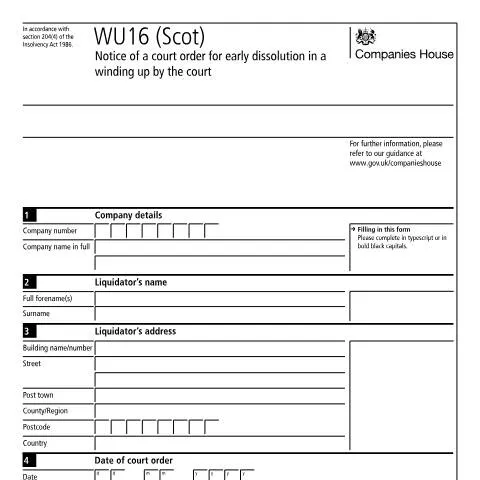
Completing the WU16 (Scot) form requires careful attention to detail. Each section of the form has a specific purpose and must be filled out accurately to avoid unnecessary delays.Form Components
| Section | Description |
|---|---|
| Company Details | Enter the full name and registration number of the company as recorded in the Companies House public register. |
| Liquidator's Details | Provide the full name and address of the liquidator managing the dissolution process. |
| Date of Court Order | Indicate the date when the court order for winding up was issued. |
| Signature | The liquidator must sign and date the form, confirming that all information provided is accurate. |
Required Documentation for Submission
Alongside the WU16 (Scot) form, certain documents must be submitted to substantiate the filing. These documents are crucial and must be prepared carefully.Essential Documents
- Copy of the Court Order: A certified copy of the court order that mandates the winding-up process must be attached. This is a non-negotiable requirement.
- Liquidator’s Statement: A brief statement from the liquidator summarising the current situation and outlining the next steps can be useful.
- Proof of Identity: Documentation proving the identity and authority of the liquidator may also be necessary, especially in case of any inquiries from Companies House.
Who Needs to Be Informed? The Stakeholders’ Perspective
The dissolution of a company impacts various stakeholders, and they must be kept informed throughout the winding-up process.Profiles of Affected Parties
- Directors: Company directors are responsible for overseeing the dissolution process. They must ensure that the liquidator monitors the company's affairs diligently.
- Shareholders: Shareholders are entitled to information regarding the liquidation status and any potential returns on their investments.
- Creditors: All creditors should be notified of the winding-up order, as they have a vested interest in the repayment of their dues.
- Employees: If applicable, employees of the company must be informed of the dissolution, particularly regarding their rights and entitlements.
The Consequences of Failing to Submit the WU16 (Scot)
Neglecting to file the WU16 (Scot) form may have serious consequences for the company and its stakeholders.Potential Ramifications
- Legal Complications: Failing to file can result in legal action against the company and its directors, potentially leading to personal liability.
- Extended Dissolution Process: Without timely submission of the WU16 (Scot), the winding-up process may be prolonged, causing additional costs and complications.
- Impact on Creditors: Creditors may remain in limbo, delaying their ability to make claims or receive payments.
- Loss of Public Record: The company’s status will remain active within the public register, which could affect the reputation of the directors.
Post-Submission Process: What Happens Next?
Once the WU16 (Scot) is submitted, the liquidator awaits confirmation from Companies House regarding the dissolution.After Filing the WU16 (Scot)
- Await Confirmation: Companies House will review the submission and confirm whether the document is accepted or if further information is needed.
- Complete Liquidation: The liquidator will continue to manage the liquidation process, concluding any remaining activities.
- Official Dissolution: Once all affairs are settled, Companies House will officially dissolve the company and update the public register.
- Final Notification: The liquidator will notify all stakeholders about the successful dissolution.
Final Thoughts on the WU16 (Scot) Form
Navigating the complexities of company dissolution in Scotland can be challenging, especially when dealing with formalities such as the WU16 (Scot) form. Liquidators, directors, and stakeholders must approach this process with diligence and care. By understanding the significance of the form, adhering to the requirements, and maintaining open communication with all relevant parties, one can ensure a smoother journey through the minefield that is insolvency. The successful execution of the early dissolution process is not merely a matter of compliance; it is a crucial step towards closure and moving forward. For further guidance, stakeholders should refer to the official Companies House resources for updates and changes to the filing procedures.Understanding the Grounds for Early Dissolution in Court Winding Up
Under the Companies Act 1985 (as amended), Scottish companies can be subjected to winding up by the court for several reasons. However, early dissolution of a company in this process is often dependent on specific grounds that may accelerate the termination of the company's existence. One of the primary grounds for early dissolution arises when the court is satisfied that the company is solvent. If the court determines that it is unnecessary to continue the winding-up process due to the availability of sufficient assets to settle all debts, the judge may grant an early dissolution. This not only expedites the closure of the company but also serves to protect the interests of creditors in scenarios where further prolonged proceedings may lead to unnecessary costs.
Additionally, if a company is found to be inactive or has not traded for an extended period, the court may consider this an appropriate reason for early dissolution. The rationale behind this is straightforward: it prevents the unnecessary burden on the court system and ensures that resources are allocated efficiently. It is important for company directors to be aware of the implications of inactivity; regular filing and compliance are essential to maintaining a company's status and avoiding potential complications when seeking an early dissolution.
Procedures and Requirements for Early Dissolution
The procedure for obtaining an early dissolution during a winding up by the court is precise and must adhere to the established legal framework. Initially, the liquidator, appointed to oversee the winding-up process, plays a crucial role in assessing the financial status of the company. To initiate early dissolution, the liquidator must file a motion with the court showcasing the grounds for such a request. This includes providing evidence of the company's solvency or other justifiable reasons for termination. The court will then review the application and may schedule a hearing to address any queries or concerns from interested parties.
Alongside the motion, it is essential to submit various documents, including the completed WU16 (Scot) form, which details the company's circumstances and financial status. The liquidator must ensure that all financial statements, tax obligations, and other liabilities are settled before proceeding with the dissolution request. This thorough preparation is vital, as the court requires assurance that all creditors have been adequately informed and given the opportunity to claim any due amounts.
Implications of Early Dissolution for Directors and Stakeholders
Directors and stakeholders must consider the broader implications of early dissolution for both personal and business perspectives. When a company is dissolved, the directors may face challenges concerning their reputational capital and future business engagements. This is particularly relevant if the winding-up process involved any allegations of misconduct or mismanagement. Maintaining a clean record is critical in maintaining credibility within the business community and for future ventures.
Moreover, stakeholders, including employees and creditors, must also navigate the consequences of an early dissolution. Employees may lose their jobs, and creditors might have to write off debts if they are not compensated fully. Therefore, it is advisable for directors to engage in transparent communication with all parties involved. Ensuring that employees are aware of their rights and potential entitlements can alleviate some concerns during the dissolution process.
In conclusion, the early dissolution of a Scottish company during court winding up involves navigating complex legal grounds, procedures, and implications for all stakeholders involved. By adhering to the established processes and maintaining open communication, directors can effectively manage the transition and mitigate potential fallout.