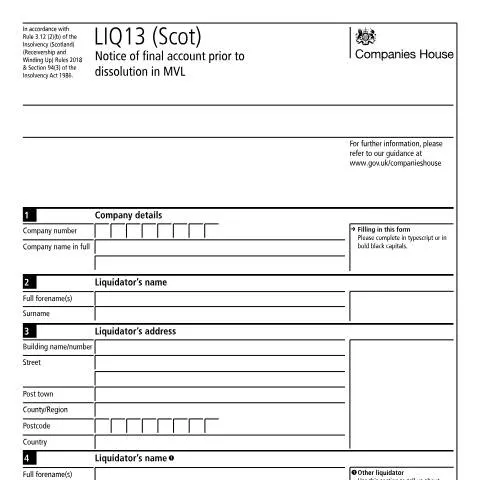
Understanding the LIQ13 (Scot) Document: A Vital Step in Company Dissolution
When a Scottish company finds itself on the path towards dissolution, it is necessary to navigate a series of formalities mandated by law. Among these, the submission of the LIQ13 (Scot) form stands out as a crucial document in the process of winding up the affairs of a company. This form serves as a notification of the final account prior to dissolution, specifically for companies undergoing a Members’ Voluntary Liquidation (MVL). Given its importance, understanding the intricacies of this document is vital for any company director or liquidator involved in the process.
The Liquidation Process: Initiating the LIQ13 (Scot)
Before delving deep into the LIQ13 (Scot), it is essential to grasp the context surrounding its necessity. The Members’ Voluntary Liquidation is typically initiated when a company is solvent but is no longer desired or needed by its owners. The process includes the appointment of a liquidator who is charged with managing the company’s final accounts and ensuring all assets are properly distributed. The LIQ13 (Scot) form is submitted towards the conclusion of this process, signalling the final steps needed to formally dissolve the company.
Who is Responsible for Filing?
The responsibility of filing the LIQ13 form falls squarely on the shoulders of the liquidator. This individual is tasked with ensuring that all formalities are observed and that the final accounts, prepared in accordance with Section 94(2) of the Insolvency Act 1986, are accurate and fully reflective of the company’s financial standing.
- Primary Liquidator: The main individual responsible for overseeing the liquidation process.
- Additional Liquidators: In cases where more than one liquidator is appointed, the details of all individuals involved must be included in the form.
Deciphering the LIQ13 (Scot) Form: An In-Depth Look
Completing the LIQ13 (Scot) form requires meticulous attention to detail. Any errors or omitted information may lead to delays or the rejection of the form. Below, we break down each section of the form and provide insight into common pitfalls to avoid.
Section 1: Company Details
This section is fundamental as it identifies the company undergoing the dissolution.
- Company Name: Ensure that the full name matches the records held at Companies House.
- Company Number: This must be accurate, as it acts as the unique identifier for the company in official records.
Section 2: Liquidator's Information
Provided here are specific details about the liquidator(s) handling the dissolution process.
- Full Names: Both forenames and surnames must be accurately recorded.
- Addresses: Complete information including building name/number, street, town, county, and postcode.
Section 3: Final Accounts and Signature
The final accounts detail how the company’s assets and liabilities have been managed throughout the liquidation process.
- Signatures: The liquidator must sign and date this section to affirm that the final account has been delivered to the company’s members.
Common mistakes in this section include failing to attach the final account or neglecting to sign the document, which can lead to unnecessary delays.
The Importance of Accuracy: Consequences of Mistakes
Submitting an accurately completed LIQ13 form is paramount. Companies House maintains stringent standards for documentation, and inaccuracies or incomplete submissions can result in the rejection of the form.
- Checklist: Companies House provides a checklist to ensure all necessary information is included, which is an essential step in the filing process.
- Ensure that the company details match the public register.
- Double-check that all required documents are attached.
- Confirm that the form is signed by the liquidator.
Failing to adhere to these guidelines can lead to prolonging the dissolution process and incurring additional administrative costs.
Timing and Deadlines: Critical Points in the Liquidation Process
Understanding the timeline for submission is important for both directors and liquidators. The LIQ13 (Scot) form must be submitted as a part of the overall winding-up process, ideally towards the conclusion after all necessary accounts have been settled.
- Submission Timing: It’s best practice to submit the LIQ13 as soon as the final accounts are ready and approved by the members, ensuring no delays are introduced that can complicate the formal dissolution.
The deadline for submitting the LIQ13 form is not set in stone, but it must occur within a reasonable timeframe following the completion of the winding-up process.
Exploring Additional Circuits of Communication: Filing Methods
When it comes to submitting the LIQ13 (Scot) form, companies have several options available—each with distinct benefits.
Online Submission: While traditionally forms were submitted by mail, Companies House has modernized the process, allowing for electronic submission. This can be a quicker method for submitting forms, offering immediate confirmation of receipt.
Paper Submission: Filers still have the option to send a paper copy of the LIQ13 form. To ensure expedient processing, it is advisable to send this to the specific Companies House address provided in the guidance notes.
Address for Submission
For those who choose to submit via paper, the preferred address is: The Registrar of Companies, Companies House, Fourth floor, Edinburgh Quay 2, 139 Fountainbridge, Edinburgh, Scotland, EH3 9FF.
The Role of the LIQ13 in Company Dissolution: A Foundation for Finality
The LIQ13 (Scot) form is not just a procedural requirement; it acts as a foundation for the finality of a company's existence. By submitting this form, the liquidator is declaring that all necessary actions have been taken to settle the company’s affairs and that there is nothing outstanding that could hinder the dissolution.
Upon receiving the LIQ13 form, Companies House will check the submission for compliance and completeness. If everything is in order, they will proceed to deregister the company from the public register, marking the official end of the company’s operation.
What Happens Next?
Once the LIQ13 form has been accepted:
- The company is officially dissolved.
- The records will be updated, and the dissolution will be reflected on Companies House records.
- Company members will receive confirmation of the dissolution, allowing them to move forward without the company’s obligations.
Conclusion: Navigating the Path of Dissolution with Confidence
The journey of dissolving a company through a Members’ Voluntary Liquidation can be complex, but understanding the role of the LIQ13 (Scot) form can dramatically simplify the process. With meticulous attention to detail and a clear understanding of the formal requirements, liquidators can streamline the winding-up process and ensure that their responsibilities are fulfilled efficiently.
As the final step in dissolving a company, the LIQ13 form encapsulates the culmination of efforts made throughout the liquidation process. By following the guidelines set forth by Companies House and ensuring that all aspects of the form are completed accurately, liquidators can confidently bring closure to the company’s lifecycle.
Understanding the Final Account Process in MVL
For a Scottish company undergoing a Members' Voluntary Liquidation (MVL), preparing a final account is a critical step that must be navigated with precision. The final account, submitted in accordance with the LIQ13 (Scot) form, acts as the concluding financial report of the company prior to its dissolution. This document essentially details how assets were handled, how liabilities were settled, and what distributions were made to shareholders.
The final account must be prepared in accordance with the Companies Act 2006, ensuring compliance with all relevant financial reporting standards. It is recommended that the final accounts are audited where necessary, especially if the company was previously subject to statutory audits. The final accounts often include a balance sheet, a cash flow statement, and a profit and loss statement, which enables the liquidator to transparently communicate the financial position of the company to its shareholders and creditors.
Additionally, the final account must be approved by the members during a final meeting, which is convened specifically for this purpose. It is essential that all members receive adequate notice of this meeting to ensure that their rights to approve the final accounts are respected. If the final accounts are contested, the liquidator must take appropriate steps to address any disputes before proceeding with the dissolution process.
Common Challenges and Considerations
Navigating the final account process in MVL can present various challenges for directors and liquidators alike. One of the most prevalent issues arises from accurately valuing the assets of the company. This can be particularly complex for companies with intangible assets, such as intellectual property or goodwill, which might not have a clear market value. Engaging a qualified professional for asset valuation can mitigate the risk of undervaluing or overvaluing assets, which can lead to disputes among members or creditors.
Another common challenge is ensuring that all creditor claims are settled prior to the submission of the final account. The liquidator must ensure that a thorough review of all outstanding liabilities is completed and that provisions are made to settle any debts. This is especially important in the context of HMRC obligations, as failure to address tax liabilities could result in personal liability for the directors if not handled appropriately.
Furthermore, the timing of the submission of the final account can also pose challenges. The Companies House requires that the LIQ13 (Scot) form must be submitted within a specific timeframe following the final meeting. Missing this window can complicate the liquidation process, causing unnecessary delays and potentially incurring additional costs. It is advisable for directors and liquidators to maintain a detailed timeline, marking key deadlines to ensure compliance with all statutory requirements.
Post-Dissolution Considerations
Once the final account has been approved and the dissolution process is complete, it may seem like the closure of the company is final. However, there are important post-dissolution considerations that should be kept in mind. For example, it is crucial for the former directors to retain copies of all liquidation documents for a period of at least six years following the dissolution. This is particularly important in case of any future inquiries or claims that may arise regarding the company’s activities during its operational period.
Additionally, directors should be aware of the implications of the dissolution on their personal liability. In circumstances where there has been wrongful trading or where the company has been dissolved to avoid debts, directors could face disqualification from acting as directors in the future. Understanding the legal ramifications following liquidation is essential for maintaining good standing in any future business endeavors.
Furthermore, directors should also inform relevant stakeholders about the dissolution of the company. This includes notifying any clients, suppliers, and service providers to prevent any future confusion regarding the business's operational status. Clear communication will help mitigate any reputational risks associated with the dissolution.
In summary, while the final account process ahead of dissolution in MVL for a Scottish company via the LIQ13 (Scot) form can be complex, understanding the nuances of the process can ensure a smoother transition. Engaging with qualified professionals, adhering to all legal requirements, and planning for post-dissolution implications can help directors navigate this critical phase effectively.