When Court-Appointed Liquidation Becomes Official: The Critical Role of Form WU04
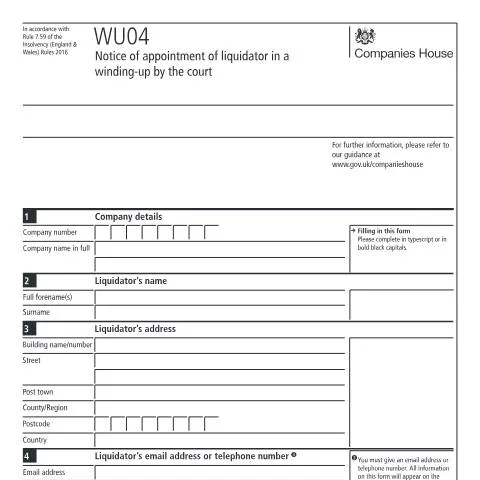
The moment a court orders the winding-up of a company marks a pivotal transition in corporate insolvency proceedings. However, this judicial decision alone doesn't automatically establish who will oversee the liquidation process. The WU04 form serves as the crucial bridge between the court's order and the official recognition of the appointed liquidator's authority by Companies House.
This notice operates under Rule 7.59 of the Insolvency (England & Wales) Rules 2016, establishing a mandatory reporting mechanism that ensures transparency in court-ordered liquidations. Unlike voluntary liquidations where directors or shareholders may have direct involvement, court-appointed scenarios often involve complex stakeholder dynamics where the liquidator's identity and authority must be formally documented on the public register.
The form's significance extends beyond mere administrative compliance. It creates an official public record that creditors, suppliers, employees, and other interested parties can access to understand who holds authority over the company's affairs during the winding-up process. This transparency becomes particularly vital when dealing with companies that may have operated across multiple jurisdictions or maintained complex business relationships.
Understanding Court-Ordered Liquidation Context
Court-ordered winding-up typically occurs when a company cannot pay its debts and creditors petition the court for liquidation. This differs fundamentally from voluntary liquidation scenarios where company directors initiate the process. In court-ordered cases, the Official Receiver initially takes control, but may subsequently appoint a qualified insolvency practitioner as liquidator.
The WU04 form becomes necessary when this appointment occurs, whether the liquidator is:
- A licensed insolvency practitioner appointed by the Official Receiver
- A liquidator appointed directly by the court
- A replacement liquidator following resignation or removal of a previous appointee
- Joint liquidators working in partnership on complex cases
The timing of this notification carries legal implications. The liquidator's powers and duties commence from the date of appointment, but their authority isn't formally recognised on the public register until Companies House processes the WU04 form. This gap can create practical challenges, particularly when the liquidator needs to demonstrate authority to third parties such as banks, landlords, or regulatory bodies.
Decoding the Form's Structure and Essential Information
The WU04 form follows a logical progression that reflects the administrative needs of both Companies House and the insolvency process. The document requires company identification details that must precisely match the information already held on the public register. This matching requirement prevents errors that could delay processing or create confusion about which company is subject to liquidation proceedings.
The liquidator information sections accommodate the reality that insolvency cases may involve joint appointments. The form provides dedicated sections for up to two liquidators, recognising that complex cases often benefit from shared expertise or workload distribution. Each liquidator must provide complete contact details, including either an email address or telephone number that will become part of the public record.
| Information Type | Requirement Level | Public Record Impact |
|---|---|---|
| Company name and number | Mandatory (exact match required) | Links liquidation to correct entity |
| Liquidator full name | Mandatory | Identifies responsible party |
| Complete address | Mandatory | Enables creditor communication |
| Email or telephone | Mandatory (either option) | Provides accessible contact method |
| Appointment date | Mandatory | Establishes authority commencement |
The statement of appointment section requires confirmation of the specific date when the liquidator's authority commenced. This date becomes crucial for determining the validity of actions taken by the liquidator and for calculating time limits that may apply to various insolvency procedures.
The Authority Framework: Who Appoints and Who Reports
The form's design accommodates the various bodies that may appoint liquidators in court-ordered scenarios. The "Name of the person, body or court making the appointment" section reflects the reality that different appointing authorities may be involved at different stages of the process.
Initially, the Official Receiver typically assumes control when a winding-up order is made. However, the Official Receiver may subsequently appoint a qualified insolvency practitioner to take over the liquidation. Alternatively, the court itself may make a direct appointment, particularly in cases involving specific expertise requirements or where stakeholder conflicts necessitate judicial intervention.
The reporting obligation falls on the liquidator themselves, as evidenced by the signature requirement. This personal responsibility ensures that liquidators maintain direct communication with Companies House and cannot delegate this crucial notification to third parties without oversight. The signature also serves as a formal declaration of acceptance of the appointment and its associated duties.
In joint liquidator scenarios, either appointee may submit the form, but the signature confirms that the signatory takes responsibility for the accuracy of all information provided. This approach prevents confusion about which liquidator serves as the primary contact point while maintaining joint accountability for the appointment's validity.
Navigating Joint Appointments and Succession Scenarios
The provision for multiple liquidators reflects the practical realities of complex insolvency cases. Joint liquidators may be appointed when a company's affairs span multiple specialisms, geographical areas, or when the workload justifies shared responsibility. The WU04 form accommodates up to two liquidators in its standard format, though additional liquidators would require supplementary documentation.
Joint appointments raise important questions about authority and decision-making. While the form documents both appointments equally, the actual working arrangements between joint liquidators must be established separately. Some appointments specify that liquidators may act jointly and severally (independently), while others require joint action for all decisions. The WU04 form doesn't capture these nuances, focusing instead on establishing the basic fact of appointment.
Succession scenarios present particular challenges for the notification process. When a liquidator resigns, is removed, or becomes unable to act, a replacement appointment triggers the need for a fresh WU04 form. The timing becomes critical because any gap in properly appointed liquidator authority could compromise ongoing proceedings or create liability issues.
The form doesn't explicitly address whether it should be used to notify the cessation of a previous liquidator's appointment alongside the new appointment. In practice, this may require coordination between outgoing and incoming liquidators to ensure proper documentation of the transition on the public record.
Compliance Timeline and Processing Considerations
While the form itself doesn't specify a deadline for submission, the underlying insolvency legislation and professional obligations create implicit urgency around notification. Liquidators must establish their authority quickly to commence their duties effectively, and delays in filing the WU04 form can create practical obstacles to performing these duties.
Companies House processing times can vary, particularly during periods of high submission volumes. The form includes specific guidance to return it to the Cardiff address for expediency, suggesting that routing to other Companies House offices may result in slower processing. This geographical preference reflects the centralised processing arrangements for insolvency-related filings.
The public record implications commence immediately upon processing. Once Companies House accepts the form, all provided information becomes accessible to public searches. This includes the liquidator's contact details, which may result in direct approaches from creditors, former employees, or other interested parties. Liquidators should prepare for this increased visibility and ensure their contact systems can handle the potential volume of inquiries.
Common processing delays arise from mismatched company details, incomplete liquidator information, or unclear appointment documentation. The form's checklist emphasises verifying that company names and numbers match the public register exactly, as even minor variations can trigger rejection and require resubmission.
Strategic Implications for Stakeholder Communication
The WU04 form serves as more than administrative compliance; it functions as a stakeholder notification mechanism that initiates formal communication channels in the liquidation process. Once filed, the form enables creditors and other interested parties to identify and contact the liquidator directly, bypassing the need to work through court offices or the Official Receiver.
This direct access carries both advantages and responsibilities for liquidators. While it facilitates efficient communication and information gathering, it also exposes liquidators to immediate pressure from various stakeholders who may have competing interests or urgent concerns about the liquidation process.
The requirement to provide either email or telephone contact details recognises modern communication preferences while ensuring accessibility for parties who may not have digital access. However, liquidators should consider the operational implications of their contact method choices, as the provided details will likely receive significant traffic once the appointment becomes public knowledge.
Professional insolvency practitioners often maintain dedicated contact systems for liquidation cases, separating this communication from their general business operations. The WU04 form's contact requirements should align with these professional systems to ensure appropriate response capabilities and proper record-keeping for the liquidation proceedings.
Integration with Broader Insolvency Documentation
The WU04 form operates within a comprehensive framework of insolvency documentation and reporting requirements. It connects with other Companies House forms and court documentation to create a complete public record of the liquidation proceedings. Understanding these connections helps liquidators and advisers coordinate their compliance obligations effectively.
The form references Rule 7.59 of the Insolvency (England & Wales) Rules 2016, positioning it within the broader regulatory framework governing insolvency proceedings. This rule forms part of a comprehensive system designed to ensure transparency and proper oversight of insolvency processes, with the WU04 form serving as a specific component of this larger structure.
Subsequent developments in the liquidation may require additional Companies House filings, such as notices of liquidator resignation or removal, final account submissions, or dissolution applications. The WU04 form establishes the foundation for this ongoing reporting relationship, creating the initial link between the liquidator and Companies House that facilitates future communications and filings.
The form's integration with court documentation becomes particularly important when questions arise about the liquidator's authority or the validity of their appointment. The combination of court orders, Official Receiver documentation, and the Companies House filing creates a comprehensive audit trail that supports the liquidator's position and provides clarity for all stakeholders involved in the process.
Special Circumstances and Variations in Court-Appointed Liquidations
The WU04 notice requirements can vary significantly depending on the specific circumstances surrounding the court-ordered winding-up. Understanding these variations is crucial for ensuring proper compliance with your legal obligations.
Cross-Border and International Elements
When dealing with companies that have international operations or assets, the liquidator appointment notice may require additional considerations. If the company being wound up has subsidiaries or operations in other EU member states, the liquidator must consider whether parallel insolvency proceedings are necessary. The WU04 form itself remains the same, but you may need to provide additional documentation regarding overseas assets or liabilities.
For companies with significant operations in Scotland or Northern Ireland, be aware that while the WU04 applies across all UK jurisdictions, local court rules may impose additional notification requirements. The liquidator should verify whether separate notices need to be filed with relevant local authorities or regulatory bodies in these jurisdictions.
Regulatory and Licensed Companies
Companies operating under specific regulatory frameworks face enhanced notification obligations when a liquidator is appointed. Financial services firms regulated by the Financial Conduct Authority (FCA) or Prudential Regulation Authority (PRA) require immediate notification to these bodies, typically within 24 hours of the liquidator's appointment.
Similarly, companies holding licences from Ofcom, Ofgem, or other sector-specific regulators must ensure these authorities are promptly notified. While the WU04 serves as the primary statutory notice, regulatory bodies often maintain their own notification procedures that run parallel to Companies House requirements.
Licensed premises, such as those holding alcohol licences from local authorities, present particular challenges. The liquidator must determine whether trading can continue under the existing licences and notify the relevant licensing authority accordingly. Failure to provide proper notice could result in automatic licence revocation, potentially affecting asset values.
Timing Considerations and Practical Challenges
The statutory timeframe for filing the WU04 can present practical challenges, particularly when the winding-up order is made late on a Friday or before a bank holiday. Companies House operates standard business hours, and while electronic filing is available, technical issues or system maintenance can occasionally cause delays.
When calculating the 14-day period, remember that this runs from the date of the court order, not from when you become aware of the appointment. If you're appointed as liquidator but only discover this several days later, you're still bound by the original timeline. This underscores the importance of maintaining clear communication channels with the court and all parties involved in the proceedings.
In exceptional circumstances where compliance within the statutory timeframe proves impossible due to circumstances beyond your control, you should file the WU04 as soon as practically possible and consider whether a separate explanatory filing is appropriate. Companies House has discretion in enforcement matters, but documented evidence of reasonable efforts to comply will strengthen your position.
Managing Stakeholder Communications and Disclosure Requirements
The appointment of a liquidator triggers a cascade of communication obligations that extend far beyond the basic WU04 filing. These requirements serve to protect various stakeholder groups and ensure transparency in the winding-up process.
Employee Notification and TUPE Considerations
Employees represent one of the most sensitive stakeholder groups requiring immediate attention following liquidator appointment. While the WU04 provides public notice, employees are entitled to direct communication about their employment status and rights. The liquidator must assess whether any employment contracts can be maintained during the liquidation process or whether immediate termination is necessary.
When employee redundancies are inevitable, the liquidator must consider collective consultation requirements under the Trade Union and Labour Relations (Consolidation) Act 1992. For companies with 20 or more employees, minimum consultation periods apply, and failure to follow proper procedures can result in protective awards that rank as preferential debts in the liquidation.
The Transfer of Undertakings (Protection of Employment) Regulations 2006 may also apply if parts of the business are being sold as going concerns. In such cases, the liquidator must provide detailed information to employee representatives and ensure proper consultation procedures are followed before any transfer completion.
Creditor Communication Strategy
Beyond the statutory WU04 notice, creditors require more detailed communication about the liquidation process and their prospects of recovery. The liquidator should establish a systematic approach to creditor communications, beginning with immediate notification to known creditors and followed by formal meetings as required under the Insolvency Act 1986.
Secured creditors warrant particular attention, as their rights may not be affected by the winding-up order. The liquidator must quickly assess the extent of any fixed or floating charges and establish working relationships with secured creditor representatives. This is especially important where secured creditors may wish to exercise powers of sale over charged assets.
Trade creditors often hold retention of title clauses that could affect asset realisations. The liquidator should request immediate confirmation of any such claims and establish procedures for validating retention of title rights. Early identification of these issues can prevent costly disputes and ensure optimal asset recovery.
Regulatory Reporting and Ongoing Compliance
Court-appointed liquidations often involve companies that were subject to ongoing regulatory reporting requirements. The liquidator must determine which of these obligations continue during the liquidation process and ensure appropriate steps are taken to maintain compliance or formally cease reporting.
Companies that were required to file annual accounts with Companies House face particular considerations. If accounts were due before the winding-up order but remain unfiled, the liquidator should assess whether filing is still required or whether the liquidation relieves this obligation. Similarly, confirmation statements may need to be filed or formally discontinued.
VAT-registered companies require immediate attention to ensure HMRC is notified of the liquidator's appointment and that appropriate arrangements are made for ongoing VAT compliance. The liquidator may need to register for VAT in their own capacity if trading continues during the liquidation process.
Asset Recovery and Realisation Considerations
The appointment of a liquidator immediately crystallises the company's asset position and triggers various legal and practical considerations that can significantly impact recovery prospects for stakeholders.
Immediate Asset Securing and Valuation
Upon appointment, the liquidator assumes legal control over all company assets, but physical securing may present immediate challenges. Assets located on third-party premises, such as goods held by customers or stock in external warehouses, require urgent attention to prevent unauthorised disposal or deterioration.
The liquidator should conduct an immediate asset verification exercise, comparing book records with physical assets where possible. This process often reveals discrepancies that may indicate preferential transactions, asset stripping, or simple record-keeping failures that occurred before the winding-up order.
Intellectual property assets deserve particular attention, as these may not appear prominently in the company's records but could represent significant value. Trade marks, patents, copyrights, and know-how may be exploitable either through licensing arrangements or outright sale. The liquidator should consider engaging specialist IP valuers where significant intellectual property assets are identified.
Investigation Powers and Antecedent Transactions
Court-appointed liquidators possess extensive statutory investigation powers under sections 234 and 235 of the Insolvency Act 1986. These powers enable the liquidator to require former directors, employees, and professional advisers to provide information about the company's affairs and attend for examination under oath.
The liquidator must assess whether any transactions entered into before the winding-up order are vulnerable to challenge as preferences, transactions at undervalue, or transactions defrauding creditors. The relevant look-back periods vary depending on the relationship between the company and the transaction counterparty, with connected party transactions subject to longer review periods.
Director conduct investigation represents another crucial aspect of the liquidator's role. The Company Directors Disqualification Act 1986 requires liquidators to report on director conduct where the company's estimated deficiency exceeds £5,000. This threshold is frequently exceeded in court-ordered liquidations, making director conduct reporting a routine requirement.
Asset Realisation Strategies and Market Timing
The method and timing of asset realisations can significantly impact recovery levels for creditors. The liquidator must balance the need for prompt realisations against market conditions and the potential for enhanced recoveries through strategic timing or asset enhancement.
Business assets may be realisable as going concerns, particularly where the winding-up order relates to financial difficulties rather than fundamental business model failures. The liquidator should quickly assess whether continuing to trade is viable and beneficial to creditors, bearing in mind the personal liability risks associated with wrongful trading during liquidation.
Property assets often represent the most significant realisable value in company liquidations. The liquidator must consider whether immediate disposal is appropriate or whether market timing considerations suggest a delayed sale strategy. However, carrying costs such as insurance, security, and maintenance must be weighed against potential appreciation in asset values.
For companies with seasonal businesses or assets, timing considerations become particularly important. Retail companies with seasonal stock may achieve better realisations if sales are timed to coincide with peak demand periods, provided the additional carrying costs and risks are justified by enhanced recovery prospects.