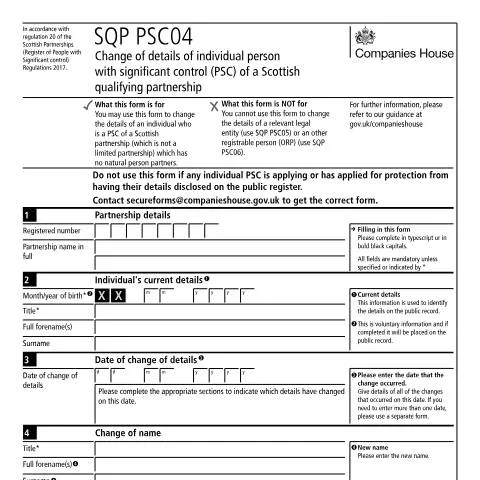
Navigating the SQP PSC04: A Practical Guide to Changing Control Details in Scottish Qualifying Partnerships
Understanding the intricacies of business control is paramount in the UK’s corporate landscape, particularly for Scottish qualifying partnerships (SQPs). When one needs to update the details of a person with significant control (PSC) within such a partnership, the SQP PSC04 notice serves as a crucial instrument. But how does one effectively utilize this document?
The Significance of the SQP PSC04 Notice
The SQP PSC04 notice is not just a routine administrative step; it holds immense significance in the governance of Scottish qualifying partnerships. This document is specifically designed for making amendments concerning individuals who hold significant control within the partnership. It is essential for ensuring transparency and compliance with the Scottish Partnerships (Register of People with Significant Control) Regulations 2017.
Understanding the context of this notice is vital. In Scotland, partnerships may consist of various entities, but the SQP PSC04 specifically caters to those that do not have natural person partners. This is crucial for maintaining accurate records and preventing potential governance disputes.
Who Is A Person With Significant Control?
A PSC is typically defined as an individual who meets one or more of the following criteria:
- Holds more than 25% of the shares in the partnership.
- Holds more than 25% of the voting rights.
- Has the right to appoint or remove a majority of the management.
- Exercises significant influence or control over the partnership.
Understanding who qualifies as a PSC is fundamental, as any changes in control can have far-reaching implications for the partnership's operations and compliance responsibilities.
Step-by-Step: Utilizing the SQP PSC04 Document
To effectively navigate the process of changing details for a PSC using the SQP PSC04, one needs to follow a structured approach. Below is a detailed breakdown of the steps involved:
1. Identify the Changes Required
Before filling out the SQP PSC04, identify precisely which details need to be updated. This could include:
- Name changes
- Change of service address
- Changes in nationality or country of residence
- Alterations in the nature of control held by the individual
2. Gather Necessary Information
Ensure that you have accurate information at hand. This includes:
- Full name and title of the PSC.
- Current and new service address.
- Details of the nature of control (percentage of shares, voting rights, etc.).
- Any other necessary personal details such as date of birth.
3. Completing the SQP PSC04 Form
When filling out the SQP PSC04 notice, adhere to the following guidelines:
- Use typescript or bold black capitals as required.
- Complete all mandatory fields carefully.
- If the usual residential address has changed, make sure to provide the new details accurately. Note that PO Box addresses are not acceptable.
Common Misinterpretations and Their Implications
Misunderstandings regarding the SQP PSC04 can lead to compliance failures. Here are some common pitfalls:
Using Incorrect Forms
The SQP PSC04 is explicitly for changing details of an individual PSC. If the changes involve a relevant legal entity or another registrable person, you must use the correct forms — SQP PSC05 for legal entities and SQP PSC06 for other registrable persons. Failing to do so may result in the rejection of your submission.
Assuming All Changes Are Public
While details submitted via the SQP PSC04 could become part of the public record, not all information is mandatory for public disclosure. For instance, the service address does not need to be the PSC's residential address. If privacy is a concern, be mindful of what information is shared publicly.
Understanding Key Definitions and Terminology
Familiarity with key terms can significantly streamline the process. Here are some important definitions:
| Term | Description |
|---|---|
| Scottish Qualifying Partnership (SQP) | A type of partnership that meets specific legal criteria in Scotland. |
| Significant Control | The ability to influence or control decisions made within the partnership. |
| Service Address | The address where official communications can be sent, which does not need to be the residential address. |
| PSC Regulations | The legislation that mandates the registration and disclosure of persons with significant control. |
Interlinking with Other Documents and Procedures
Understanding the relationship between the SQP PSC04 and other regulatory documents is crucial for maintaining compliance. Here’s how it fits into the larger framework:
Coordinating with Company Registration
When changes are made to the PSC details, it is essential to also consider the broader implications for company registration. Documents such as the Annual Confirmation Statement (CS01) may need to be updated to reflect accurate records regarding ownership and control.
Reporting to Companies House
All changes must be reported to Companies House within the prescribed timeframe to avoid penalties. This is especially important as failure to comply can lead to administrative consequences, such as fines or inquiries into the partnership’s operations.
Practical Scenarios for Using the SQP PSC04
Consider the following scenarios where an SQP PSC04 might be necessary:
Change of a Partnership’s Control Structure
Imagine a situation where a partner has acquired additional shares, thus altering their control status. This scenario necessitates a change to reflect the new distribution of control and influence within the partnership.
Updating Personal Information for a PSC
In cases where a PSC has changed their name due to personal reasons, the SQP PSC04 must be utilized to update this information promptly, ensuring conformity with the public record.
Resources and Further Guidance
While this guide offers a comprehensive overview, further assistance can be sought from various resources:
- The Companies House official website provides ample resources regarding compliance and regulations.
- Seek legal advice if uncertain about the implications of changes made.
- Consult with an accountant familiar with partnerships to ensure financial aspects are covered.
By understanding and utilizing the SQP PSC04 effectively, individuals can ensure their partnerships remain compliant and transparent, reflecting the current state of control and influence within the business structure.
Understanding the Role of Persons with Significant Control in Scottish Qualifying Partnerships
In the context of Scottish qualifying partnerships, it's essential to grasp the concept of Persons with Significant Control (PSC). A PSC is an individual or entity that holds significant influence or control over a partnership's strategic decisions. This typically includes anyone who directly or indirectly holds more than 25% of the voting rights, or who has the right to appoint or remove the majority of the partners. In the case of partnerships, the PSCs are crucial in maintaining transparency in business operations and ensuring compliance with regulatory frameworks.
For partnerships in Scotland, clarifying who holds this significant control is vital for several reasons, including tax implications, legal responsibilities, and accountability. Understanding who qualifies as a PSC ensures that the partnership aligns with the requirements set forth by Companies House and the Financial Conduct Authority (FCA), which oversee business governance and compliance. Additionally, partnerships are often required to gather and maintain accurate records of their PSCs to aid in preventing fraud and maintaining corporate integrity.
Process for Updating PSC Information in the SQP PSC04 Form
Updating the details of a PSC within a Scottish qualifying partnership is a structured process that must be approached methodically. When a change occurs—whether due to a new appointment, a departure, or any alteration in the control percentages—it's imperative to follow the formal procedure for amending the information provided in the SQP PSC04 form.
To initiate this process, the partnership must first convene a meeting of its partners to discuss and approve the proposed changes. Documentation of this meeting, including minutes and any relevant evidence supporting the change in control, should be retained as part of the partnership's records. Once consensus is reached, the partnership must complete the SQP PSC04 form accurately, ensuring that all new details are correct and current.
It’s crucial to note that the SQP PSC04 form requires information such as the PSC’s name, address, and the nature of the control they exert over the partnership. Additionally, any supporting evidence should be submitted alongside the form to substantiate the claims made. Once filled, the form must be submitted to Companies House within 14 days of the change occurring, in order to comply with the legal obligations set forth by the Partnership Act 1890 and related regulations.
Partnerships should also consider the implications of the Data Protection Act 2018 when updating PSC information. Personal data must be handled with care, ensuring that only the necessary information is disclosed and that consent from the PSC is obtained where applicable. Safeguarding personal information is not only a legal requirement but also builds trust among partners and stakeholders.
Consequences of Failing to Update PSC Details
Neglecting to notify changes regarding Persons with Significant Control can lead to serious repercussions for Scottish qualifying partnerships. One significant consequence is the potential for penalties imposed by Companies House, which can include fines or restrictions on the partnership's ability to conduct business. The lack of compliance may also attract scrutiny from regulators, resulting in investigations that could further jeopardize the partnership's credibility and operational capacity.
Moreover, inaccurate PSC information can complicate relationships with financial institutions, impacting the partnership's ability to secure funding or credit. Banks and investors often conduct due diligence by reviewing a partnership's compliance with regulatory frameworks. If discrepancies are found in PSC disclosures, it may lead to a loss of trust and increased difficulty in establishing necessary financial relationships.
In addition to financial and operational consequences, there may be reputational risks associated with non-compliance. Stakeholders, including customers, suppliers, and the general public, may perceive the partnership as lacking transparency, which can deter potential collaborations and partnerships. Maintaining an accurate and up-to-date record of PSCs is not just about compliance; it’s also about fostering a culture of transparency and trust within the business community.