The Strategic Role of Service Representatives in Overseas Company Operations
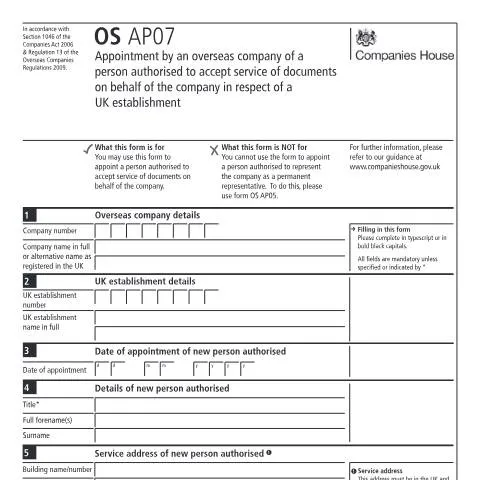
When overseas companies establish business operations in the UK, they enter a complex regulatory landscape that demands reliable channels for official communication. The OS AP07 form serves as the mechanism for appointing authorised persons to receive legal documents on behalf of the company, creating a crucial bridge between international businesses and UK regulatory authorities.
This appointment differs fundamentally from general business representation. Whilst companies may designate various personnel for commercial activities, the person authorised under OS AP07 carries specific legal responsibilities tied to the company's UK establishment. They become the official point of contact for service of documents, including legal notices, regulatory correspondence, and enforcement actions.
The distinction between this role and permanent representation cannot be overstated. Companies House explicitly clarifies that OS AP07 does not create permanent representative status, which requires separate form OS AP05. This separation reflects the different legal frameworks governing service of documents versus ongoing business representation under the Companies Act 2006.
Navigating the Legal Framework for Document Service
The OS AP07 form operates within the strict parameters of Section 1046 of the Companies Act 2006 and Regulation 13 of the Overseas Companies Regulations 2009. These provisions establish that overseas companies must maintain accessible channels for receiving official documents related to their UK establishments.
The legal requirement stems from practical enforcement needs. UK authorities, courts, and regulatory bodies must be able to serve documents reliably, whether for routine compliance matters or urgent legal proceedings. Without a designated service representative, overseas companies risk missing critical deadlines or failing to respond to regulatory requirements.
| Document Type | Typical Source | Service Requirements |
|---|---|---|
| Compliance notices | Companies House | Must reach authorised person within statutory timeframes |
| Tax assessments | HMRC | Service address must be current and monitored |
| Legal proceedings | Courts | Proper service essential for valid legal process |
| Regulatory correspondence | Various authorities | Authorised person must understand forwarding obligations |
The appointment creates legal obligations for both the company and the authorised person. The company remains responsible for ensuring the appointed person fulfils their duties, whilst the authorised person assumes responsibility for proper handling of received documents.
Detailed Analysis of Form Requirements and Completion Procedures
The OS AP07 form demands precise completion across six distinct sections, each serving specific regulatory purposes. Companies House applies stringent validation procedures, and incomplete or inaccurate submissions face inevitable rejection.
Company and Establishment Identification
Sections 1 and 2 require exact matching with existing Companies House records. The overseas company name must correspond precisely with the registered name or approved alternative name on the UK register. Even minor variations in spacing, punctuation, or capitalisation can trigger rejection.
The company number field accepts only the specific alphanumeric identifier assigned by Companies House during the initial overseas company registration process. This number differs from any domestic company registration numbers the parent entity may hold in other jurisdictions.
UK establishment details demand equal precision. The establishment name and number must reflect the specific UK operation being served, not the broader overseas company structure. Companies operating multiple UK establishments must file separate OS AP07 forms for each establishment requiring service representation.
Appointment Date Precision and Legal Implications
Section 3's appointment date carries significant legal weight. This date establishes when the authorised person's responsibilities commence, affecting the validity of document service from that point forward. Companies cannot backdate appointments to cover periods when no authorised person was in place.
The date format follows UK conventions: day, month, year in DD/MM/YYYY format. Companies House systems automatically validate these dates against logical parameters, rejecting future dates that exceed reasonable appointment timeframes.
Authorised Person Details and Eligibility Considerations
Section 4 captures comprehensive identification details for the appointed person. The title field remains optional, marked with an asterisk, but all other fields require completion. Companies House accepts various title formats but recommends standard options (Mr, Mrs, Ms, Dr) for consistency.
Full forenames must include all given names as they appear on official identification documents. Abbreviated forms or initials alone are insufficient. The surname field requires the complete family name without abbreviations or truncations.
Whilst the form does not explicitly restrict eligibility, practical considerations suggest appointing individuals with appropriate legal capacity and UK presence. Minors, individuals lacking mental capacity, or persons subject to certain legal restrictions may face challenges in fulfilling the role effectively.
Service Address Requirements and Public Record Implications
Section 5's service address requirements reflect the fundamental purpose of the appointment. The address must provide reliable document delivery within the UK, creating an accessible point of contact for all official correspondence.
Companies House explicitly prohibits PO Box addresses unless they form part of a complete physical address. DX numbers and Scottish Legal Post (LP) designations cannot substitute for proper street addresses. This requirement ensures that urgent documents reach the authorised person through reliable postal services.
The public record warning deserves careful consideration. All address information becomes publicly accessible through Companies House search services, potentially exposing personal residential details to commercial scrutiny. Many appointed persons opt for business addresses or professional service providers to maintain privacy whilst fulfilling legal requirements.
Address Validation and Postal Reliability
The service address must demonstrate postal deliverability through recognised UK postal services. Remote or inaccessible locations may create practical difficulties for document service, potentially affecting legal compliance deadlines.
Companies should verify address accuracy through postal validation services before submission. Incorrect postcodes or non-existent street addresses will trigger form rejection, delaying the appointment process and potentially leaving the company without proper service representation.
Signature Authority and Filing Procedures
Section 6 restricts signature authority to specific company roles: directors, secretaries, or permanent representatives. This limitation ensures that only persons with appropriate corporate authority can make service appointments affecting the company's legal obligations.
The signature requirement extends beyond mere form completion. The signatory assumes responsibility for the accuracy of all provided information and the appropriateness of the appointment. False or misleading information can result in regulatory sanctions against both the company and the signing individual.
Electronic vs Physical Submission Processes
Companies House accepts OS AP07 forms through multiple channels, each with distinct processing characteristics. Physical submissions to Cardiff, Edinburgh, or Belfast offices follow traditional postal processing timelines, typically requiring 8-10 working days for standard applications.
The form must be completed in typescript or bold black capitals to ensure machine readability. Handwritten submissions face higher rejection rates due to interpretation difficulties in automated processing systems.
Processing Timelines and Registration Outcomes
Upon successful submission, Companies House initiates validation procedures against existing company records. The processing timeline varies depending on submission method, form complexity, and current application volumes.
Standard processing typically completes within 8-10 working days for correctly submitted forms. However, applications requiring additional verification or containing discrepancies may extend processing times significantly. Companies House does not provide expedited processing for OS AP07 forms under normal circumstances.
Public Record Updates and Notification Procedures
Successful appointments generate immediate updates to the public company register. The authorised person's details become searchable through Companies House online services, with address information displayed as submitted on the form.
Companies House does not automatically notify the appointed person of their registration. The appointing company assumes responsibility for informing the authorised person of their new obligations and providing necessary contact information for document forwarding.
Ongoing Obligations and Change Management
The appointment creates continuing obligations for both the company and the authorised person. Changes in personal details, address information, or availability require prompt notification through appropriate form submissions.
Address changes demand particular attention due to their impact on document service reliability. The authorised person should notify the appointing company immediately upon any address change, enabling prompt filing of updated information with Companies House.
Termination and Replacement Procedures
Terminating service appointments requires careful coordination to avoid gaps in representation. Companies should appoint replacement authorised persons before terminating existing appointments, ensuring continuous compliance with service requirements.
The termination process involves separate form submissions to Companies House, with effective dates coordinated to maintain legal compliance throughout the transition period. Gaps in authorised person coverage can expose companies to service difficulties and potential regulatory sanctions.
Integration with Broader Compliance Frameworks
The OS AP07 appointment forms part of a comprehensive compliance structure for overseas companies operating in the UK. The authorised person's role intersects with various regulatory requirements, from annual return filings to responding to enforcement actions.
Companies should consider the authorised person's capacity to handle diverse document types and understand their forwarding obligations. Complex corporate structures may benefit from appointing professional service providers with experience in UK regulatory requirements and document handling procedures.
The appointment also affects the company's broader risk management framework. Reliable document service reduces the risk of missed deadlines, regulatory sanctions, and legal complications that can arise from communication failures between UK authorities and overseas companies.
Regular review of service arrangements ensures continued effectiveness as business operations evolve. Companies expanding their UK presence or modifying corporate structures should reassess their service appointments to maintain appropriate coverage across all establishments and regulatory obligations.
Understanding the Legal Framework and Compliance Requirements
The appointment of an authorised person to accept service of documents operates within a comprehensive legal framework that extends beyond basic company law. The Companies Act 2006 provides the primary statutory foundation, but several other pieces of legislation intersect with this requirement, creating a complex compliance landscape that overseas companies must navigate carefully.
Under Section 1139 of the Companies Act 2006, service of documents on overseas companies can be effected through various means, but having an authorised person provides the most reliable and controlled method. This appointment creates a legal nexus between the foreign entity and the UK jurisdiction, ensuring that legal proceedings, regulatory notices, and official correspondence reach the company through a designated representative who understands local procedures.
The Data Protection Act 2018 and UK GDPR also play crucial roles in this context. When appointing an authorised person, companies must ensure that personal data processing complies with these regulations. The authorised person will inevitably handle personal information contained within legal documents, correspondence from regulators, and potentially sensitive commercial information. This creates data controller and processor relationships that must be properly documented and managed.
Companies operating in regulated sectors face additional considerations. Financial services firms must comply with Financial Conduct Authority (FCA) rules regarding UK representation, while companies in sectors such as pharmaceuticals, telecommunications, or energy may have specific regulatory requirements for UK-based representatives. The authorised person appointment often serves as just one component of broader regulatory compliance strategies.
The Criminal Finances Act 2017 introduced additional obligations for overseas companies regarding unexplained wealth orders and other enforcement measures. Having a properly appointed authorised person ensures that companies receive timely notice of any such proceedings, allowing them to respond appropriately within statutory timeframes.
Brexit has introduced further complexity, particularly for companies that previously relied on EU-wide service mechanisms. The Hague Service Convention now governs many international service procedures, but having a UK-based authorised person often provides a more efficient alternative to formal treaty-based service methods.
Practical Considerations for Different Business Structures
The choice of authorised person varies significantly depending on the overseas company's structure, business model, and long-term UK strategy. Each approach carries distinct practical implications that can affect operational efficiency, cost management, and legal compliance.
Subsidiary companies often appoint directors or senior managers of their UK operations as authorised persons. This approach provides direct control and ensures that the person receiving documents has intimate knowledge of the business operations. However, it also means that key personnel must be available to receive service, which can create complications during holidays, illness, or staff turnover. Companies using this approach should establish clear backup procedures and ensure multiple individuals are familiar with service requirements.
Branch operations typically designate the branch manager or a senior local executive. This creates a direct line of communication between legal proceedings and operational management, but requires careful consideration of the individual's authority to make decisions regarding litigation or regulatory responses. The appointed person should have clear escalation procedures to head office and appropriate decision-making authority for urgent matters.
Representative offices face unique challenges, as these entities often have limited staff and restricted business activities. The authorised person in such cases may be the sole UK representative, creating potential continuity risks. Companies should consider appointing backup authorised persons or establishing relationships with professional service providers who can step in if needed.
Companies operating through distributors or agents without direct UK presence often appoint these commercial partners as authorised persons. While this provides local presence, it can create complications if the commercial relationship deteriorates or if the distributor lacks appropriate professional indemnity insurance. Clear contractual arrangements should address the authorised person's obligations and the procedures for changing appointments if commercial relationships change.
Professional service providers offer advantages for companies seeking to maintain arm's length relationships with UK legal proceedings. Law firms, accountants, and company secretarial services can provide experienced handling of legal documents and often maintain appropriate professional indemnity insurance. However, this approach requires careful selection of providers with relevant expertise and robust procedures for urgent communication with overseas principals.
The authorised person's geographical location within the UK can also affect practical operations. While legal service can be effected anywhere in the UK, companies may prefer appointments in major commercial centres where professional services and legal expertise are readily available. However, this must be balanced against cost considerations and the need for the authorised person to have genuine connections to the business operations.
Technology considerations have become increasingly important, particularly following the COVID-19 pandemic. Authorised persons must be able to receive documents through various means, including electronic service where permitted. Companies should ensure their appointed persons have appropriate IT infrastructure and understand the legal requirements for different types of document service.
Managing Changes and Ongoing Compliance
The appointment of an authorised person is not a static arrangement but requires ongoing management and periodic review to ensure continued effectiveness and compliance. Companies must establish robust procedures for managing changes in appointments, monitoring compliance with filing obligations, and adapting to evolving legal and regulatory requirements.
Change management procedures are critical, as gaps in authorised person appointments can leave companies vulnerable to missed legal deadlines or regulatory notices. The OS AP07 form must be filed within specific timeframes when changes occur, and companies should maintain detailed records of all appointments and changes. Best practice involves appointing replacement authorised persons before terminating existing appointments, ensuring continuous coverage.
Regular compliance reviews should assess whether the current authorised person arrangement remains appropriate for the company's evolving business needs. Factors to consider include changes in business structure, expansion or contraction of UK operations, alterations in regulatory requirements, and the performance of the current authorised person. Companies should establish annual review cycles, with more frequent assessments if business circumstances change significantly.
Communication protocols between the authorised person and the overseas company require careful design and regular testing. The authorised person must have reliable methods to contact key decision-makers in the overseas company, particularly for urgent legal matters. Companies should establish primary and backup communication channels, taking into account time zone differences and the potential need for out-of-hours contact.
The authorised person's authority and decision-making powers should be clearly documented and regularly reviewed. While the primary role involves accepting service of documents, practical situations may require the authorised person to make urgent decisions about legal representation, interim applications, or regulatory responses. Companies should provide clear guidelines about the extent of the authorised person's authority and the circumstances requiring consultation with head office.
Insurance and indemnity arrangements require ongoing attention, particularly where professional service providers act as authorised persons. Companies should regularly review professional indemnity insurance coverage, ensuring it remains adequate for potential liabilities arising from the authorised person role. Internal appointees may require specific indemnification from the company for actions taken in their capacity as authorised persons.
Companies must also monitor regulatory developments that might affect authorised person requirements. Changes in company law, court rules, or sector-specific regulations can alter the practical requirements for authorised persons. Staying informed about such developments requires ongoing attention to legal updates and professional guidance where appropriate.
Record-keeping obligations extend beyond the basic filing of OS AP07 forms. Companies should maintain comprehensive records of all documents served on authorised persons, actions taken in response to such service, and any changes in appointment arrangements. These records may be crucial in legal proceedings or regulatory investigations, and should be maintained in accordance with applicable data protection requirements.
The performance monitoring of authorised persons, particularly external service providers, requires regular assessment. Key performance indicators might include response times to document service, accuracy in forwarding documents to the overseas company, compliance with filing obligations, and effectiveness in handling urgent matters. Regular performance reviews help ensure that the authorised person arrangement continues to meet the company's needs and legal requirements.