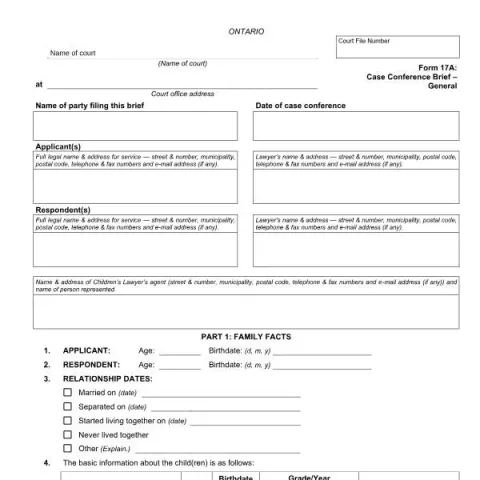
Understanding the Ontario Courts Form 17A: Case Conference Brief – General
The Ontario Courts utilize the Form 17A: Case Conference Brief – General as a critical document in family law proceedings. This form serves as a comprehensive overview of the case facts, issues, and proposed resolutions, facilitating effective case management and settlement discussions during the case conference. It is essential for parties involved in family law disputes to understand how to complete this form accurately and on time to ensure a smooth judicial process.
Purpose and Applicability of Form 17A
The primary purpose of the Form 17A is to provide the court with a detailed summary of the case prior to the scheduled case conference. This conference aims to clarify issues, encourage settlement, and prepare for potential court hearings. The form is applicable in various family law matters, including disputes over decision-making responsibility, parenting time, support, and property division.
Key Sections and How to Complete Them
Part 1: Family Facts
This section gathers basic information about the parties and children involved:
- Applicant and Respondent: Provide full legal names, addresses, contact details, and lawyer information if applicable.
- Family Relationships: Document marriage or separation dates, and whether the parties have lived together.
- Children’s Details: List full names, ages, birthdates, current grades, schools, and who the children are currently residing with.
Part 2: Issues
This section distinguishes between issues already settled and those still in dispute:
- Settled Issues: Indicate which matters, such as decision-making responsibility or support, have been resolved through court orders or agreements.
- Unsettled Issues: Specify remaining disputes and provide the parties’ income details if support is involved.
Additionally, parties should describe any attempts at settlement and whether they have attended parenting education sessions.
Part 3: Issues for the Case Conference
This part focuses on the specific issues to be addressed during the upcoming conference:
- Identify the key facts and issues requiring resolution.
- Propose potential solutions or next steps.
- Indicate if temporary or final orders are sought from the court.
Part 4: Financial Information
Part 4 requires detailed financial disclosure, especially if support claims are involved:
- Attach updated financial statements if there have been significant changes.
- Provide details about child support expenses or reasons why the guideline amount may not be appropriate.
Part 5: Procedural Issues
This section addresses procedural considerations, such as:
- Whether a parenting assessment is necessary.
- If any party needs legal representation from the Children’s Lawyer.
- Compliance with automatic court orders and disclosure requirements.
- Any expert reports or additional procedural orders needed.
Filling Out the Form: Step-by-Step Guidance
Completing the Form 17A involves careful collection of information and adherence to deadlines:
Fill in your form directly online
No printing: type your details into the boxes of the official form, tick, then download the PDF ready to send.
- 1Type into the form boxes
- 2Tick in one click
- 3Save and download the PDF
- Gather all relevant personal, financial, and family details.
- Identify which issues are settled and which remain in dispute.
- Draft proposed resolutions and indicate whether court orders are requested.
- Attach supporting financial documents if support is claimed.
- Review procedural questions to ensure compliance with court rules and orders.
Important Deadlines and Submission Tips
The form must be filed prior to the scheduled case conference date. Failing to submit a complete and accurate Form 17A may result in delays or adverse court decisions. Parties should verify the filing requirements with the local Ontario court office and ensure all attachments are properly included. Typically, the form is served on the opposing party and filed with the court in accordance with local rules.
Post-Submission Considerations
After submitting the Form 17A, parties should prepare for the case conference by reviewing their proposed resolutions and gathering any additional evidence or documentation. The court may use the information provided to facilitate settlement discussions or prepare for a hearing if necessary.
In summary, the Ontario Form 17A is an essential tool for streamlining family law proceedings, promoting transparency, and encouraging settlement. Accurate and timely completion of this form can significantly impact the efficiency and outcome of your case.