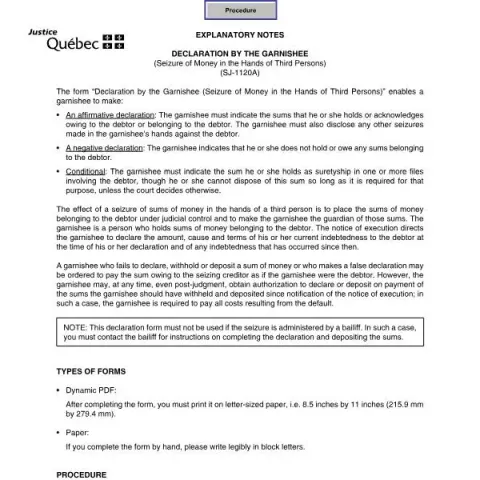
Understanding the "Declaration by the Garnishee" Form (SJ-1120A) in Québec
The "Declaration by the Garnishee" form, designated as SJ-1120A, is an official legal document used within the Province of Québec. Managed by the Ministère de la Justice, this form facilitates the process of seizure of money held by third parties on behalf of a debtor. Whether you are a garnishee, creditor, or court official, understanding how to properly complete and submit this form is essential to ensure compliance with legal procedures and to protect your rights.
What Is the Purpose of the SJ-1120A Form?
The main function of the SJ-1120A form is to record the status of funds held by a third party (the garnishee) that belong to a debtor. It allows the garnishee to declare:
- Affirmatively, the sums they hold or owe to the debtor, including any previous seizures.
- Negatively, that they hold no sums belonging to the debtor.
- Conditionally, sums held as suretyship in ongoing files involving the debtor, which cannot be disposed of unless authorized by the court.
This declaration is crucial in the enforcement of court judgments, as it places the seized funds under judicial control, ensuring proper management until the matter is resolved.
Who Should Complete the Form?
The form is intended for third parties who hold sums of money belonging to a debtor and have received a notice of seizure. These garnishees are legally required to declare the status of these funds within ten days of being served with the notice. Failure to declare or providing false information can result in legal consequences, including being ordered to pay the owed sums as if they were the debtor themselves.
Step-by-Step Procedure for Filling Out the Form
1. Gather Necessary Information
Before completing the form, ensure you have details such as:
- The court file number.
- The name of the debtor and creditor involved.
- The amount of money held or owed to the debtor.
- Details of any previous seizures or sums held as suretyship.
2. Complete the Declaration Section
Depending on your situation, you will select one of the following options:
- Affirmative declaration: Fill in the amount of money held and provide explanations if needed.
- Negative declaration: Indicate that you hold no sums belonging to the debtor.
- Conditional declaration: Declare sums held as suretyship and specify the related files.
3. Sign and Date the Form
Once completed, the form must be signed and dated by the garnishee or their authorized representative. Ensure all information is legible, especially if filling out by hand, using block letters.
Important Deadlines and Submission Requirements
Within ten days of receiving the notice of execution, the garnishee must:
- Submit the completed declaration to the creditor (seizor).
- Notify the debtor of the declaration.
- File the declaration with the court clerk.
- Withhold and remit the seized funds to the court, typically via cheque or bank transfer made payable to the Minister of Finance, referencing the court file number.
Subsequent changes to the declaration, such as new sums held or releases, must be declared immediately to maintain compliance.
Fill in your form directly online
No printing: type your details into the boxes of the official form, tick, then download the PDF ready to send.
- 1Type into the form boxes
- 2Tick in one click
- 3Save and download the PDF
Additional Considerations
If the seizure is administered by a bailiff, this form should not be used. Instead, you must contact the bailiff directly for instructions on completing the declaration and depositing the sums.
For further guidance or to locate the appropriate court, consult the official website of the Ministère de la Justice at www.justice.gouv.qc.ca.
Summary
The SJ-1120A form is a vital legal instrument ensuring transparency and proper management of seized funds in Québec. Accurate completion and timely submission help uphold the legal rights of all parties involved, facilitating the enforcement of court judgments efficiently and fairly.