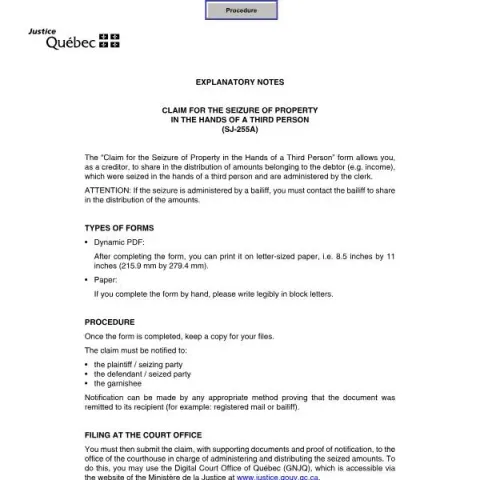
Understanding the SJ-255A Form: Claim for the Seizure of Property in the Hands of a Third Person
The SJ-255A form is an official legal document used within the judicial system of the Province of Québec, Canada. It allows a creditor to claim a share of funds or property that have been seized from a third party holding assets belonging to the debtor. This process is part of enforcement procedures aimed at satisfying a debt when the assets are not directly in the debtor's possession but are held by a third party, such as a bank or employer.
When and Why to Use the SJ-255A Form
This form is typically used after a seizure has been initiated and the assets are in the hands of a third person, known as the garnishee. If you are a creditor seeking to claim your portion of the seized funds or property, the SJ-255A provides a formal mechanism to participate in the distribution process managed by the court clerk. It is essential to understand that if the seizure is administered by a bailiff, you must contact them directly to share in the distribution, as the court’s process applies specifically to seizures managed through the court system.
Key Conditions and Eligibility
To be eligible to file the SJ-255A claim, you must be a creditor with a legal interest in the seized property or funds. The claim is only valid if the seizure is currently in effect and the assets are being administered by the court clerk. The form is applicable for claims related to amounts owed by the debtor, including principal, interest, and disbursements, which have been seized and are awaiting distribution.
Step-by-Step Procedure for Filling Out the Form
1. Identify the Court and File Number
Begin by entering the name of the judicial district and the file number as indicated on the notice sent by the court clerk. This information ensures your claim is properly linked to the relevant case.
2. Provide Details of Parties Involved
- Enter the full name and address of the plaintiff or seizing party.
- Include the name and address of the garnishee, the third party holding the assets.
- Specify the defendant or seized party’s details, including their name and address.
3. Declare the Claim Amount and Supporting Documents
Specify the amounts you are claiming as principal, interest, and disbursements, excluding court costs. Calculate the total claim and list all supporting documents, such as judgments, invoices, or contracts, which justify your claim. Attach original copies of these documents when submitting the form.
4. Complete the Declaration and Sign
Fill in your name, indicate whether you are the claimant, a representative, or an attorney, and provide your attorney or bailiff number if applicable. Sign and date the declaration to certify the information provided.
Notification and Filing
Once completed, the claim must be notified to all involved parties: the plaintiff, the defendant, and the garnishee. Notification should be done through a method that provides proof of delivery, such as registered mail or via a bailiff.
Subsequently, submit the claim along with supporting documents and proof of notification to the courthouse office responsible for managing the seized assets. This can be done physically or through the Digital Court Office of Québec (GNJQ) accessible via the Ministère de la Justice website. Court costs are payable at the time of filing, and further information about these costs can be obtained from the court or the ministry’s website.
Fill in your form directly online
No printing: type your details into the boxes of the official form, tick, then download the PDF ready to send.
- 1Type into the form boxes
- 2Tick in one click
- 3Save and download the PDF
Post-Filing Considerations
After filing, the amounts seized are distributed to creditors every three months. It is important to keep your contact information updated with the court clerk to receive any notices or cheques related to your claim. If you are represented by an attorney, cheques will be issued in the attorney’s name and sent to their address.
In summary, the SJ-255A form provides a structured legal pathway for creditors to claim their rightful share of assets seized from third parties. Proper completion, notification, and submission are crucial steps to ensure your claim is processed efficiently and fairly within the Québec judicial system.