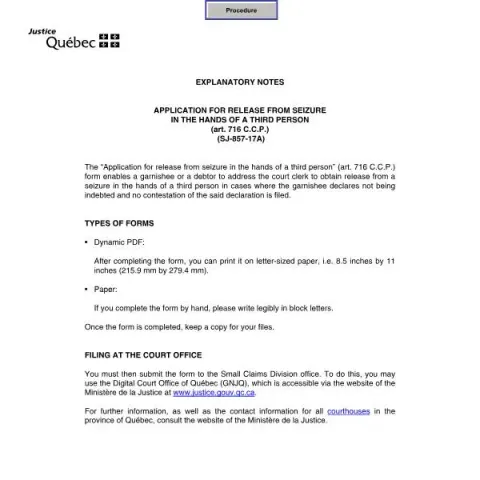
Understanding the Application for Release from Seizure in the Hands of a Third Person (art. 716 C.C.P.)
If you are involved in a legal process where a seizure has been placed on your property or assets in the hands of a third person, you may need to apply to the court for a release. This process is governed by article 716 of the Code of Civil Procedure (C.C.P.) and is facilitated through the official form designated for this purpose by the Canada Court of Québec, Ministère de la Justice. This article explains the purpose of the form, when and how to use it, and key points to consider during the process.
What Is the Purpose of the Form?
The "Application for Release from Seizure in the Hands of a Third Person" form allows a garnishee or debtor to formally request the court to lift a seizure that has been placed on property held by a third party. This situation commonly arises when a creditor (the seizing party) has obtained a court order to seize assets belonging to the debtor, but the assets are held by someone else (the garnishee). If the garnishee declares that they are not indebted to the debtor, and no contestation is filed within the legal timeframe, the debtor can use this form to seek the seizure's release.
When Should You Use This Form?
This form is applicable in situations where:
- A seizure has been made in the hands of a third person, such as a bank account or property held by a third party.
- The garnishee (the third person holding the assets) declares that they are not indebted to the debtor.
- No contestation or dispute has been filed within the prescribed legal period following the declaration.
In such cases, the debtor or garnishee can file this application to request the court to release the seized assets, facilitating the debtor’s access to their property or funds.
How to Complete and Submit the Form
Completing the Form
The form is available in a dynamic PDF format, which can be filled out electronically and printed, or completed by hand in block letters. When filling out the form:
- Ensure all information is clear and legible.
- Accurately specify the date of seizure and details of the third person holding the assets.
- Provide your personal details, including your Social Insurance Number (SIN), as it is used as primary identification.
Submitting the Form
Once completed, the form must be submitted to the Small Claims Division office of the court. You can do this either by:
- Using the Digital Court Office of Québec (GNJQ) accessible via the Ministère de la Justice’s website, which allows for online submission.
- Or by physically submitting a printed copy at the court’s office, ensuring you keep a copy for your records.
Points of Attention and Legal Considerations
Before submitting your application, verify that:
Fill in your form directly online
No printing: type your details into the boxes of the official form, tick, then download the PDF ready to send.
- 1Type into the form boxes
- 2Tick in one click
- 3Save and download the PDF
- The declaration of the garnishee confirms they are not indebted, and no contestation has been filed within the legal timeframe.
- All information provided on the form is accurate and complete to avoid delays or rejection.
- You are aware of the specific court district handling your file, as this can affect where and how you submit your application.
Note that the process involves legal costs, and the court may require additional documentation or evidence supporting your claim for release. It is advisable to consult with a legal professional if you have questions about your specific situation or the process of filing this application.
Final Remarks
The application for release from seizure in the hands of a third person is an essential legal tool to regain control over assets that have been seized under court order, provided the conditions are met. Proper completion and timely submission of the form are crucial to ensure your rights are protected and that the court can process your request efficiently.