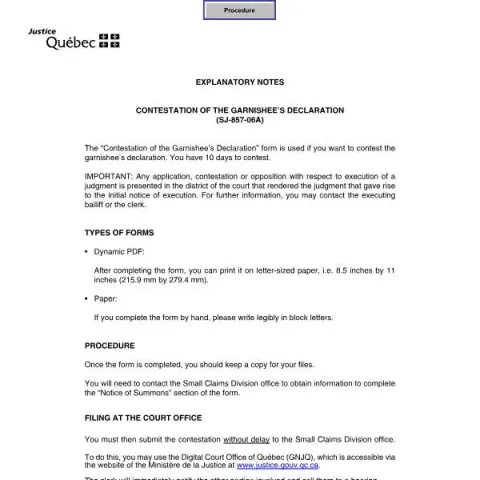
Understanding the Form for Contesting a Garnishee’s Declaration in Québec
If you are involved in a legal process related to the enforcement of a judgment in Québec, you may encounter a situation where a garnishee (a third party holding assets or funds belonging to the debtor) has submitted a declaration regarding the seized assets. If you believe this declaration is incorrect or incomplete, you have the right to contest it by filling out the Form SJ-857-06A, Contestation of the Garnishee’s Declaration. This article explains how this form functions, who should use it, and the steps involved in contesting a garnishee’s declaration effectively.
Purpose and Scope of the Form
The Contestation of the Garnishee’s Declaration form is specifically designed for defendants or debtors who wish to challenge the garnishee’s statement concerning the assets or funds they hold in relation to a judgment enforcement. The form allows you to formally dispute the accuracy of the declaration, whether it concerns the amount owed or the nature of the assets held. It is a legal document used within the Québec judicial system, particularly in small claims proceedings, and must be filed within a strict timeframe.
When and Why to Use This Form
You should consider using this form if:
- You believe that the garnishee’s declaration underestimates the amount owed to you or the debtor.
- You suspect that the garnishee holds additional assets or funds belonging to the debtor that have not been declared.
- You wish to contest the legality or accuracy of the declaration submitted by the garnishee during enforcement proceedings.
It is important to act quickly. You have only 10 days from the date you are notified of the garnishee’s declaration to file your contestation. Failing to do so within this period may limit your ability to challenge the declaration later.
Step-by-Step Procedure for Completing and Filing the Form
1. Gather Necessary Information
Before filling out the form, collect all relevant details, including:
- The case’s district, locality, and file number, as indicated in the judgment or seizure notice.
- The name of the garnishee and the date of their declaration.
- Details of the garnishee’s declaration you wish to contest.
2. Complete the Form Accurately
Follow these key steps:
- Fill in the heading with the district, localities, file number, and the names of the plaintiff and defendant.
- Provide the garnishee’s name and the date of their declaration in the designated section.
- State clearly your grounds for contesting the declaration in the relevant section. This could include discrepancies in the amount owed or the assets held.
- Specify the conclusions you seek, such as dismissing the garnishee’s declaration or ordering the garnishee to pay or remit assets.
- Sign and date the form, indicating your role (e.g., defendant).
3. Keep Copies and Contact the Court
Once completed, retain a copy for your records. You will need to contact the Small Claims Division office to obtain the necessary information to complete the “Notice of Summons” section if applicable.
4. Filing the Contestation
The form must be filed promptly with the Small Claims Division office. This can be done via the Digital Court Office of Québec accessible through the website of the Ministère de la Justice. Filing electronically ensures quicker processing and immediate notification to all involved parties.
Fill in your form directly online
No printing: type your details into the boxes of the official form, tick, then download the PDF ready to send.
- 1Type into the form boxes
- 2Tick in one click
- 3Save and download the PDF
The court clerk will then notify the other parties and schedule a hearing to review the contestation.
Post-Filing Considerations
After submitting your contestation, be prepared to attend the scheduled hearing. The court will review the grounds of your contestation and decide whether the garnishee’s declaration should be upheld, amended, or dismissed. If the court rules in your favor, it may order the garnishee to pay additional funds or remit assets to you or the enforcement officer.
Remember, contesting a garnishee’s declaration is a formal legal process that requires timely action and accurate documentation. If you are uncertain about completing the form or the legal implications, consider consulting a legal professional familiar with Québec civil procedures.