Understanding the Application to Remove a Young Person from Care (Form SJ-881A)
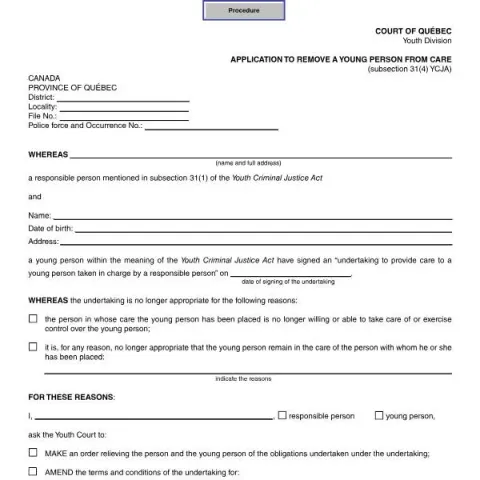
The Application to Remove a Young Person from Care (form SJ-881A) is an official document used in the Youth Division of the Court of Quebec. It serves as a formal request to the court to end the care arrangement of a young person who has been placed under the supervision of a responsible person, typically following an undertaking under the Youth Criminal Justice Act (YCJA). This article provides a detailed overview of the form’s purpose, eligibility criteria, step-by-step filling instructions, deadlines, and subsequent procedures.
Purpose and Scope of the Form
This form is specifically designed for cases where a responsible person or the young person themselves wishes to request the court’s intervention to terminate the existing care arrangement. It is used in situations where the undertaking to care for the young person is no longer appropriate, whether due to changes in circumstances or the inability of the responsible person to continue providing care.
The form is applicable under subsection 31(4) of the Youth Criminal Justice Act (YCJA), which governs the legal procedures for modifying or ending care arrangements for young persons involved in youth justice proceedings. The court’s decision can lead to the removal of the young person from the current care setting, subject to the court’s assessment of the case.
Who Can Fill Out the Form?
The application can be submitted by either the responsible person who has been caring for the young person or the young person themselves, provided they meet the legal criteria. The responsible person must be identified in the original undertaking signed on a specific date, indicating their willingness and capacity to care for the young person.
It is essential that the applicant provides accurate personal details, including full name, date of birth, and address. The form also requires the applicant to specify the reasons why the current care arrangement is no longer appropriate.
Step-by-Step Guide to Filling Out the Form
1. Identifying Information
- Complete the district and locality details, as well as the file number and police force information if applicable.
- Provide the full name, date of birth, and address of the young person involved.
2. Stating the Reasons for the Application
Check the appropriate box(es) to indicate why the current care arrangement is no longer suitable:
- The responsible person is unwilling or unable to care for the young person.
- The care arrangement is no longer appropriate for other reasons, which must be detailed.
3. Making the Request
The applicant must clearly specify whether they are requesting:
- That the court relieve the responsible person and the young person of their obligations under the undertaking.
- That the terms and conditions of the undertaking be amended, specifying the desired changes.
4. Signing and Dating
The form requires signatures from the applicant (either responsible person or young person) and the date of signing. The applicant’s name should be printed in block letters for clarity.
Important Deadlines and Follow-up Procedures
Once the form is completed and submitted to the Youth Court, the court will review the application. There are no explicitly stated deadlines within the form itself, but it is advisable to submit the application promptly to ensure timely court consideration. After the court’s decision, a copy of the order must be sent to the prosecutor, as mandated by the legal process.
Fill in your form directly online
No printing: type your details into the boxes of the official form, tick, then download the PDF ready to send.
- 1Type into the form boxes
- 2Tick in one click
- 3Save and download the PDF
If the court grants the application, an official order will be issued to remove the young person from care. This order must be sent to all relevant parties, including the police and social services involved in the case.
Post-Order Procedures and Implications
Following the court’s order, the responsible person will be relieved of their obligations, and the young person’s care arrangements will be officially changed. It is important to keep a copy of the court order for future reference. If the circumstances change again, or if there are concerns about the young person’s well-being, a new application or legal process may be initiated.
In summary, the SJ-881A form is a critical legal document used within the youth justice system in Quebec to ensure that care arrangements for young persons are appropriate and legally documented. Proper completion and timely submission are essential to facilitate the court’s decision-making process and ensure the best interests of the young person are maintained.