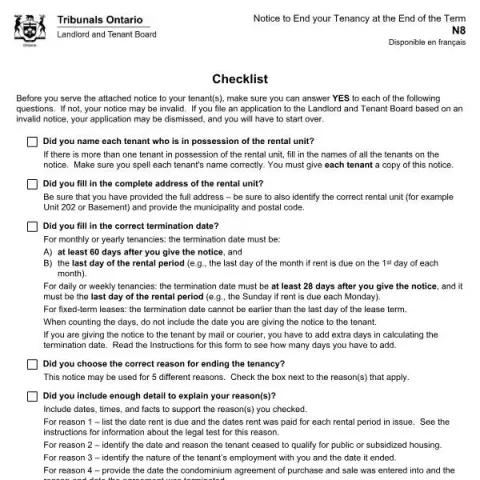
Understanding the "Notice to End Your Tenancy at the End of the Term" Form (N8)
If you are a landlord in Ontario planning to end a tenancy at the conclusion of a lease or rental period, you will need to complete the official "Notice to End Your Tenancy at the End of the Term" form, designated as N8. This legal document, issued by the King's Printer for Ontario, is essential for ensuring that the termination process complies with provincial regulations and that tenants are properly informed of the landlord’s intentions.
Purpose of the N8 Form
The N8 form serves as a formal notification to tenants that their tenancy will be ending at the conclusion of the current lease or rental period. It is used when the landlord has valid reasons for ending the tenancy, such as non-payment of rent, change in tenancy conditions, or other specific legal grounds outlined in Ontario’s Residential Tenancies Act. Properly completing and serving this notice is crucial to avoid invalid notices, which could lead to delays or dismissal of eviction proceedings.
Who Should Fill Out the N8 Form?
This form is intended for landlords who wish to terminate a tenancy at the end of a lease or rental period. It must be filled out by the landlord or their authorized representative. The landlord is responsible for ensuring that all details are accurate, complete, and supported by the appropriate reasons listed in the form. It is also important that each tenant in possession of the rental unit receives a copy of the notice.
How to Complete the N8 Form
1. Identifying the Tenants and Rental Unit
- List all tenants occupying the rental unit, ensuring their names are spelled correctly.
- Provide the full address of the rental property, including street number, street name, unit or apartment number, municipality, province, and postal code.
2. Specifying the Termination Date
- Determine the correct termination date based on the type of tenancy:
- For monthly or yearly leases: at least 60 days after serving the notice, on the last day of a rental period.
- For daily or weekly tenancies: at least 28 days after serving the notice, on the last day of the rental period.
- For fixed-term leases: no earlier than the last day of the lease.
- Remember to add extra days if the notice is sent by mail or courier, as per the instructions.
3. Selecting the Reason for Ending the Tenancy
- Check the box(es) corresponding to the valid reason(s) for ending the tenancy, such as non-payment of rent, loss of eligibility for subsidized housing, or other legal grounds.
- Provide detailed supporting information, including relevant dates, facts, and circumstances, to justify the reason(s) checked.
4. Signing and Dating the Notice
The form must be signed and dated by the landlord or authorized agent. An unsigned notice may be considered invalid and could delay the eviction process.
Additional Tips for Filling Out the N8 Form
- Double-check the spelling of all tenant names and the accuracy of the property address.
- Ensure the reason(s) for ending the tenancy are clearly explained with supporting details.
- Verify that the termination date complies with legal requirements based on the tenancy type.
- Remove the checklist section before serving the notice to avoid confusion.
Where and How to Serve the Notice
The completed N8 form must be served directly to each tenant in person, by mail, or courier. It is recommended to keep proof of service, such as a signed acknowledgment of receipt or a courier receipt, in case the landlord needs to demonstrate proper delivery during legal proceedings.
Fill in your form directly online
No printing: type your details into the boxes of the official form, tick, then download the PDF ready to send.
- 1Type into the form boxes
- 2Tick in one click
- 3Save and download the PDF
Common Mistakes to Avoid
- Failing to list all tenants in possession of the unit.
- Providing an incorrect or inconsistent termination date.
- Not supporting the reason for ending the tenancy with sufficient details.
- Forgetting to sign and date the notice.
By carefully completing the N8 form according to the guidelines, landlords can ensure they follow the legal process for ending a tenancy at the end of the term, reducing the risk of disputes or delays in eviction proceedings.