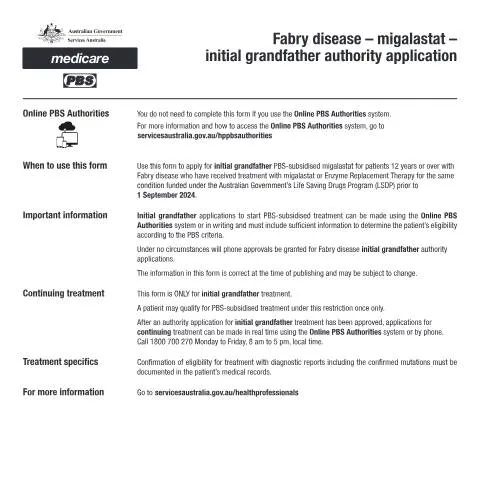
Navigating the PB374: Understanding the Application for Migalastat in Fabry Disease
For health professionals navigating the complexities of Fabry disease treatment, the PB374 - Fabry disease - migalastat - initial grandfather authority application form serves a critical function. Providers seeking to secure access to migalastat for their patients must understand this form's nuances and implications, as incomplete or incorrect submissions can delay vital treatment. This guide delves into the details of the PB374, offering insights on its completion, submission, and the essential follow-up steps involved.
Decoding the Structure of the PB374 Form
Familiarity with the PB374 form's structure is essential for ensuring a smooth application process. Each section is designed to elicit specific information critical for the assessment of the application.
Identifying Information
The initial part of the form requests identifying information about both the health professional completing the form and the patient in question. This section often includes:
- Practitioner’s name and contact details
- Practice address
- Patient’s name, date of birth, and Medicare number
One potential pitfall is inaccurately entering the Medicare number; a mismatch here can lead to immediate pushback from Services Australia. Always double-check the patient’s Medicare card before submission.
Clinical Information Section
Next is the clinical information section, which requires detailed medical history and current treatment specifics. Health professionals must provide accurate details about:
- Diagnosis of Fabry disease
- Previous treatments attempted
- Current symptoms and their severity
Be cautious when documenting prior treatments; the administration places significant emphasis on understanding what has or hasn’t worked previously. Ambiguities here can lead to questions or delays.
Evidence of Need for Treatment
The PB374 form uniquely necessitates explicit evidence supporting the need for migalastat. This section should contain detailed clinical justification for the treatment, including:
- Clinical efficacy evidence of migalastat for the patient’s specific type of Fabry disease
- Any relevant test results or diagnostic imaging
When preparing this evidence, ensure that it is both current and comprehensively addresses the patient’s condition. Submitters should attach any relevant reports or letters from specialists to strengthen their case.
Gathering Supporting Documentation
As the PB374 requires various supporting documents, understanding what to include can significantly bolster the application. Here’s a list of suggested documentation:
| Document Type | Description |
|---|---|
| Patient's Medicare Card | A current card showing the patient’s details. |
| Clinical History | Detailed report from the prescribing doctor outlining diagnosis and treatments. |
| Test Results | Laboratory confirmation of Fabry disease and other pertinent investigations. |
The inclusion of these documents not only provides a more robust application but also helps to expedite the review process. Remember, all documents should be clear and legible; illegible submissions can lead to immediate rejection.
Submission Process: What to Expect?
Once the PB374 and supporting documentation are prepared, the next step is to submit the application. The submission process is straightforward but requires attention to detail:
- Review the entire application for completeness and accuracy.
- Submit the form and documentation through the designated channels outlined by Services Australia.
- Retain copies of everything submitted for your records.
After submission, expect a waiting period for the review of the application. This timeframe can vary based on workload and the complexity of individual cases. During this time, it is prudent to keep a record of submission confirmation, as it may be necessary for follow-ups.
Responding to Application Outcomes: Acceptance and Rejections
Receiving the outcome of the PB374 application can be a pivotal moment for both health professionals and patients. Should the application be accepted, it opens the door for the patient to receive necessary treatment. However, if rejected, understanding the process for addressing this is equally vital.
What to Do Upon Acceptance
In the event of a successful application, the next steps involve:
- Communicating the approval to the patient.
- Initiating the prescribed treatment plan.
- Monitoring the patient's response to treatment and reporting any adverse effects.
Addressing a Rejection
Facing a rejection requires a clear understanding of the reasons provided. Common reasons may include insufficient clinical justification or missing documentation. Here’s how to navigate a rejection:
- Carefully review the rejection notice to identify specific issues.
- Gather any additional evidence or documentation that addresses these concerns.
- Prepare a response to Services Australia that includes the new information, clearly articulating the need for reconsideration.
It's important to approach the resubmission with detailed documentation, as repetition of previous errors may lead to further delays or rejections.
Follow-up and Tracking Your Application
Maintaining communication with Services Australia post-submission is crucial. Health professionals should actively monitor the status of their application by:
- Utilizing the tracking features available through myGov, if applicable.
- Contacting Services Australia directly for updates, especially if delays exceed typical timeframes.
- Documenting all communications for reference.
Engaging proactively with Services Australia can facilitate faster resolutions and highlight the urgency of treatment when necessary. Health professionals should be prepared to provide additional information promptly if requested.
Understanding the Implications for Patients
Completing the PB374 form and securing approval for migalastat is not merely a procedural step; it has significant ramifications for the patient’s health journey. Understanding these implications is vital for both health professionals and patients alike.
Rights and Responsibilities
For patients, receiving approval for treatment entitles them to several rights:
- Access to necessary medications without undue delay.
- The right to appeal if a rejection occurs.
However, with these rights come responsibilities. Patients should ensure they attend all required follow-up appointments and adhere to the treatment regime. Failure to comply may lead to complications, including the potential cessation of medication approval.
Consequences of Incomplete Applications
Submitting an incomplete or incorrect application can have direct consequences for patient care. Delays in processing may lead to:
- Deterioration of the patient’s health condition.
- Increased medical costs due to unmanaged symptoms.
- Frustration and confusion for both the patient and healthcare providers.
To mitigate potential issues, health professionals must prioritize accuracy and completeness when preparing the PB374 form.
Final Thoughts: Enhancing the Application Experience
Successfully navigating the PB374 application process requires diligence and detailed attention to the requirements set by Services Australia. As treatment protocols evolve, remaining informed about changes in guidelines or documentation requirements is crucial for health professionals. Engaging with peer networks or professional forums to discuss experiences can also provide valuable insights and support.
In sum, the PB374 application is not just a bureaucratic hurdle; it is a gateway to essential treatment for patients with Fabry disease. A comprehensive understanding of the process, from filling out the form to managing application outcomes, empowers healthcare professionals to advocate effectively for their patients' needs.
Understanding Fabry Disease and Its Management in Australia
Fabry disease, a rare genetic condition, is caused by a deficiency of the enzyme alpha-galactosidase A. This deficiency leads to the accumulation of globotriaosylceramide (Gb3) in various tissues, resulting in a range of symptoms including pain, kidney dysfunction, and cardiovascular issues. Though the disease is inherited in an X-linked pattern, both males and females can be affected, albeit with varying degrees of severity.
In Australia, the management of Fabry disease often involves a multidisciplinary approach, including regular monitoring and treatment options aimed at alleviating symptoms and reducing complications. Enzyme replacement therapy (ERT) has traditionally been the standard treatment; however, recent advancements have introduced oral therapy options such as migalastat, which may be suitable for certain patients based on their specific genetic mutations.
Health professionals and patients should engage in thorough discussions regarding treatment options, taking into account the patient’s overall health and disease progression. It's also essential to stay updated with the latest research and clinical guidelines, as the management of such rare diseases can significantly evolve over time.
Application Process for Grandfather Authority for Migalastat
The initial grandfather authority application form, PB374, is crucial for patients seeking access to migalastat through the Pharmaceutical Benefits Scheme (PBS) in Australia. This process is designed to ensure that patients with Fabry disease who meet specific eligibility criteria can receive the medication subsidized by the government.
To initiate the application, patients must work closely with their healthcare provider, who will need to complete the PB374 form. This form requires comprehensive clinical information, including the patient's diagnosis, previous treatments, and justification for why migalastat is the most appropriate medication for their condition. Given the complexities surrounding genetic conditions, it is vital that the healthcare provider has a thorough understanding of the patient’s medical history and current health status to adequately complete the form.
Additionally, patients need to ensure that all supporting documents, such as genetic test results and detailed treatment history, are attached to the application. This information is key for the assessment process by the appropriate authorities, which can help expedite the approval. Patients are encouraged to be proactive in following up on their application status through their healthcare provider.
Patient Support Resources and Advocacy in Australia
For individuals dealing with Fabry disease, having access to support resources and advocacy groups can make a significant difference in managing their health and navigating the healthcare system. Various organisations in Australia provide valuable information, resources, and community support tailored specifically for those affected by rare diseases like Fabry.
These organisations often facilitate patient education workshops, provide access to medical professionals experienced in treating Fabry disease, and offer emotional support groups. Patients and their families can benefit from sharing experiences and strategies for coping with the physical and emotional challenges associated with the disease.
Moreover, advocacy groups play a crucial role in raising awareness of Fabry disease within the wider community and advocating for better access to treatment and support services. By engaging with these organisations, patients can find a sense of community and empowerment, which is essential for navigating the complexities of living with a chronic condition.
The collaboration between patients, healthcare providers, and advocacy groups can significantly enhance the overall quality of care, promote research initiatives, and contribute to policy changes that benefit individuals with Fabry disease at both local and national levels.