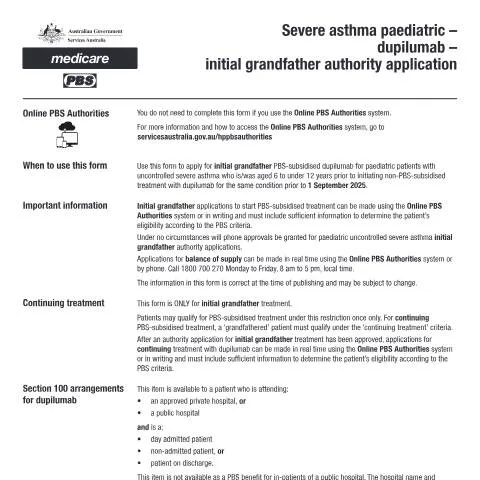
Understanding the Severe Asthma Paediatric Authority Application Process
For parents and guardians navigating the complexities of paediatric severe asthma management, the Severe asthma paediatric - dupilumab - initial grandfather authority application form (PB386) serves a pivotal role. This document is not just a mere formality; it is essential for securing critical medication that can significantly improve a child’s quality of life.
Who is Involved in the Application Process?
The application is typically initiated by a healthcare professional—often a specialist in respiratory health or paediatrics—who assesses the child's condition and prescribes dupilumab as a necessary treatment. Parents or guardians must collaborate closely with their healthcare provider to ensure all necessary information is accurately conveyed to Services Australia.
The Healthcare Professional’s Role
- Evaluates the child's health condition.
- Prescribes dupilumab when other treatments have proven ineffective.
- Completes the PB386 form with pertinent details about the child's health status.
Parents and Guardians: Key Responsibilities
- Ensure the healthcare professional has all necessary medical history and documents.
- Monitor the child’s response to treatments and provide updates to the healthcare provider.
Framework and Historical Context of the Application
The PB386 form is entrenched in Australia's healthcare delivery framework, aimed at providing timely access to essential medications for severe asthma management in children. The provision for authorisation of high-cost medicines like dupilumab is rooted in policies designed to alleviate the financial burden on families while ensuring that children receive appropriate care.
Over the years, the Australian government has recognised the growing prevalence of severe asthma in children, leading to enhanced provisions for treatment access. Dupilumab, an innovative therapeutic option, has emerged as a treatment of choice in severe cases, necessitating a robust application process to facilitate its use through the public healthcare system.
The Significance of the PB386 Form in Treatment Access
Completing the PB386 form is a critical step in obtaining a grandfather authority for dupilumab. This authority permits the dispensing of the medication without the upfront cost normally associated with high-cost therapies. The authority, once granted, relieves families of substantial financial obligations involved in accessing life-changing treatments.
Process Flow of Application
- Assessment by the healthcare professional.
- Completion of the PB386 form with detailed medical information.
- Submission to Services Australia for review.
- Awaiting approval notification, which will indicate whether the authority has been granted.
Timelines and What to Expect After Submission
As with any administrative process, understanding the timeline is essential. While exact timeframes can vary based on workload and specific circumstances, it is advisable for families to prepare for a waiting period post-submission.
Once the application is submitted, Services Australia will review the details provided in the PB386 form. Typically, the review process aims to confirm the medical necessity of dupilumab for the child’s specific situation.
Potential Outcomes of the Application
After the evaluation, there are several possible outcomes:
- Approval: The family receives an authority number, leading to subsidised access to dupilumab.
- Request for Additional Information: Services Australia may require more details to make a fully informed decision.
- Denial: In cases where the information does not meet the required criteria, families will be notified of the reasons for the refusal.
Submission Channels: Navigating Options for Application
The PB386 form can be submitted through various channels, which cater to different preferences and situations. Understanding these options can facilitate a smoother application experience.
Online Submission via myGov
For those who prefer a digital approach, the myGov platform provides a straightforward means of submitting the PB386. Parents or guardians should ensure they have linked their Services Australia account to their myGov profile.
Papers and In-person Options
Alternatively, for those who may not have access to online services, paper submissions can still be made. It’s crucial to ensure that all sections of the PB386 form are filled accurately, as incomplete forms can lead to delays.
Preparing Supporting Documents: A Detailed Look
When completing the PB386 form, it is critical to gather all required supporting documents. These documents substantiate the claims made in the application and can include:
- Medical history documents detailing asthma severity and prior treatments.
- Prescriptions indicating the need for dupilumab.
- Any relevant test results that support the diagnosis of severe asthma.
Varied Situations and Their Document Needs
| Situation | Required Documents |
|---|---|
| New Application | Complete medical history; recent prescriptions. |
| Renewal Application | Updated progress notes; response to previous treatments. |
| Request for Additional Information | Clarifying documents as specified by Services Australia. |
Distinctions Between PB386 and Other Forms
It’s important to differentiate the PB386 from other similar applications to avoid confusion. The PB386 specifically applies to dupilumab for severe asthma in children, while other forms may pertain to different medications or conditions.
Understanding the unique nature of the PB386 ensures that families do not inadvertently submit the wrong documentation, which can lead to unnecessary delays in treatment access.
Related Forms and Their Purposes
- Continued Treatment Application: For patients already on dupilumab seeking ongoing authority.
- Alternative Asthma Treatment Application: Pertains to therapies other than dupilumab and may require different documentation.
Final Thoughts on Navigating the PB386 Form
Engaging with the PB386 application process can initially seem daunting; however, understanding its importance and the steps involved can vastly improve the experience for families seeking critical medications for their children. Collaboration with healthcare professionals and thorough preparation of supporting documentation will bolster the chance of a successful application.
Families embarking on this journey should feel empowered by their role in advocating for their child’s health needs, knowing that resources are available to guide them through the process.
Understanding Severe Asthma in Paediatric Patients
Severe asthma is a complex and challenging condition that affects a significant number of children in Australia. It is characterized by frequent exacerbations, daily symptoms, and the need for high doses of inhaled corticosteroids or systemic corticosteroids. Clinicians must be aware of the clinical presentation and the various triggers that can lead to acute asthma attacks in children.
To qualify for treatments like dupilumab, the severity of asthma must be clearly demonstrated through a thorough assessment, which includes clinical history, lung function testing, and possibly allergy testing. The assessment should ideally be conducted in a coordinated manner involving paediatricians, respiratory specialists, and allergists. This multidisciplinary approach ensures that all aspects of the child's health are considered, including potential comorbid conditions such as allergic rhinitis or eczema, which commonly co-occur with asthma.
Moreover, it's essential for healthcare providers to educate families regarding the nature of severe asthma, self-management strategies, and the importance of adherence to treatment plans. This understanding not only empowers families but also enhances the overall management of the condition, reducing hospital admissions and improving quality of life.
Eligibility Criteria for Initial Grandfather Authority Application (PB386)
The Initial Grandfather Authority Application Form (PB386) plays a significant role in securing access to dupilumab for paediatric patients with severe asthma. It is crucial to understand the eligibility criteria that must be met for a successful application.
Patients must have a documented diagnosis of severe asthma, requiring confirmation from a specialist in respiratory medicine or paediatrics. Additionally, the following conditions must be satisfied:
- The child must be aged between 6 and 17 years.
- The patient must have a history of asthma exacerbations despite optimal treatment, which typically includes high-dose ICS (Inhaled Corticosteroids) and a second controller medication (such as a LABA or leukotriene receptor antagonist).
- Clinical evidence must indicate that the patient has been on a stable dose of asthma medications for a certain duration, often around three months, before applying for dupilumab.
- Allergy testing may be required to rule out other causes of exacerbations or to confirm atopic conditions that may coexist with asthma.
It is also pertinent to include any recent spirometry results and peak flow measurements, as these will demonstrate the severity of the condition. Furthermore, parents or guardians should be prepared to provide information on previous treatment history, including any adverse reactions to standard therapies.
Steps to Complete the PB386 Application Form Efficiently
Filling out the Initial Grandfather Authority Application Form (PB386) can be daunting due to its intricate nature and the critical information that must be conveyed. Here are step-by-step instructions to complete the form efficiently:
- Gather Required Documents: Ensure that all necessary documentation is in order before beginning the application. This includes medical history, previous treatment details, and spirometry or peak flow results.
- Start with Patient Information: Accurately fill out the child's details, including their name, age, and Medicare number. This section is crucial for identification and processing by Services Australia.
- Detail the Asthma History: In the section dedicated to the clinical history, be comprehensive yet concise. Explain the impact of asthma on the child's daily life, including missed school days and any hospital admissions.
- Document Current Treatment: Clearly outline the current asthma management plan. Include specific medications, dosages, and the duration for which these treatments have been used. Highlight any side effects experienced if applicable.
- Provide Supporting Evidence: Attach any additional documentation that reinforces the need for dupilumab. This can include letters from specialists, recent test results, or previous prescriptions.
- Review and Submit: Once completed, thoroughly review the application for accuracy. It is recommended to have a colleague or another healthcare professional review the submission to catch any errors or omissions. Submit the form electronically via myGov or postal mail, depending on the preference.
By adhering to these steps, healthcare providers can enhance the likelihood of a successful application for dupilumab through the Initial Grandfather Authority Application Form (PB386).