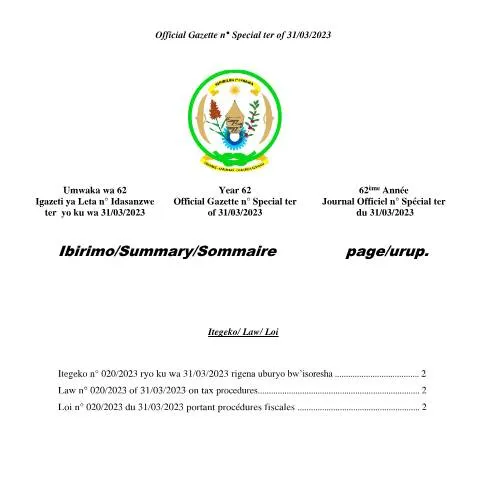
Understanding the Official Gazette Notice on Tax Procedures in Rwanda
The Official Gazette of Rwanda, in its special edition published on March 31, 2023, introduces a comprehensive legal framework concerning tax procedures through Law No. 020/2023. This legislative act aims to streamline and clarify the processes related to tax collection, taxpayer obligations, and administrative procedures in accordance with the country's legal standards. This article provides an overview of the key elements of this law, its scope, and the implications for taxpayers and tax authorities in Rwanda.
Scope and Purpose of the Law
The primary objective of Law No. 020/2023 is to establish clear, consistent procedures for the assessment, collection, and management of taxes within Rwanda. It aims to enhance transparency, efficiency, and compliance in tax administration, aligning with Rwanda's broader efforts to modernize its fiscal system. The law applies to all taxpayers subject to tax obligations under Rwandan law, covering various forms of taxes, including income, value-added tax, and other fiscal levies.
Key Provisions and Structural Framework
General Provisions
The law begins by defining essential terms and establishing the authority responsible for tax enforcement, which is typically the Rwanda Revenue Authority (RRA). It specifies the legal language used in communication, the methods for calculating deadlines, and the procedures for issuing tax rulings. These provisions aim to standardize interactions between taxpayers and tax authorities, ensuring clarity and legal certainty.
Taxpayer Registration and Identification
A significant component of the law pertains to taxpayer registration. It mandates that all taxpayers must register with the RRA, which assigns a unique taxpayer identification number (TIN). This number is crucial for all tax-related activities, including filing returns and making payments. The law emphasizes the importance of accurate registration to facilitate effective tax administration and compliance.
Accounting, Record-Keeping, and Tax Declaration
Taxpayers are required to maintain proper accounting books and records, which must be kept in accordance with the law. This includes the use of electronic invoicing systems, where applicable, to ensure transparency and facilitate audits. The law also stipulates the deadlines for submitting tax declarations and the procedures for requesting extensions, reinforcing the importance of timely compliance.
Tax Assessment and Notification
The law details the process for issuing tax assessments and notifications of tax due. Tax authorities are responsible for preparing assessment notices that specify the amount of tax owed, based on the information provided by the taxpayer or determined through audits. Taxpayers are entitled to receive written notifications, which serve as official documentation of their tax obligations.
Implications for Taxpayers and Tax Authorities
- For taxpayers: The law emphasizes the importance of accurate registration, diligent record-keeping, and timely submission of tax declarations. It also clarifies procedures for requesting extensions and handling disputes related to assessments.
- For tax authorities: The law provides a structured framework for tax collection, assessment, and enforcement, aiming to improve efficiency and reduce disputes.
References and Enforcement
This legal framework aligns with Rwanda's broader fiscal policies and legal standards, including the Law No. 22/2018 relating to civil, commercial, labor, and administrative procedures. It underscores the commitment of the Rwandan government to modernize tax administration and ensure compliance through clear legal provisions and effective enforcement mechanisms.
Conclusion
The publication of Law No. 020/2023 in the Official Gazette marks a significant step towards enhancing Rwanda's tax system. By establishing detailed procedures for registration, record-keeping, declaration, and assessment, the law aims to foster a transparent, efficient, and taxpayer-friendly fiscal environment. Taxpayers, tax professionals, and authorities are encouraged to familiarize themselves with these provisions to ensure compliance and facilitate the smooth functioning of Rwanda's tax administration.