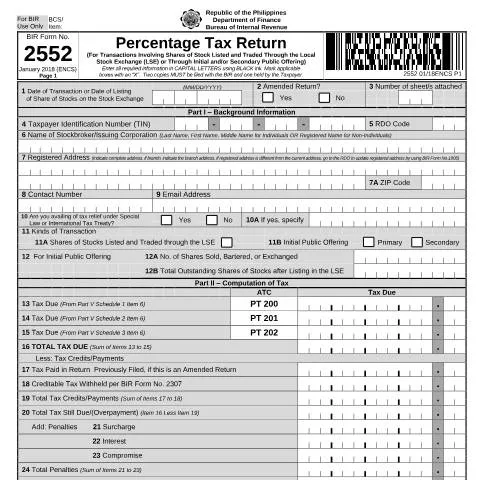
Navigating the Complexities of BIR Form No. 2552
In the bustling world of investment in the Philippines, compliance with tax regulations is paramount, especially for transactions involving shares of stock. The BIR Form No. 2552, officially titled the Percentage Tax Return for Transactions Involving Shares of Stock Listed and Traded Through the Local Stock Exchange or Through Initial and/or Secondary Public Offering, plays a vital role in this ecosystem. This document is not merely a formality but a regulatory requirement that ensures transparency and adherence to local tax obligations.
Understanding Who Must File BIR Form No. 2552
This form is required for individuals or entities engaged in the sale, barter, or exchange of stock traded on the local stock exchange. The following profiles commonly need to submit this form:
- Individuals: Retail investors and stockholders who engage in selling shares.
- Corporations: Companies that issue shares and engage in public offerings.
- Stockbrokers: Agents who facilitate transactions on behalf of their clients.
Each of these profiles has unique nuances that can affect tax liability, especially when considering the implications of tax relief measures under special laws or international tax treaties. For example, foreign investors might have different obligations and may need to include additional documentation to substantiate claims for tax relief.
Dissecting the Sections of BIR Form No. 2552
The form is structured into various sections, each requiring specific information that is crucial for accurate tax computation. Understanding these sections can help taxpayers avoid common pitfalls.
Part I – Background Information
- Date of Transaction: Enter the date in MM/DD/YYYY format—accuracy is essential.
- Taxpayer Identification Number (TIN): This is critical for processing; ensure it is correct to avoid delays.
- Stockbroker/Issuing Corporation Name: This section requires the full legal names, which must be consistent with registration documents.
Part II – Computation of Tax
This section involves calculating the tax due based on the sale, barter, or exchange of shares. The relevant tax rates apply here, and it's essential to have accurate figures in:
- Tax Due: Ensure that all applicable sales figures are reported.
- Penalties: Be mindful of any penalties that could increase the total amount owed.
Part III – Details of Payment
In this part, taxpayers must provide information on how they plan to pay the calculated tax. Different payment methods exist, such as cash, checks, or tax debit memos.
Crucial Distinctions from Similar Forms
The BIR Form No. 2552 can often be confused with other tax-related forms. However, it's distinct due to its focus on transactions involving publicly traded stocks. Unlike the BIR Form 1700, which pertains to personal income tax returns, or BIR Form 2551Q for quarterly percentage tax, this document specifically addresses the nuances of stock transactions.
Understanding these distinctions is essential for accurate filing and avoiding potential audits or penalties.
Compliance and Consequences of Non-Submission
Failing to file BIR Form No. 2552 can have serious repercussions. Not only can it lead to penalties, but it can also impact an individual's or corporation's ability to engage in future transactions. Compliance with tax obligations is not just a legal requirement; it is vital for maintaining a good standing in the financial markets.
For instance, late submissions may incur interest penalties, and repeated failures can lead to more severe consequences, including audits by the BIR. Thus, it is crucial to understand the timelines for submission and ensure all filings are completed accurately.
Preparing for Submission: Gathering Necessary Documents
Before filing, it is essential to gather all necessary documentation to support the information provided on the form. These may include:
- Proof of Transaction: Documentation for each transaction must be maintained, including sales invoices and contracts.
- Tax Compliance Certificates: These validate that past tax obligations have been met.
- Additional Forms: Depending on the nature of the transaction, other forms may be required to support claims for tax relief.
Common Challenges in Completion
Many individuals find certain sections of the form challenging, particularly when determining the correct tax rates applicable to transactions. The Alphanumeric Tax Code (ATC) indicates specific transactions and must be adhered to meticulously. For example, transactions classified under:
| ATC | Taxable Transaction | Tax Rate |
|---|---|---|
| PT 200 | Sale, Barter, or Exchange of Shares of Stock Listed and Traded through the LSE | 0.6% |
| PT 201 | Sale/Exchange of Shares of Stock through Primary Public Offering | 4% |
| PT 202 | Sale/Exchange of Shares of Stock through Secondary Public Offering | Varies |
Incorrect entries or misclassification can lead to significant financial repercussions, including overpayments or audits.
Additional Considerations for Foreign Investors
Foreign entities and individuals dealing with local stocks must pay special attention to the submission requirements of BIR Form No. 2552. In many cases, they are subject to different withholding tax rates and may avail themselves of tax treaties to reduce their tax burden. Understanding the intricacies of these treaties and ensuring compliance with the corresponding laws is vital to avoid unnecessary tax liabilities.
Conclusion: The Importance of Accurate Filing
Filing BIR Form No. 2552 is not merely a bureaucratic step; it is a fundamental part of participating in the Philippine stock market responsibly. Accurate, timely submissions ensure the smooth operation of financial transactions and protect taxpayers from penal consequences. By understanding the form's requirements and implications, individuals and corporations can navigate their tax obligations with confidence and clarity.
Filing Procedures for BIR Form No. 2552
Filing BIR Form No. 2552 is a crucial process for individuals and corporations involved in transactions concerning shares of stock listed and traded through the local stock exchange or public offerings. The filing process can be categorized into several steps to ensure compliance with the Bureau of Internal Revenue (BIR) regulations.
Firstly, taxpayers must gather all necessary documents that substantiate the transactions involving the shares. This includes, but is not limited to, copies of the stock certificates, transaction slips, and any related contracts. Documentation is indispensable as it provides evidence of the transactions undertaken and supports the accuracy of the information reported in the tax return.
Secondly, the taxpayer must accurately complete BIR Form No. 2552. This form requires detailed information about the taxpayer, including Tax Identification Number (TIN), the nature of the transaction, and the total percentage tax due. It's pivotal to ensure that all information is filled with precision to avoid discrepancies that may result in penalties or delays.
After completing the form, the next step is to file it through designated channels. Taxpayers have the option to file electronically via the eBIRForms system or submit a hard copy to the local Revenue District Office (RDO). Electronic filing is generally encouraged as it provides a more efficient way to manage submissions and can expedite the processing of returns.
Lastly, once the form is filed, the taxpayer must ensure the payment of the corresponding percentage tax. The payment can also be made online through authorized payment channels or at banks accredited by the BIR. It’s important to retain the payment confirmation as proof of compliance, which may be required for future reference or audit purposes.
Common Pitfalls and How to Avoid Them
When filing BIR Form No. 2552, taxpayers may encounter several common pitfalls that can lead to mistakes and complications. Awareness of these issues is vital for ensuring a smooth filing process.
One frequent mistake is the failure to include all relevant transactions. Taxpayers should meticulously review all transactions involving shares of stock to ensure that no activity is overlooked. Missing transactions can not only lead to incorrect tax calculations but may also result in penalties imposed by the BIR for underreporting.
Another typical error is incorrect information entry on the form itself. Taxpayers should double-check all entries for accuracy, especially the TIN, amounts, and transaction details. Utilization of the eBIRForms system can help mitigate this risk, as the system prompts users to review their entries before final submission.
Additionally, many taxpayers neglect to keep proper documentation. It is essential to maintain organized records of all transactions and relevant documents, as these may be required for verification by the BIR. Establishing a systematic filing system will aid taxpayers in retrieving necessary documents when needed.
To avoid complications regarding payment of taxes, taxpayers should ensure they are aware of deadlines for both filing and payment. These dates are crucial to avoid incurring interest and penalties. Setting reminders and using calendar tools can assist in tracking these important dates effectively.
Impact of Tax Compliance on Future Transactions
Compliance with BIR Form No. 2552 not only fulfills regulatory obligations but also has a strategic impact on future transactions involving shares of stock. A clean tax record can enhance a taxpayer’s credibility with financial institutions and potential investors, thereby facilitating easier access to financing and investment opportunities.
Proper compliance demonstrates to stakeholders that the taxpayer is responsible and adheres to legal requirements. This reputation can lead to more favorable terms in future transactions, such as lower interest rates on loans or more attractive investment partnerships. Conversely, a history of non-compliance can deter potential investors and limit access to markets.
Moreover, businesses that maintain compliance with tax obligations are likely to face fewer audits and scrutiny from the BIR. A transparent tax history can reduce the risk of unexpected tax liabilities arising from audits, which often occur as a result of previous inconsistencies in reporting or payment.
Ultimately, the impact of diligently filing BIR Form No. 2552 extends beyond mere compliance; it fosters a proactive approach toward financial management and lays a solid foundation for future business endeavors.