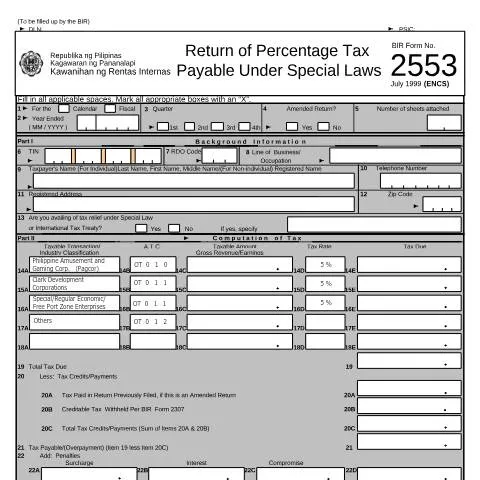
Understanding BIR Form No. 2553: Return of Percentage Tax Payable Under Special Laws
The Bureau of Internal Revenue (BIR) in the Philippines requires certain taxpayers to file specific tax returns to ensure compliance with the country's tax laws. Among these is the BIR Form No. 2553, known as the Return of Percentage Tax Payable Under Special Laws. This form is essential for taxpayers subject to percentage tax under various special laws, including those operating within economic zones, free port zones, or under specific legislative provisions.
Scope and Purpose of BIR Form No. 2553
The primary purpose of this form is to declare and remit the percentage tax due by taxpayers who are liable under special laws. Unlike regular value-added tax (VAT) or percentage tax filings, this return caters to entities or individuals whose tax obligations are governed by specific legislative acts or regulations outside the standard VAT system. The form captures detailed information about the taxpayer, their taxable transactions, and the computation of tax liabilities, ensuring transparency and compliance with legal requirements.
Who Should File the Return?
All taxpayers who are mandated by law to pay percentage tax under special laws are required to file BIR Form No. 2553. This includes:
- Operators within economic zones or free port zones
- Entities under specific legislative exemptions or privileges
- Organizations like the Philippine Amusement and Gaming Corporation (Pagcor) or Clark Development Corporation
- Other industries or enterprises specified by law as subject to percentage tax
Taxpayers must ensure they are registered with the BIR and have a valid Taxpayer Identification Number (TIN) before filing this return.
Filing and Payment Procedures
Filing Deadlines and Locations
The return must be filed on or before the due date for the payment of the respective percentage tax, as stipulated in the applicable special law. Filing is generally done through any Authorized Agent Bank (AAB) within the territorial jurisdiction of the Revenue District Office (RDO) where the taxpayer is registered. In areas without an AAB, the return can be filed directly with the Revenue Collection Officer or the duly authorized City or Municipal Treasurer within the RDO jurisdiction.
Payment of Tax
Upon filing the return, the total tax payable must be settled at the same location where the return is filed. Payment can be made via bank deposit, check, or other authorized means. The lower portion of the return form must be machine-validated and stamped by the bank to serve as proof of payment. This validation indicates the date, amount paid, and transaction code. Additionally, the bank or collection officer will issue an official receipt or bank debit advice, which serves as official proof of remittance to the BIR.
Completing the Return
The form requires detailed information, including:
- Taxpayer's TIN, RDO code, and business line or occupation
- Taxpayer's registered name, address, and contact details
- Details of taxable transactions, including gross revenue or earnings, applicable industry classification, and tax rates
- Calculation of the total percentage tax due, any credits or payments already made, and the net amount payable or overpaid
- Declaration of accuracy and truthfulness by the taxpayer or authorized representative
Legal and Regulatory References
The filing and payment of this return are governed by the provisions of the National Internal Revenue Code of 1997, as amended, and the regulations issued by the BIR. Penalties for non-compliance include surcharges, interest, and possible criminal sanctions, emphasizing the importance of timely and accurate submission of the return.
Additional Attachments and Considerations
Taxpayers are advised to attach supporting documents such as:
- Certificate of Creditable Tax Withheld at Source (BIR Form No. 2307), if applicable
- Tax Debit Memo, if applicable
- Proof of previous payments or filings in case of amendments
It is crucial to ensure all background information is correctly filled out to avoid penalties or delays in processing. Proper compliance with filing deadlines and payment procedures helps maintain good standing with the BIR and avoids penalties such as surcharges or interest charges.