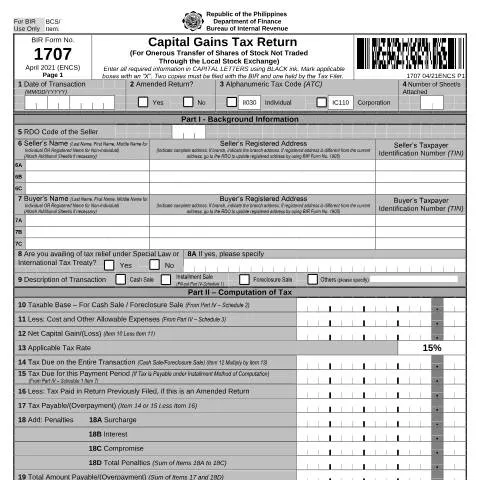
Navigating the Capital Gains Tax Landscape: BIR Form No. 1707
Understanding the intricacies of tax regulations is crucial for any individual or corporation engaging in the transfer of shares not traded on the local stock exchange in the Philippines. When it comes to capital gains tax, BIR Form No. 1707 is an essential document that must be carefully filled out and submitted to the Bureau of Internal Revenue (BIR). This article delves into the nuances of this form, its purpose, who needs to file it, and the steps required to ensure compliance.
Who Should File BIR Form No. 1707?
This form is specifically intended for the onerous transfer of shares of stock that are not traded through the local stock exchange. This typically includes:
- Individuals: Private shareholders who sell their shares, either as a one-time transaction or in installments.
- Corporations: When a corporation engages in transactions involving the sale of shares owned or held by it.
- Non-Philippine residents: Foreign investors must also comply, particularly if they have shares in Philippine corporations.
It is crucial to recognize the significance of the Alphanumeric Tax Code (ATC) specified in the form, which denotes the category under which the taxpayer falls. For instance, if the transfer is executed by an individual, the ATC will be marked as II030, while corporations will use IC110.
Filling Out BIR Form No. 1707: Key Sections
The form itself comprises several parts, each necessitating accurate and thorough information:
Part I - Background Information
This section requires vital information pertaining to both the seller and the buyer, including:
- Date of Transaction
- Seller's and Buyer's Names and Taxpayer Identification Numbers (TIN)
- Registered Addresses
- Type of transaction (cash sale, installment sale, etc.)
Particular attention should be paid to the section where it asks about tax relief under special laws or international tax treaties. If applicable, specifying this can significantly impact the tax obligations of the seller.
Part II - Computation of Tax
This is a critical part of the form where taxpayers compute the capital gains tax due. The steps involved include:
- Determining the Taxable Base by using Part IV - Schedule 2.
- Subtracting allowable costs and expenses (Part IV - Schedule 3) to arrive at the Net Capital Gain/(Loss).
- Applying the applicable tax rate, which is currently set at 15% for both individuals and corporations.
- Calculating the total tax due, including any penalties or interests for late payments.
Part III - Details of Payment
In this section, taxpayers will outline how the tax payment has been made, including:
- Method of payment (cash, bank debit memo, check, etc.)
- Date of the transaction
- Amount paid
It is advisable to keep all receipts and validation details, as they may be required for future reference or audits.
Submission Process and Important Deadlines
Once the form is completed, it needs to be submitted to the relevant BIR office, along with two copies of the form. Here’s an overview of the submission process:
- Determine the right Revenue District Office (RDO): The RDO where the seller is registered must be identified for filing.
- Prepare for submission: Ensure all required information is filled out in capital letters and in black ink, marking applicable boxes with an “X.”
- File before the deadline: The deadline for filing BIR Form No. 1707 is April 15 of the following calendar year for transactions occurring within the previous year.
Not adhering to the deadlines can incur penalties, so it is prudent to file early. If there are discrepancies or difficulties encountered during filing, contacting the BIR or consulting with a tax professional can be beneficial.
Addressing Common Issues and Concerns
Even with meticulous attention to detail, issues can still arise during the completion or submission of BIR Form No. 1707. Below are some strategies for managing such situations:
In Case of Refusal or Denial
If the BIR denies the return or requests additional documentation, taxpayers can:
- Review the BIR’s feedback carefully to understand the reasons for the denial.
- Gather any additional required documents and resubmit the form within the timeframe specified by the BIR.
- Consider filing an appeal if the reason for denial is unclear or seems unjustified.
Rectifying Errors
In the event of an error in the filed BIR Form No. 1707:
- Amend the tax return by completing a new form and marking it as "Amended Return."
- Provide correct details in the appropriate sections, ensuring to highlight changes made.
It’s important to remember that amending a return does not exempt taxpayers from penalties if the original filing was submitted late.
Special Considerations for Foreign Nationals
Foreign investors face a unique set of challenges when filing BIR Form No. 1707. The following considerations must be made:
- Understanding the implications of international tax treaties that may reduce tax liabilities.
- Ensuring compliance with both Philippine laws and the tax regulations of the investor's home country.
- Utilizing the services of local tax professionals who can navigate the complexities of cross-border taxation.
Linking Form No. 1707 to Broader Financial Obligations
BIR Form No. 1707 does not exist in a vacuum; it is part of a larger framework of tax obligations that must be managed. Here’s how it connects to other financial obligations:
- Income Tax Returns: Filing this form is essential to accurately report capital gains in the broader context of annual income tax returns.
- Tax Refunds: If there’s an overpayment, taxpayers should utilize BIR Form No. 1914 for refunds.
- Documentation: Retaining copies of all tax filings is essential for maintaining comprehensive financial records.
Understanding Your Obligations Post-Submission
After filing BIR Form No. 1707, it’s crucial for taxpayers to stay informed about their obligations:
- Keep track of payment due dates for subsequent tax liabilities, especially if the tax is to be paid in installments.
- Monitor for any updates from the BIR regarding changes to tax laws and regulations that may impact future filings.
- Engage with tax advisers for ongoing financial planning and compliance assurance.
Conclusion: Staying Informed and Prepared
Filing BIR Form No. 1707 is not merely a procedural requirement but a vital component in the landscape of taxation in the Philippines, especially for those involved in share transactions. By understanding its intricacies, ensuring accurate completion, and maintaining compliance with deadlines, individuals and corporations can navigate this obligation successfully. It is advisable to stay updated on any regulatory changes and seek professional advice whenever necessary to ensure that all transactions remain compliant with the Bureau of Internal Revenue.
Understanding the Nature of Capital Gains Tax and Its Application in the Philippines
Capital gains tax (CGT) in the Philippines, particularly under BIR Form No. 1707, primarily applies to the sale of shares of stock that are not traded through the local stock exchange. This tax obligation is established under the National Internal Revenue Code (NIRC) which mandates that any profit earned from the sale of shares of stock, termed “onerous transfers,” is subject to taxation. It's important to distinguish between different types of shares and their treatment under tax law.
The gain is determined by the selling price or the fair market value of the shares sold, minus the cost or adjusted basis of the shares. This can include any costs associated with the acquisition of shares, such as broker fees or other transactional costs. Understanding these nuances is vital for individuals and corporations engaging in stock transfers as they relate directly to the computation of the taxable gain.
In instances where shares are inherited or gifted, special rules may apply. For example, if shares are passed down from an estate, the basis for determining gain may be adjusted to reflect the fair market value at the time of the decedent’s death, potentially limiting the capital gains tax liability for heirs.
It is also crucial for taxpayers to know their obligations regarding payment and filing. The capital gains tax is generally imposed at a rate of 15% as of the latest updates, although different rates may apply based on the specifics of the transaction. Proper filing and payment are required within 30 days of the sale, with penalties for late submissions or failures to comply with tax obligations.
Filing Process for BIR Form No. 1707: Step-by-Step Guide
Filing BIR Form No. 1707 requires careful attention to detail and adherence to the proper procedures outlined by the Bureau of Internal Revenue (BIR). Below is a step-by-step guide to assist taxpayers in completing the form correctly and timely.
- Gather Necessary Documents: Before beginning the filing process, collect all relevant documents including the Deed of Sale, proof of payment for any selling prices, and any documentation supporting the basis cost of the shares sold. This may include purchase receipts and agreements.
- Complete BIR Form No. 1707: The form consists of several sections requiring details such as the seller and purchaser’s information, the description of the shares, the date of sale, selling price, and the cost or adjusted basis of the shares. Be thorough when filling out these sections to avoid misreporting, which could lead to penalties.
- Calculate the Capital Gains Tax: Utilize the rates provided under the current tax regulations to compute the tax due based on the reported gain. Ensure that the computation aligns with the latest guidelines from the BIR.
- Submit the Form: After completing the form, the next step is submission. Taxpayers have the option of submitting the form through the BIR's e-filing system or in person at the appropriate Revenue District Office (RDO). Ensure to keep copies of all documents submitted for your records.
- Pay the Capital Gains Tax: Payment is typically made at the same time as filing the form. Payment can be done via authorized agent banks or through the BIR's online payment facility. Make sure to obtain a copy of the payment receipt as proof of payment.
- Confirmation and Acknowledgment: Once the form is submitted and payment is made, the BIR will issue a confirmation. It is essential to retain this as part of your records in case of future audits or inquiries.
Common Pitfalls and How to Avoid Them When Filing BIR Form No. 1707
While filing BIR Form No. 1707 may seem straightforward, taxpayers often encounter certain pitfalls that can lead to penalties or complications. This section highlights common mistakes and preventative measures to ensure compliance with the tax regulations.
- Incomplete Information: One of the most frequent errors involves submitting forms with missing or incorrect information. Ensure that all required fields are filled out completely and accurately. Cross-check details against supporting documents to avoid discrepancies.
- Misunderstanding Capital Gains Calculations: Taxpayers sometimes miscalculate their gains by failing to account for the adjusted basis of the stock or not including all associated costs. Take the time to verify each component of the gain calculation to ensure accuracy.
- Missing Deadlines: Failing to file within the designated 30-day period after the sale can result in significant penalties. Ensure you are aware of your deadlines and set reminders to avoid last-minute rushes.
- Improper Payment Methods: Using unauthorized payment channels can delay processing and lead to complications. Always use methods approved by the BIR to ensure your payment is properly recorded.
- Neglecting Record Keeping: Not retaining copies of submitted forms and payment receipts can be detrimental. Always keep thorough records of all transactions and tax filings for potential future reference or audits.
By fostering diligence in filing and maintaining a clear understanding of the requirements associated with BIR Form No. 1707, taxpayers can navigate the complexities of capital gains tax effectively and avoid common pitfalls.