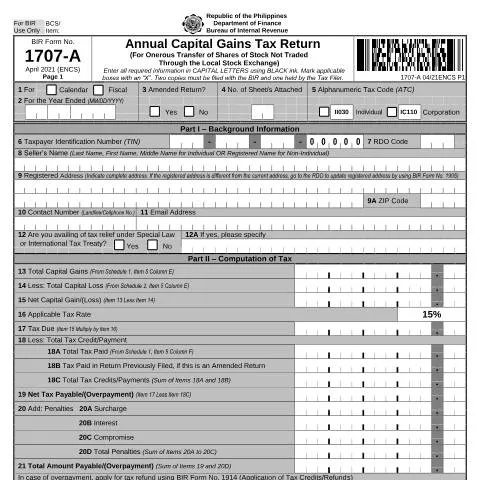
Navigating the Intricacies of BIR Form No. 1707-A: A Comprehensive Guide
Filing taxes is crucial for any individual or business involved in the transfer of shares not traded through the local stock exchange. For those who find themselves in this scenario, the BIR Form No. 1707-A—Annual Capital Gains Tax Return for Onerous Transfer of Shares of Stock Not Traded Through the Local Stock Exchange—becomes an essential document. Understanding its nuances can pave the way for smoother compliance and avoidance of penalties. Here, we dissect the essential elements of this form to provide you with a detailed roadmap.
Understanding the Stakes: What the BIR Form 1707-A Means for You
When you engage in the sale of stocks that are not publicly traded, you may encounter capital gains tax obligations. The BIR Form No. 1707-A facilitates the process of reporting these gains to the Bureau of Internal Revenue (BIR). Here’s why this form is pivotal:
- Legal Obligation: Filing the form is a mandatory requirement under the National Internal Revenue Code.
- Implications of Non-Compliance: Failure to file can lead to penalties, including fines and additional tax liabilities.
- Claiming Tax Credits: Proper filing may allow you to offset taxes owed with credits from prior payments, minimizing financial liabilities.
When to File: The Critical Timeline for Form 1707-A
For calendar year taxpayers, the deadlines for submitting BIR Form No. 1707-A can significantly impact your financial standing. Below is a breakdown of critical dates:
- Filing Period: The form must be submitted on or before April 15 of the year following the transfer of shares.
- Extensions: In some cases, extensions may be granted, but prior approval from the BIR is essential.
Demystifying the Form: Key Sections and Common Pitfalls
The BIR Form 1707-A comprises several sections, each requiring accurate and precise information. Below, we break down each part to ensure clarity:
Part I – Background Information
This section gathers essential data about the taxpayer:
- Taxpayer Identification Number (TIN): Ensure that the TIN is correct; errors can lead to processing delays.
- Registered Address: Any discrepancies here must be reported to the relevant RDO using BIR Form No. 1905.
- Contact Information: Providing up-to-date contact details is crucial for any follow-up queries.
Part II – Computation of Tax
Accurate tax computation is vital to avoid overpayment or underpayment:
- Total Capital Gains: Derived from Schedule 1; ensure all transactions are documented.
- Capital Losses: Recorded in Schedule 2, these can be deducted from gains to determine net taxable income.
Who Needs to Fill Out Form 1707-A? The Profile of Tax Filers
While the form primarily targets individuals and corporations that transfer shares, specific circumstances dictate who exactly must file:
- Individuals: Those selling stocks owned personally or through partnerships.
- Corporations: Any domestic or foreign corporation engaging in the transfer of shares must comply with this requirement.
- Exceptions: Certain tax reliefs under special laws or international tax treaties may exempt specific filers from capital gains tax obligations.
Necessary Documents: Preparing Your Paperwork
To successfully file the BIR Form 1707-A, certain documents are indispensable:
- Transaction Records: Documents that detail each sale, including selling price and date of transaction.
- Related Tax Documents: Any previous tax returns and payments relevant to the current reporting period.
- Authorization Letters: If an authorized representative is filing on your behalf, appropriate documentation must be attached.
Handling Errors: What to Do in Case of Filing Mistakes
Even the most diligent taxpayers may submit incorrect forms. Here’s how to address common issues:
- Amended Returns: If you realize an error post-filing, you can submit an amended return using the same BIR Form No. 1707-A, marking it clearly as “Amended Return.”
- Missing Information: If crucial sections were left incomplete, expeditiously complete the form and submit it again, along with any penalties.
Charting Your Post-Filing Journey: Next Steps After Submission
Once you submit BIR Form 1707-A, the following procedures unfold:
- Processing Time: The BIR generally processes returns within 30 days. However, any discrepancies may extend this timeline.
- Payment of Taxes: Ensure payments are made promptly to avoid penalties. Use the details provided in Part III of the form.
- Tax Refunds: If overpayments occur, you can apply for a tax refund using BIR Form No. 1914.
The Bigger Picture: BIR Form 1707-A within Philippine Tax Obligations
Filing the BIR Form 1707-A is not an isolated task but part of a broader landscape of tax compliance in the Philippines:
- Integration with PhilSys: The national ID system is becoming essential for tax-related services, ensuring that all taxpayers are linked to their unique identifiers.
- Connecting with Other Forms: It’s crucial to understand how this form interacts with other income tax returns and declarations, such as BIR Form No. 1700 for individual income tax.
Conclusion: Empowering Yourself through Knowledge
Understanding BIR Form No. 1707-A goes beyond merely filling out a form. It entails recognizing the obligations and benefits inherent in the process. By being informed and prepared, you unlock opportunities for proper tax compliance and financial management, paving the way for future transactions.
In the fluctuating landscape of stock transactions, taking the initiative to understand your obligations under the BIR is not just advisable—it's necessary.
Understanding the Scope of BIR Form No. 1707-A
The BIR Form No. 1707-A is specifically designed for the Annual Capital Gains Tax Return applicable to the onerous transfer of shares of stock that are not traded through the local stock exchange. This form primarily caters to individuals and corporations engaged in the transfer of shares not listed on the Philippine Stock Exchange (PSE). The necessity for this form arises from the obligation to report capital gains realized from the sale of shares, ensuring compliance with the provisions outlined in the National Internal Revenue Code (NIRC).
The capital gains tax imposed on these transactions is 15% of the net capital gains, calculated based on the selling price or the fair market value of the shares at the time of transfer, whichever is higher. The use of Form No. 1707-A facilitates the accurate reporting of these transactions to the Bureau of Internal Revenue (BIR), helping taxpayers fulfill their tax liabilities in accordance with local regulations.
Taxpayers should be acutely aware of the distinctions between shares traded on the local stock exchange and those that are not. While shares traded through the PSE are subject to different regulations and forms, the onerous transfer of shares not listed on the exchange requires specific attention to detail, particularly in the documentation and calculation of gains. This differentiation is paramount as it affects taxation rates, reporting requirements, and potential exemptions.
Filing Procedures and Considerations for BIR Form No. 1707-A
Filing BIR Form No. 1707-A entails several critical steps that must be adhered to in order to ensure compliance. First and foremost, it is essential to gather all necessary documentation related to the transfer of shares. This includes the original and duplicate copies of the Deed of Sale or any other relevant contracts, as these documents serve as proof of the transaction and establish the basis for reporting capital gains.
Next, taxpayers must accurately compute the capital gains realized from the transfer. This involves determining the selling price and subtracting the cost or adjusted basis of the shares sold. For taxpayers who acquired their shares at different points in time or through various means (such as inheritance or gifts), meticulous record-keeping becomes indispensable. Taxpayers should also be cognizant of any allowable deductions that may further reduce the taxable capital gains, such as expenses directly associated with the sale.
Once the computations are complete, taxpayers can proceed to fill out Form No. 1707-A. It is crucial to ensure all information is entered accurately to avoid complications or penalties. This form can be submitted either manually at the local BIR Revenue District Office (RDO) or electronically through the BIR's official e-filing and payment system. Taxpayers are advised to keep a copy of the filed form and any supporting documentation for future reference, as the BIR may request these documents during audits.
After submission, the taxpayer is required to pay the corresponding capital gains tax. Payments can be made at authorized banks or via the BIR's online payment channels. Failure to pay the tax on time may result in additional penalties and interest charges, underscoring the importance of adhering to the deadlines set forth by BIR regulations.
Common Issues and Resolutions Related to BIR Form No. 1707-A
Taxpayers often encounter various challenges when filing BIR Form No. 1707-A, which can lead to delays or complications in tax compliance. One of the most common issues is the incorrect reporting of capital gains due to errors in calculation or misunderstandings regarding the basis of the shares sold. To mitigate this risk, it is advisable for taxpayers to consult with a tax professional who can provide guidance on appropriate valuation methods and ensure that all gains are reported accurately.
Another frequent issue involves the documentation required to substantiate the transfer of shares. Taxpayers must ensure that all required documents, such as the Deed of Sale and any pertinent transfer certificates, are duly executed and filed with the BIR. If there are discrepancies or missing documents, it can lead to penalties and a reassessment of tax liabilities. Therefore, meticulous record-keeping is crucial throughout the transaction process.
Taxpayers may also face challenges related to the timeframes for filing and paying taxes. The deadline for filing Form No. 1707-A is typically on or before April 15 of the year following the transfer. Missing this deadline can result in fines and additional charges, prompting taxpayers to stay vigilant about their filing obligations. To alleviate stress and ensure compliance, utilizing the BIR's e-filing platform can expedite the process and provide immediate confirmation of submission.
In cases where taxpayers believe they have been assessed incorrectly or received unfavorable treatment from the BIR, they have the right to appeal. The process for appealing a BIR assessment is detailed in the Administrative Code of 1987. Taxpayers must adhere to specific procedures, which generally involve submitting a formal protest to the BIR along with supporting evidence to substantiate their position. It is advisable to seek the assistance of a tax attorney or consultant during this process to navigate the complexities of tax legislation and administrative procedures effectively.