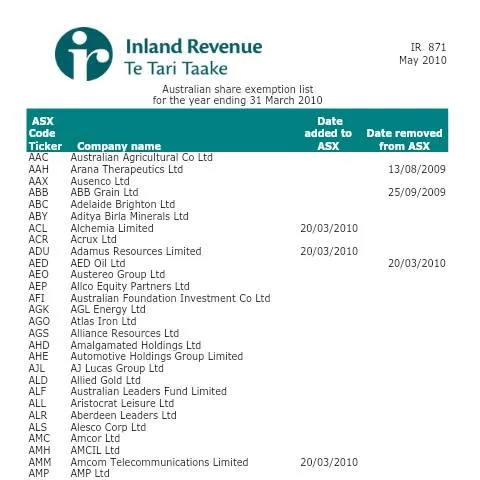
Navigating the IR871 Form: Your Guide to the Australian Share Exemption
Understanding the intricacies of international tax obligations can be daunting, especially for New Zealand residents with investments across the Tasman. The IR871 form, also known as the Aus exe.xls, plays a critical role in claiming the Australian share exemption. This guide aims to provide a comprehensive overview of the IR871 form, from its purpose to the step-by-step process of completion and submission. We will explore who needs to file this form, the necessary documentation, and the implications of the exemption it offers.
The Significance of the IR871 Form in Your Tax Journey
The IR871 form is essential for New Zealand tax residents who have dividends from shares listed on the Australian Stock Exchange (ASX). By submitting this form, you can claim an exemption on Australian tax withheld from your dividends, effectively ensuring that you are not taxed twice on your income. The significance of this exemption cannot be overstated, as it impacts your net income and financial standing.
Who Should File the IR871?
- New Zealand Tax Residents: Individuals or entities residing in New Zealand that receive dividends from Australian shares.
- Investors in ASX-listed Companies: Those who hold investments in companies listed on the ASX and receive dividends from them.
- Taxpayers Seeking to Reduce Withholding Tax: Anyone looking to reclaim tax that has been withheld at the time of dividend payment.
Completing the IR871 Form: A Detailed Breakdown
Filling out the IR871 form requires careful attention to detail. The form has several sections, each requiring specific information. Here’s how to navigate through them:
Section 1: Taxpayer Information
This section requires you to provide your personal details, including:
- Your full name
- Your IRD number
- Your residential address
Ensure the information matches your official records to prevent delays in processing.
Section 2: Investment Information
In this section, you need to detail the ASX shares you own. Include:
- The name of the company
- The number of shares held
- The total dividends received
Accuracy is crucial here, as discrepancies could lead to complications in your claim.
Section 3: Claim Details
When completing this section, specify the amount of tax withheld that you are claiming back. This involves calculating the withholding tax based on the dividend income received. Make sure to:
- Cross-check your dividend statements for accurate figures.
- Calculate the withholding tax using the correct rate applicable to your income level.
Submission Process: From Filling Out to Filing the IR871
Once you have accurately completed your form, the next step is submission. Here’s how to do it:
Submitting Your IR871 Form
You can submit your IR871 form through the New Zealand Inland Revenue Department (IRD) via their online portal or by mailing it. Here’s what to bear in mind:
- Online Submission: If you choose to submit online, ensure you have a RealMe digital ID for access. This is the most efficient method and provides immediate confirmation of receipt.
- Mail Submission: If you prefer mailing, send your completed form to the IRD address specified on their website. Keep a copy for your records and consider using a trackable mailing option to ensure it reaches the IRD.
Understanding the Processing Timeline and Follow-Up
After submission, monitoring the progress of your claim is essential. The IRS typically processes claims within a specified timeframe, but it can vary based on the volume of applications. Here are some practical steps:
Tracking Your IR871 Submission
You can track your application status using your online IRD account. Here’s how:
- Log into your IRD account using your RealMe digital ID.
- Navigate to the “My Applications” section.
- Check the status of your IR871 submission for any updates or required actions.
If you notice any unexpected delays, do not hesitate to contact the IRD directly through their official channels for clarification.
Key Documents to Keep Handy: Preparing for Submission
Prior to filling out the IR871, assembling the right documents is vital. This not only streamlines the process but also ensures accuracy. Here’s a checklist of documents to consider:
- Dividend Statements: Collect statements for each ASX share where you received dividends.
- Tax Records: Have your previous tax returns and IRD correspondence readily available.
- Identification Documents: Ensure your IRD number and proof of identity are easy to reference.
Situations Requiring Special Attention
There are various circumstances under which individuals might face unique challenges when filing the IR871. Below are some common scenarios and what to consider:
Investors with Complex Tax Situations
If your investment portfolio includes various ASX shares, or if you have multiple income streams, consider the following:
- Consulting a tax professional can help clarify your obligations and ensure all income is reported accurately.
- Keep detailed records of all transactions to simplify the filing process.
Non-Residents and Temporary Residents
For individuals who may not be permanent New Zealand residents but have investments in Australia, filing the IR871 becomes even more nuanced. Here’s what to keep in mind:
- Check if there are specific provisions for non-residents regarding dividend withholding tax.
- Seek guidance from a tax advisor familiar with cross-border taxation rules.
Addressing Potential Errors and What to Do Next
Errors can occur at any stage of the filing process, leading to potential delays or rejection of your claim. Here’s how to address common issues:
If Your Claim is Rejected
Receiving a rejection from the IRD can be disheartening but not the end of the road. Here’s how to respond:
- Review the Rejection Notice: Carefully read the notice for specific reasons for rejection.
- Gather Additional Documentation: If requested, compile any further information or documentation to support your claim.
- Reapply If Necessary: If the issues stem from overlooked details, consider resubmitting your application with the correct information.
Correcting Errors in Submitted Forms
If you discover an error after submission, it’s critical to act swiftly:
- Contact the IRD as soon as possible to report the error.
- Provide detailed information about the mistake and any supporting documents if required.
- Follow their guidance on whether to submit a corrected form or if they will amend it on your behalf.
Final Thoughts on the IR871: Empowering Your Investment Journey
The IR871 form serves a vital purpose in supporting New Zealand residents with Australian investments in navigating tax obligations. By understanding every aspect of this form—from completion to submission—you empower yourself to manage your tax responsibilities efficiently. As you journey through the complexities of international investments, remember to stay informed, organized, and proactive. Seeking professional guidance can further enhance your understanding and help you maximize your tax positions, ensuring that your investments yield their full potential.
Understanding the Aus exe.xls Framework
The Aus exe.xls serves as a critical tool within the context of New Zealand's administrative processes, primarily in relation to the taxation and revenue system governed by the Inland Revenue Department (IRD). This spreadsheet is designed to facilitate the management and documentation of various financial activities that individuals and businesses engage in across the Tasman Sea.
Within the Aus exe.xls framework, users can expect to find templates and data entry fields that correspond to different financial reporting obligations. For example, self-employed individuals may use this tool to track their income and expenses, ensuring that their annual tax returns align with the fiscal year, which runs from 1 July to 30 June. Additionally, businesses can leverage this framework to prepare for their Goods and Services Tax (GST) filings, allowing them to remain compliant with local regulations.
It is crucial to note that while the Aus exe.xls provides a structured approach to financial data management, users must ensure that they are entering accurate information to prevent discrepancies that may arise during audits conducted by the IRD. Accordingly, best practices suggest regularly updating the spreadsheet and cross-referencing entries with official documentation. This helps maintain transparency and accuracy, which are paramount when dealing with tax obligations.
Common Pitfalls to Avoid When Using Aus exe.xls
Despite its utility, there are several common pitfalls that users may encounter when utilizing the Aus exe.xls framework. One of the most significant mistakes relates to data entry errors. Inaccuracies in income reporting or expense claims can lead to underreporting or overreporting, causing complications with the IRD. To counteract this, it is advisable to double-check all entries and utilize the spreadsheet's validation features, if available, to minimize human error.
Another frequent issue is the failure to update the document regularly. Many users may neglect to input new financial data promptly, resulting in outdated information that could skew their financial analysis and tax obligations. Setting a recurring reminder to update the Aus exe.xls periodically can help mitigate this issue.
Lastly, some users might not take full advantage of the features within the Aus exe.xls framework. For instance, users should familiarize themselves with any built-in formulas that can automatically calculate totals or generate reports. Not utilizing these features may lead to more manual work than necessary, detracting from the efficiency that this tool aims to provide.
The Role of RealMe in Managing Aus exe.xls Files
In today's digital landscape, managing sensitive financial information like that contained in Aus exe.xls requires a secure and efficient identity verification process. This is where RealMe comes into play. RealMe is New Zealand's official digital identity service that allows users to access various government services securely. By integrating RealMe with the Aus exe.xls framework, users can ensure that their financial data is not only organized but also protected against unauthorized access.
When users log into their accounts via RealMe, they can effectively manage their Aus exe.xls files with the confidence that their identity has been verified through a reliable system. This adds an additional layer of security, particularly when sharing financial information with accountants or tax advisors.
Moreover, using RealMe can facilitate smoother interactions with various government agencies, including the IRD and the Ministry of Business, Innovation and Employment (MBIE). With a verified digital identity, users can submit their Aus exe.xls data electronically, which streamlines the process of filing taxes and fulfilling any business-related obligations. Overall, integrating RealMe with Aus exe.xls not only enhances security and convenience but also aligns with the broader shift towards digitization in New Zealand's public services.