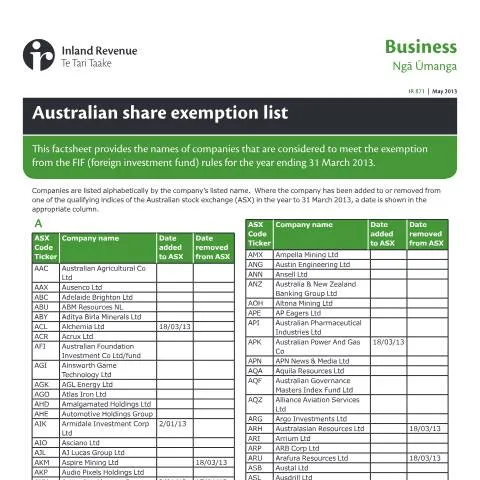
Understanding the Significance of IR871 in the New Zealand Tax Framework
For investors engaging with Australian equities, the IR871 document, officially named the Australian Share Exemption List, serves as a critical resource. This official list outlines companies that qualify for exemption from the Foreign Investment Fund (FIF) taxation rules, which can offer substantial tax relief for New Zealand residents investing in Australian shares. But what does this mean in practice, and how should one navigate these waters?
Who Needs to Submit IR871?
The IR871 form is predominantly relevant for New Zealand residents who hold shares in Australian companies. Specifically, it targets individual and institutional investors who wish to claim exemptions from FIF rules on their Australian investments. Understanding the scope of who is impacted by this form is crucial for effective tax planning, especially for those holding equity interests in companies listed on the Australian Stock Exchange (ASX).
- Individuals: New Zealand residents investing directly in Australian stocks.
- Trusts and Partnerships: Entities needing to report their investments in Australian companies.
- Investment Funds: Funds that need to delineate their Australian equity holdings for tax exemption purposes.
A Deep Dive into the Components of IR871
Completing the IR871 form requires careful attention to detail. Below, we explore each component of the form, including common pitfalls and essential data to include.
Company Name and ASX Code
Each entry on the IR871 form includes the name of the company and its associated ASX code. This is pivotal as the IRD uses these identifiers to cross-check compliance with the current ASX-listed companies qualifying for exemption.
Dates of Listing and Delisting
The relevance of the company can change based on its listing status. The form specifies the date a company was added to or removed from the ASX, impacting the eligibility for FIF exemptions. Investors must ensure they stay updated with these dates:
| ASX Code | Company Name | Date Added | Date Removed |
|---|---|---|---|
| AAC | Australian Agricultural Co Ltd | N/A | N/A |
| ABY | Aditya Birla Minerals Ltd | N/A | N/A |
| AGK | AGL Energy Ltd | N/A | N/A |
| AMH | AMCIL Ltd/fund | 18/03/13 | N/A |
FIF Exemption Claims
To utilize the exemptions, investors must ascertain that the companies listed align with the exemptions outlined in the IR871. The IRD explicitly mentions the qualifying criteria that a company must meet to be listed, including being a non-foreign investment fund and having a minimum percentage of Australian-held assets.
Step-by-Step Process from Filing to Resolution
The journey from filing the IR871 to receiving an exemption involves several stages. Here's a streamlined guide to help navigate this process:
- Gathering Required Information: Collect your investment records and the latest IR871 document.
- Completing the Form: Ensure accuracy with company names, ASX codes, and relevant dates.
- Submission: File the form with the IRD, making sure to keep a copy for your records.
- Processing Period: The IRD typically processes claims within 20 working days; however, this may vary based on volume.
- Receiving Confirmation: Expect a confirmation letter detailing the outcome of your application.
Navigating Potential Challenges with IR871
Not every submission results in a straightforward approval. Understanding the common challenges will equip you to address them effectively:
Dealing with Rejections
If your claim for exemption under the IR871 is rejected, the IRD will provide reasoning for their decision. You may have options to appeal or clarify the discrepancies. It's vital to:
- Review the rejection letter carefully.
- Contact the IRD for clarification on specific points of contention.
- Provide additional documentation if necessary.
Missing Information or Errors
Errors in submission can lead to delays or rejections. If you encounter a missing piece of information or find an error post-submission, it’s essential to act swiftly:
- Gather the correct information promptly.
- Submit the corrected details through the appropriate IRD channels.
Timelines: When to Act and What to Expect
The tax year in New Zealand runs from 1 July to 30 June, and understanding how this timeline impacts your IR871 filing is crucial:
Initial Filing Period
Typically, you can begin preparing your IR871 as soon as you have completed your end-of-year financial statements. The submission of the IR871 should ideally coincide with your annual tax return filing to ensure that you can take advantage of the exemption promptly.
Follow-up and Confirmation
Once filed, the IRD will process your application. If you have not received a response within the expected timeframe, it’s wise to follow up to check the status of your submission. Keeping detailed records of your interactions with the IRD can aid in expediting your inquiries.
The Regulatory Landscape Surrounding IR871
Understanding the legal framework within which the IR871 operates is critical for compliance and effective tax planning. The document is governed by the provisions set forth in the Income Tax Act and relevant regulations established by the IRD.
The Role of the Official Information Act 1982
The Official Information Act 1982 permits New Zealand residents to request government-held information, which includes data pertinent to the IR871. This transparency allows investors to better understand how tax policies evolve and can inform future investment decisions.
Practical Tips for Managing Your IR871 Submissions
Efficient management of your IR871-related activities can save you time and enhance your experience:
- Use Digital Tools: Utilize online services provided by the IRD for a more streamlined filing process.
- Stay Informed: Regularly check for updates to the Australian Share Exemption List, as changes can occur which might affect your holdings.
- Consult a Tax Professional: If in doubt, seeking advice from a tax advisor familiar with international investment can help navigate complexities.
By understanding the nuances of the IR871 form, investors can better position themselves to leverage available exemptions and minimize their tax liabilities effectively.
Understanding the Australian Share Exemption List
The Australian Share Exemption List, or ASX Exemption List, is vital for New Zealand investors and companies engaging with Australian shares. This list outlines specific exemptions that allow New Zealand residents to invest in shares without incurring additional tax liabilities typically associated with foreign income. It’s essential to understand how this exemption works to maximize investment returns.
Under the double tax agreement between Australia and New Zealand, certain income from share investments can be exempted from taxation in New Zealand. This includes dividends and capital gains derived from Australian companies listed on the ASX (Australian Securities Exchange). The following are important considerations:
- Eligibility Criteria: Only shares that meet specific criteria outlined in the exemption list are eligible. Typically, these are shares in public companies that are registered with the ASX and comply with New Zealand’s taxation regulations.
- Tax Residency Status: To benefit from these exemptions, investors must be tax residents in New Zealand. This means that they have a permanent home in New Zealand or have spent more than 183 days in the country within a 12-month period.
- Documentation Requirements: Investors must provide the IRD (Inland Revenue Department) with sufficient documentation to confirm the legitimacy of their claims for exemption. This includes share purchase receipts and statements from Australian companies confirming dividends paid.
Understanding these nuances can significantly impact investment strategies and financial planning for New Zealand residents looking to invest in Australian markets.
Impact of Currency Fluctuations on Investments
Investing in Australian shares from New Zealand brings with it the potential for additional financial risks, notably currency exchange rate fluctuations. The NZD/AUD exchange rate can significantly impact the actual returns on investments when converted back to New Zealand dollars. Here’s what investors should consider:
- Exchange Rate Monitoring: Investors should regularly monitor the NZD/AUD exchange rate as fluctuations can affect the value of their dividends and capital gains. Tools such as currency converters and financial news platforms can aid investors in making informed decisions regarding the timing of conversions.
- Hedging Options: Some investors may choose to hedge against currency risks. This can be done through financial instruments such as forward contracts or options that lock in exchange rates for future transactions, thus providing a buffer against adverse currency movements.
- Tax Implications on Currency Gains: It’s also essential to consider the tax implications of any currency gains or losses incurred during the conversion of Australian dollars back to New Zealand dollars. These gains or losses may need to be reported to the IRD and could affect the overall tax liability of the investor.
By being aware of these factors and actively managing currency risk, investors can enhance their overall investment performance in the Australian share market.
Navigating Regulatory Changes and Compliance
Keeping abreast of regulatory changes in both Australia and New Zealand is crucial for investors dealing with Australian shares. Regulatory bodies such as the IRD and the Australian Securities and Investments Commission (ASIC) frequently update guidelines and compliance requirements that can affect investment strategies. Here are some key areas to focus on:
- Changes in Tax Legislation: Tax laws can evolve, affecting how dividends, capital gains, and other income from Australian shares are taxed in New Zealand. Investors should stay informed regarding any new tax regulations or amendments to the existing framework to avoid penalties and ensure compliance.
- Reporting Obligations: Both countries may impose specific reporting obligations on investors, especially those holding significant foreign investments. This includes declaring assets, income, and any relevant capital gains or losses in both jurisdictions, as per the guidelines established by the IRD.
- Engagement with Financial Advisors: Given the complexities involved, consulting with financial advisors who specialize in cross-border investments can provide tailored guidance. Advisors can offer strategies to optimize tax efficiency and ensure compliance with both countries' regulations.
Adhering to regulatory changes and compliance requirements not only helps in avoiding legal repercussions but also optimizes investment potential in the competitive landscape of Australian shares.