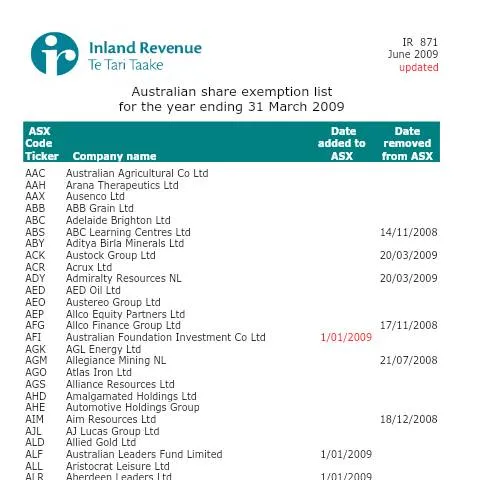
Navigating the Australian Share Exemption List: A Critical Resource for Investors
For anyone engaging in cross-border investments, comprehension of taxation regulations is paramount. In New Zealand, the Income Tax Department has produced the Australian Share Exemption List 2009 (IR871), which serves an important purpose in the realm of international taxation for investors dealing with Australian shares. This document not only delineates which shares exempt New Zealand residents from paying tax on dividends received from those shares but also reflects the New Zealand government's commitment to facilitating international trade and investment.
A Peek Into the History of the IR871 Document
Understanding the Australian Share Exemption List requires a brief exploration of the regulatory framework that underpins it. Established under the Income Tax Act 2007, the IR871 document's foundation lies in the Double Taxation Agreement (DTA) between New Zealand and Australia. This agreement aims to prevent double taxation and fiscal evasion concerning taxes on income. The initial Australian Share Exemption List was first published in 2009, aiding investors in understanding which shares would qualify for exemption from New Zealand income tax.
The Role of the Australian Share Exemption List
The IR871 document provides a comprehensive list of Australian companies whose shares, if held by New Zealand residents, would be exempt from New Zealand income tax on dividends paid. Notably, the list includes several key companies across diverse sectors, such as:
- AAC: Australian Agricultural Company Ltd
- ABC: Adelaide Brighton Ltd
- AMP: AMP Ltd
- ANZ: Australia & New Zealand Banking Group
This list is crucial for investors aiming to optimise their portfolios while ensuring compliance with New Zealand's tax obligations.
Who Should File IR871 and Why?
Typically, the Australian Share Exemption List 2009 is intended for New Zealand tax residents who have investments in Australian shares. As an investor, if you receive dividends from these companies listed in IR871, you should be well aware of your tax obligations. The exemption allows you to focus on investment growth rather than worrying about potential tax liabilities. Therefore, this document is essential not only for individual taxpayers but also for financial advisors, accountants, and tax professionals who assist clients in managing their investments effectively.
Exemption Eligibility and Obligations
Investors must ensure that they are holding the shares under the appropriate conditions to qualify for the exemption. Below are some points to consider:
- The shares must be legally held and not acquired through non-compliant means.
- Investors should maintain accurate records of their shareholdings to substantiate eligibility.
- Changes in the status of a company, such as removal from the ASX, could affect the exemption and must be monitored.
Filling Out the IR871 Form: A Step-by-Step Guide
Completing the IR871 form is a straightforward process, although attention to detail is crucial. Here are some key sections of the form:
Section 1: Personal Information
Here, you will provide your name, address, IRD number, and any other identifying information. Accuracy in this section is vital, as discrepancies may lead to delays or complications.
Section 2: Declaration of Shareholdings
This section requires you to detail the specific Australian shares you hold. You must refer to the Australian Share Exemption List to ensure that you accurately declare your holdings. Pay close attention to the ASX codes and company names; errors can lead to complications down the line.
Section 3: Acknowledgement of Exemption
In this section, you will declare your understanding of the tax exemption on dividends. This declaration serves as a compliance mechanism to ensure you recognise your responsibilities under New Zealand law.
Submission Channels: How to Submit the IR871
Once completed, the IR871 can be submitted via various channels.
Online Submission
The most efficient route is through the IRD's online services. If you have a RealMe digital ID, you can quickly file your form. Online submissions are generally processed faster than paper submissions and provide immediate confirmation of receipt.
Paper Submission
Alternatively, you can print the forms and send them via post. However, remember that postal submissions may take longer to process and can be subject to delays, especially if there is an influx of filings around tax season.
In-Person Submission
For those who prefer face-to-face interaction, you can visit your local IRD office. While this option allows for questions to be answered in real-time, it often requires waiting in line, so prepare accordingly.
Consequences of Non-Compliance: What Happens If You Miss the Deadline?
Failure to submit the IR871 form can result in significant tax implications. If you neglect to file, the IRD may treat the dividends as taxable income, leading to back taxes, penalties, and interest charges. Here are the potential repercussions:
- Tax Liabilities: Unreported dividends may be taxed at the marginal tax rate, which could range from 10.5% to 33% depending on your total income.
- Fines: The IRD has the authority to impose fines for late submissions, which can add up substantially over time.
- Audit Risk: Non-compliance raises the risk of an audit by the IRD, which may lead to further scrutiny of your financial affairs.
Special Cases: Navigating Complex Situations
Certain situations may complicate the filing process for the IR871 form. Here, we will outline some special cases.
Investors with Foreign Residency
If you are a New Zealand citizen residing abroad and continue to hold Australian shares, you are still subject to these regulations. Your residency status may affect your taxation obligations, so consult a tax professional before filing the IR871.
Complex Corporate Structures
For investors who operate under complex corporate structures, such as trusts or partnerships, additional considerations may need to be taken into account. Ensure that you accurately represent your ownership structure on the IR871 to avoid compliance issues.
Understanding the Impact of Changes in the Share List
The dynamic nature of the Australian Stock Exchange means that shares may be added or removed from the exemption list. It is your responsibility to stay informed about these changes. For example, if a company from which you receive dividends is removed from the IR871, you may become liable for taxes on future dividends from that company.
Monitoring Changes
Investors should regularly check the IRD's website for updates to the Australian Share Exemption List. Furthermore, any changes in your individual investment strategy should prompt a review of your exemption status.
Taking Action: What to Do Next?
After you have completed and submitted the IR871 form, it is essential to keep a copy for your records. This documentation will serve as a protective measure in the event of an audit or inquiry from the IRD. Additionally, maintaining ongoing communication with a tax professional can provide valuable insights and updates on any relevant tax law changes.
Ultimately, while the Australian Share Exemption List 2009 (IR871) may seem like just another administrative hurdle, it is a pivotal document that can significantly impact your investment strategy. By fully understanding and utilizing this resource, you can better navigate the complexities of international investing, safeguarding your financial future in an increasingly globalized economy.
Understanding the Australian Share Exemption List
The Australian Share Exemption List, established in 2009, serves as a crucial reference for New Zealand investors involved in cross-border shareholding activities. This list comprises specific Australian shares that qualify for exemption from New Zealand's income tax, thereby promoting bilateral investment opportunities. It’s essential to comprehend the criteria and mechanics behind this exemption to optimize your investment strategy.
First and foremost, shares that fall under this exemption typically must be part of a company that meets particular thresholds regarding its operations and revenue generation. Investors looking to benefit from this exemption should ensure that the shares they are acquiring are on the list and ascertain their eligibility based on their individual financial circumstances. Doing so requires a clear understanding of both New Zealand and Australian tax regulations.
Moreover, the relevance of the Australian Share Exemption List extends to the reporting requirements mandated by the Inland Revenue Department (IRD) in New Zealand. Investors are generally required to declare their foreign shareholdings, including those exempt under this list, as part of their annual tax return. This is critical in ensuring compliance and avoiding any potential penalties.
Eligibility Criteria for Investors
Eligibility for benefiting from the Australian Share Exemption List is not universally applicable and varies according to the investor's specific profile. Individuals, companies, and entities engaged in different forms of investment must consider various factors to determine their eligibility. For instance, institutional investors may have a different set of guidelines compared to retail investors.
In assessing eligibility, investors should consider their residency status. New Zealand tax residents are typically eligible, but there may be caveats if they have overseas ties. Conversely, non-residents must navigate a labyrinth of regulations to ascertain whether they can claim exemptions on shares listed. This is where consulting with tax professionals or legal advisors who are versed in both jurisdictions becomes incredibly beneficial.
Additionally, the holding period of the shares can influence eligibility. Shares held for a longer duration may qualify for different tax treatments than those traded frequently. Investors should keep track of their transaction history and maintain comprehensive records to support their claims for exemption should the IRD require evidence.
Navigating Compliance and Reporting Obligations
Investing in Australian shares under the exemption list does not absolve investors from complying with New Zealand tax obligations. On the contrary, it introduces a layer of complexity that demands attention to detail in compliance and reporting practices. Taxpayers must be diligent in accurately reporting their share transactions, whether they yield income or capital gains.
To comply with the reporting requirements, investors must accurately fill out the appropriate sections of their tax return forms, notably the IR3 (individual income tax return) or IR4 (company tax return). In addition, the IRD expects comprehensive records that detail the acquisition, holding, and disposal of the shares, including purchase and sale agreements, to support the claims made on the tax return.
Furthermore, understanding the implications of foreign currency exchange rates can be pivotal, especially in investments spanning beyond New Zealand’s borders. Fluctuations in exchange rates can affect the reported values of income derived from Australian shares. Investors are advised to stay updated on exchange rate trends and possibly consult with forex experts to manage currency exposure effectively.
Lastly, to further navigate these complexities, the use of RealMe digital ID can facilitate smoother interactions with both the IRD and Australian tax authorities, providing a streamlined experience for sharing necessary documentation and ensuring that investors are meeting their obligations as they engage in cross-border investments. By leveraging digital services, investors can enhance their compliance efforts while minimizing the risk of errors or delays in processing their tax obligations.