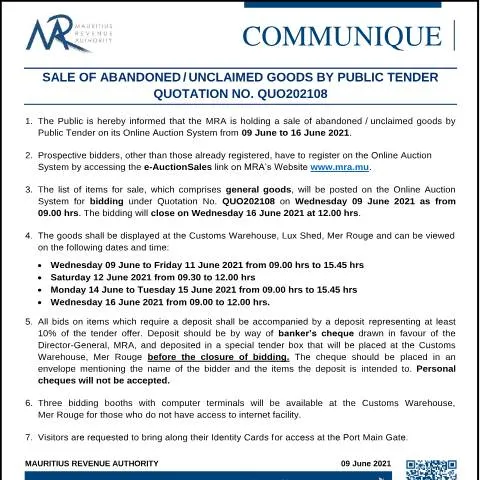
Understanding the Role of the Public Tender Form QUO202108
The sale of abandoned and unclaimed goods is an important function within the Mauritius Revenue Authority (MRA), particularly for managing public assets efficiently. This process is governed by the Communique QUO202108, which outlines the framework for public tenders. The form serves as a tool for prospective bidders to participate in the auction of these goods. It encapsulates the opportunities and procedures for both buyers and the MRA, thus fostering transparency and accountability in government asset liquidation.
Who Needs to Complete the Form?
This document is primarily aimed at individuals or entities interested in procuring unclaimed goods through a public tender process. Specifically, this includes:
- Registered bidders on the MRA's Online Auction System
- New applicants who wish to participate in the upcoming tender
- Organizations seeking to acquire goods for operational purposes
In case of a foreign entity, additional verification may be required to ensure compliance with local regulations. It is pivotal for all bidders to understand the eligibility criteria to avoid complications during the process.
Step-by-Step Procedure: From Registration to Bidding
The sale process outlined in Communique QUO202108 is straightforward but requires meticulous adherence to the outlined steps. Below is a chronological framework to guide bidders:
- Registration Phase: Prospective bidders must first register on the MRA’s Online Auction System. This can be done by visiting the e-Auction Sales link on the MRA website.
- Viewing of Goods: Once registered, bidders can view the list of items available for auction, starting from 09 June 2021. The displayed goods can be examined at the Customs Warehouse during specified hours.
- Bidding Process: Bidding commences on the same day. Bidders must submit their offers online before the auction closes on 16 June 2021, at 12:00 hrs.
- Deposit Requirement: For bids that necessitate a deposit, a banker’s cheque amounting to a minimum of 10% of the bid must be submitted in advance.
- Award of Goods: Successful bidders will receive notifications and must complete payment procedures as per the MRA's directives.
What Happens if Your Bid is Not Successful?
In the event that a bid does not win, the deposited amount (if applicable) will typically be refunded. The process of refund may take a few business days and will be carried out by the MRA’s finance department. Bidders are encouraged to check back on the auction site for updates on the status of their bids.
For those unfamiliar with the online auction platform, MRA provides computer terminals at the Customs Warehouse for ease of access to the bidding system, thus ensuring that all interested parties can participate regardless of their internet connectivity.
Important Dates and Timelines
The timeline for the auction is as follows:
| Event | Date | Time |
|---|---|---|
| Start of Auction | 09 June 2021 | 09:00 hrs |
| End of Auction | 16 June 2021 | 12:00 hrs |
| Viewing of Goods | 09-11 June & 14-15 June 2021 | 09:00 - 15:45 hrs |
| Saturday Viewing | 12 June 2021 | 09:30 - 12:00 hrs |
| Final Viewing | 16 June 2021 | 09:00 - 12:00 hrs |
All prospective bidders should ensure they are familiar with these critical dates to avoid missing any opportunities for participation.
Errors and Oversights: What to Do Next?
In the competitive landscape of public tenders, it is essential to double-check the submitted documents and bids to prevent any potential errors or omissions. If a bidder realizes they have submitted incorrect information or failed to include vital documents, the following steps should be taken:
- Immediate Correction: If possible, submit the corrected documents before the bidding closes.
- Contact MRA: Reach out to the MRA directly via phone or email to inform them of the error and request guidance on rescinding the previous bid.
- Documentation of Communication: Keep a record of all communications with MRA for future reference.
The MRA emphasizes the importance of accuracy; however, they are also committed to supporting bidders throughout the process. Therefore, open communication is highly recommended.
Submitting the Form: Channels and Methods
Bidders have several options for submitting their bids and accompanying documents, each with its own nuances:
- Online Submission: This is the preferred method. Bidders can fill out the necessary information directly on the MRA's Online Auction System. Ensure that all required fields are completed accurately.
- Physical Submission: For those opting for traditional methods, bids can be manually delivered to the Customs Warehouse. Ensure that the bids are placed in sealed envelopes with clear identification.
- Assistance at Bidding Booths: For bidders without internet access, computer terminals will be available on-site at the Customs Warehouse, facilitating the submission of bids directly.
Choosing the right submission method can significantly impact the bidding experience, especially in terms of time efficiency. Therefore, assess personal resources and preferences accordingly.
Tracking Your Bid: Post-Submission Steps
After submitting a bid, it’s natural to want to track its status. Here’s how one can follow up:
- Online Tracking: Utilize the MRA's Online Auction System to check the status of your bid. Updates are usually made in real-time.
- Follow-Up Calls: If clarity is needed, do not hesitate to contact the MRA’s customer service for any clarifications or questions regarding your bid.
- Documentation of Bids: Keep copies of all submitted forms and receipts to ensure you have a comprehensive record of your submission.
Staying proactive about tracking ensures that bidders can respond swiftly to any changes or requests from the MRA, thereby optimizing their chances of success.
Understanding the Process of Public Tender for Abandoned Goods
In Mauritius, the sale of abandoned or unclaimed goods via public tender is a systematic process governed by a combination of legal mandates and administrative procedures. Such processes are typically initiated when items have been left unclaimed within government institutions or other relevant authorities. According to the Ministry of Finance and Economic Development (MFED), abandoned goods can range from personal belongings left at police stations to items stored at customs facilities.
The key to understanding the sale process is to comprehend the various stages involved: identification of goods, valuation, legal notification, and finally, the tendering process.
Identification and ValuationBefore any goods can be sold, they must first be identified and properly valued. This is usually done by the relevant authorities, who will catalogue the items and assess their market value. The valuation process is critical, as it ensures that the government or authority does not sell the goods for less than their worth, thereby safeguarding public funds.
Legal NotificationOnce identified and valued, the next step involves legally notifying the public. This is usually done through a public announcement in local newspapers, providing details about the items for sale, the date and time of the tender, as well as the conditions of sale. It’s important for potential bidders to pay close attention to these announcements, as they provide essential information about the specific tender process.
Tender SubmissionThe public tender process requires interested parties to submit tenders in accordance with the guidelines set out in the announcement. Tenders are usually submitted via the designated online portal or through physical submission at designated government offices. Tenderers should prepare their submissions carefully, ensuring that all required documents and payment details are included, in order to avoid disqualification.
Legal Framework Surrounding Abandoned Goods in Mauritius
The legal framework governing the sale of abandoned goods in Mauritius is primarily established under the provisions of the Public Procurement Act, alongside other relevant statutes that may apply to specific types of goods or circumstances. Understanding this legal backdrop is crucial for both potential buyers and government officials involved in the tender process.
The Public Procurement Act 2006 outlines the general principles of public procurement, ensuring that the processes adhered to are transparent, equitable, and competitive. Additionally, it mandates that all tenders are advertised publicly, allowing equal opportunity for interested parties to participate.
Moreover, certain categories of goods may have specific regulations associated with them, particularly in relation to health and safety standards (for instance, unclaimed food items) or environmental considerations (like hazardous materials). It is imperative for bidders to familiarize themselves with these regulations, as failure to comply can result in penalties or the cancellation of the tender.
Furthermore, disputes concerning abandoned goods can sometimes lead to judicial review. Stakeholders, including unsuccessful bidders, may challenge outcomes if they believe the tender process was not adhered to as stipulated by law. Understanding these legal avenues is vital for ensuring that one's participation in the tender process is both informed and compliant.
Impact of E-Government Initiatives on Tender Processes
The Government of Mauritius has made significant strides in promoting e-government initiatives, particularly given the strong push towards digitization in public services. This shift has had a profound impact on the tendering processes for abandoned goods, making them more efficient and accessible.
One of the major advantages of embracing digital platforms is the increased transparency in the tendering process. By utilizing the government’s online portals, such as govmu.org, all announcements related to tender sales are readily available to the public. This not only enhances accessibility but also builds trust among potential bidders, who can have confidence that the process is open and fair.
Additionally, the online submission of tenders has streamlined the application process. Instead of requiring physical visits to government offices, bidders can now upload their documents directly through a secured electronic platform. This saves time and reduces the administrative burden on both bidders and government officials.
Importantly, e-government initiatives also allow for better tracking of tender submissions and sales. Stakeholders can monitor the status of their bids through the system, receiving updates and notifications, which fosters a more interactive and engaging experience.
However, it is worth noting that while e-processes provide numerous benefits, they also require that all participants are adequately trained and equipped to navigate these digital systems. The government has made efforts to ensure that resources and training sessions are available to assist citizens in becoming proficient in using these online tools.