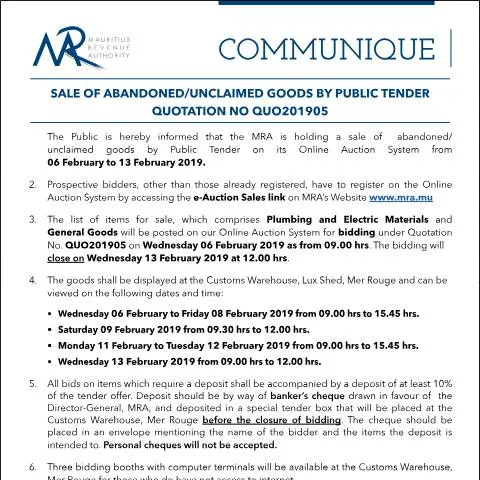
Understanding the Public Tender Process for Abandoned Goods
The Sale of Abandoned/Unclaimed Goods by Public Tender is an essential procedure that enables the Mauritius Revenue Authority (MRA) to dispose of items that have been left unclaimed. This process serves not just to clear storage but also to provide opportunities for the public to acquire these goods at competitive prices. The public tender mechanism ensures transparency and fairness, inviting qualified bidders to participate in the auctioning of goods.
Participants in the Tender: Who Can Bid?
Anyone interested in acquiring abandoned or unclaimed goods can participate in this auction, provided they fulfill specific registration requirements. It’s crucial to note that:
- Individuals must be of legal age (18 years and above).
- Potential bidders who are not already registered on the MRA’s Online Auction System must complete their registration before participating.
- Access to the auction may be limited for some, thereby necessitating the use of physical booths set up by MRA for internet access.
Registration Process for New Bidders
To participate in the auction, new bidders need to navigate to the MRA website and complete the registration process through the e-Auction Sales link. The registration typically requires personal information, such as:
- Name
- Address
- Contact numbers
- Identification details (National ID or Passport)
Once registered, bidders will receive confirmation, allowing them to bid during the specified auction period.
Critical Dates: Auction Schedule and Viewing Times
Understanding the timeline is vital for any prospective bidder. Here are key dates pertaining to the auction of abandoned goods:
| Date |
Activity |
Time |
| 06 February 2019 |
Auction Opens |
09:00 hrs |
| 06-08 February 2019 |
Viewing of Goods |
09:00 - 15:45 hrs |
| 09 February 2019 |
Viewing of Goods |
09:30 - 12:00 hrs |
| 11-12 February 2019 |
Viewing of Goods |
09:00 - 15:45 hrs |
| 13 February 2019 |
Auction Closes |
12:00 hrs |
The auction opens for bids on 6 February 2019 and closes on 13 February 2019, with specific viewing times to inspect the goods at the Customs Warehouse located at Lux Shed, Mer Rouge.
Understanding the Goods Available for Auction
The items up for auction comprise a variety of goods, including plumbing supplies, electrical materials, and general goods. Bidders should familiarize themselves with the list of items on the MRA’s Online Auction System, which will be available for bidding under the quotation number QUO201905.
It is recommended to inspect the items physically during the designated viewing days to assess their condition and value before placing a bid. This can significantly influence the bidder's decision-making process.
Deposits and Bidding: Financial Requirements Explained
Bidders must be aware of the financial commitments involved in the bidding process. For items that necessitate a deposit, bidders are required to provide at least a 10% deposit of their tender offer. The deposit must be made through a banker’s cheque, which is payable to the Director-General of MRA.
Steps for Submitting a Deposit
- Prepare a banker’s cheque drawn in favour of the Director-General, MRA.
- Place the cheque in an envelope, clearly stating the bidder’s name and the items for which the deposit is intended.
- Submit the envelope in the designated tender box located at the Customs Warehouse before the end of the bidding period.
It’s paramount to highlight that personal cheques are not accepted, ensuring that bidders are prepared with the correct form of payment.
Accessing the Auction: Physical Booths for Internet-Limited Bidders
Recognizing that not all participants may have reliable internet access, the MRA facilitates physical booths equipped with computer terminals at the Customs Warehouse. This initiative allows all interested individuals to engage in the bidding process, ensuring inclusivity.
Requirements for Accessing the Booths
Visitors planning to utilize these booths must bring along their Identification Cards to gain access at the Port Main Gate. Thus, preparation is essential for a smooth experience.
Post-Bidding: What to Expect After the Tender Closes
As the auction concludes on 13 February 2019, successful bidders will be contacted based on the outcome of their bids. The MRA will notify winning bidders and provide further instructions regarding payment and collection of their items. Bidders should keep their contact details up to date to avoid missing essential communications.
Handling Non-Winning Bids
For those whose bids were not successful, there is no formal notification unless otherwise stated by the MRA. Bidders are encouraged to participate in future tenders, as unclaimed goods are regularly auctioned.
Addressing Issues: What to Do in Case of Complications
Participants might encounter issues such as missing documents, errors in registration, or complications with deposits. It is critical to act swiftly in resolving these issues:
- Missing Documents: Contact MRA directly through their provided email address or telephone number as listed on their website.
- Errors in Registration: If there’s an error in your registration, promptly rectify it before the auction starts to avoid disqualification.
- Deposit Issues: Ensure that the deposit requirements are met, as bids without the necessary deposit will be deemed invalid.
Special Circumstances: Considerations for Diverse Bidders
Various situations can affect bidders, including international participants, minors, or those with unique circumstances. Bidders should consider:
- Foreign Bidders: Verification of identity and legal status in Mauritius is mandatory. They may need additional documentation.
- Minors: Individuals under 18 cannot legally bid without parental consent and presence.
- Unique Situations: If facing a particular challenge that may affect bidding, it is advisable to discuss this with MRA prior to the auction.
Engagement in the Public Tender for abandoned goods can be a rewarding venture for those willing to navigate the processes carefully and adhere to regulations. Proper preparation, understanding of the requirements, and timely communication with the MRA can lead to successful bidding outcomes.
Understanding the Process of Public Tender for Abandoned Goods
The sale of abandoned or unclaimed goods by public tender is a structured process governed by specific regulations in Mauritius. This procedure is outlined to ensure transparency and fairness while also adhering to the principles established under the relevant legal frameworks. The process typically begins with the identification of goods that have been classified as abandoned or unclaimed after a set period of time as stipulated by the governing bodies, such as the Local Government Service Commission (LGSC).
Public authorities must first conduct an inventory of these goods, which often requires meticulous record-keeping and verification to ascertain that the items in question are indeed unclaimed. This inventory process is critical as it also involves notifying potential claimants about the status of their possessions. Notices are usually published in local newspapers and may also be accessible on official government websites like govmu.org, providing ample opportunity for ownership claims before the goods are put up for tender.
Once the inventory is complete and the period for claims has lapsed, the next step involves determining the mode of sale. Public tender procedures are then established, which include setting the tender dates, the location for submitting tenders, and the specific terms and conditions of the sale. Tender documents, often referred to as LGSC Form 7a, must be meticulously prepared and made available to interested bidders, outlining the categories of goods for sale, the minimum bids accepted, and instructions on how to submit offers.
It is imperative for potential bidders to understand that participation in the public tender for unclaimed goods requires compliance with all stipulations set forth in the tender documents. This includes the necessity for bidders to provide valid identification and, in some cases, payment of a deposit. Furthermore, all bids are typically opened publicly, ensuring transparency in the selection process, and the successful bidder is usually required to make payment within a specified timeframe to finalize the sale.
Legal Considerations and Compliance Requirements
Engaging in the public tender process for the sale of abandoned or unclaimed goods is subject to various legal considerations and compliance requirements that participants must navigate carefully. Firstly, understanding the legal basis for the sale of such goods is crucial. The applicable laws and regulations provide a framework that governs how abandoned items can be sold, ensuring that all actions taken by public authorities are within legal boundaries.
Stakeholders must also be aware of their rights and responsibilities under the applicable legal framework. For instance, according to the Public Procurement Act and the relevant government circulars, all tenders must be conducted following principles of fairness, competition, and non-discrimination. This underscores the importance of providing equal opportunities for all interested parties to participate in the bidding process, thus preventing any form of bias that could undermine the integrity of the sale.
Moreover, compliance with the regulations of the Mauritius Revenue Authority (MRA) is essential. Successful bidders should be prepared to fulfill any tax obligations that might arise from the purchase of unclaimed goods, especially if these items are later resold for profit. The MRA has specific guidelines regarding the taxation of goods acquired through public tender processes, and failing to comply could lead to penalties or legal challenges.
Additionally, potential bidders should be aware of consumer protection laws that may apply if they intend to resell these goods. The sale of second-hand or unclaimed items is often scrutinized to ensure that consumers’ rights are protected. Therefore, it is advisable for bidders to conduct thorough due diligence on the items they wish to purchase, including understanding any potential implications related to product safety, warranties, or other liabilities.
The shift towards digital solutions in public administration has significantly impacted the public tender processes for abandoned or unclaimed goods in Mauritius. The government’s initiatives to promote e-services through the govmu.org portal have streamlined various administrative procedures, including those related to the procurement of goods via public tender.
The implementation of a centralized online platform enables bidders to access tender notices promptly, submit applications, and even communicate with relevant public authorities without the need for physical visits. This is particularly advantageous for those who may face challenges in accessing physical locations due to geographical constraints or mobility issues. Moreover, the need for face-to-face interactions has been minimized, promoting a more efficient and less time-consuming process for all stakeholders involved.
Digital transformation also allows for enhanced transparency in the bidding process. Electronic submissions can be tracked more efficiently, ensuring that all bids are logged and evaluated systematically. This minimizes the risk of tampering and increases public confidence in the integrity of the tendering process. Additionally, the publication of results and notifications about successful bids can be done in real-time, providing immediate access to information that was traditionally disseminated through slower, more cumbersome methods.
However, as the shift to digital platforms continues, it is critical for bidders to familiarize themselves with the new processes and the necessary technological tools to participate effectively. This includes understanding how to navigate the e-filing system, which is linked to the National ID Card and the Central Population Database (CPDB). Ensuring that all digital identities are up-to-date and that internet connections are reliable can significantly enhance the experience and participation in public tenders for abandoned goods.
In conclusion, the sale of abandoned or unclaimed goods through public tender in Mauritius is a multifaceted process that requires diligence and adherence to legal standards. The digital transformation within the public sector presents new opportunities and challenges that participants must navigate to ensure successful outcomes.