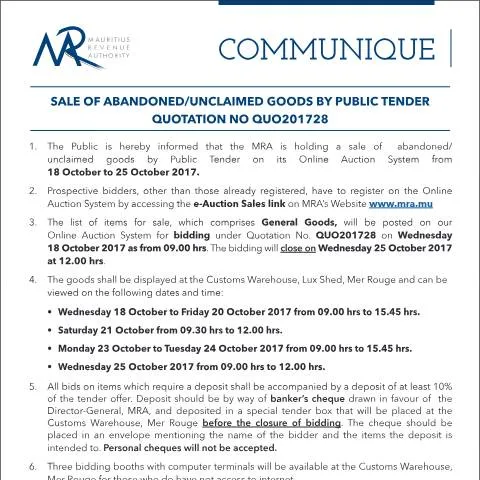
Navigating the Sale of Abandoned or Unclaimed Goods: Insights into Form CommuniqueQ28of2017
Imagine stumbling upon an opportunity to acquire valuable goods at a fraction of their market price. For anyone interested in making a savvy purchase, the CommuniqueQ28of2017, issued by the Mauritius Revenue Authority (MRA), unveils a structured pathway to participate in the Sale of Abandoned/Unclaimed Goods by Public Tender. This organized auction process, scheduled from October 18 to October 25, 2017, invites prospective bidders to engage in a transparent and regulated manner.
The Genesis of the Auction System: A Historical Perspective
The framework for the auction of abandoned and unclaimed goods has deep roots in the legal essentials of Mauritius. Governed under the laws concerning public property and oversight by the MRA, this procedure aligns with the ethos of transparency and fairness in public dealings. The MRA's mandate allows it to manage and sell unclaimed property efficiently, thereby serving the dual purpose of freeing up warehouse space while providing opportunities for citizens and businesses.
Understanding the Regulatory Framework
- The Public Tender Act: This act lays the groundwork for public tenders, ensuring that all transactions are conducted fairly and openly.
- The role of the MRA: As the custodian of public goods, the MRA oversees auctions, ensuring compliance with regulations and fairness in bidding.
- Historical Auctions: Previous instances of public auctions have demonstrated the value and demand for such goods, indicating a healthy interest from the community.
Steps to Participation: From Registration to Bidding
For individuals and entities looking to take part in this auction, adhering to a clear set of steps is critical. This section outlines how to navigate the registration and bidding process effectively.
Step 1: Registration on the Online Auction System
Before placing any bids, prospective bidders must register on the MRA's Online Auction System. Here’s how:
- Visit the MRA's official website: www.mra.mu.
- Locate the e-Auction Sales link.
- Complete the registration form, providing necessary details such as your identity and contact information.
- Once registered, you will receive a confirmation that allows access to the bidding platform.
Step 2: Pre-Auction Preparations
Before the auction begins, it’s crucial to prepare adequately. Following the registration, bidders should keep the following in mind:
- Review the list of items available for bidding, which will be posted on the Online Auction System starting from October 18, 2017.
- Inspect the items physically at the Customs Warehouse during the designated viewing periods.
- Understand the bidding requirements, including the need for a deposit.
Physical Auction Viewing: Key Dates and Locations
The goods for auction will be physically displayed at the Customs Warehouse. It is essential for interested bidders to visit and inspect these items before bidding. The viewing schedule is as follows:
| Date | Time |
|---|---|
| October 18-20, 2017 | 09:00 - 15:45 |
| October 21, 2017 | 09:30 - 12:00 |
| October 23-24, 2017 | 09:00 - 15:45 |
| October 25, 2017 | 09:00 - 12:00 |
Ensure to bring your Identity Card for access to the Port Main Gate during your visit.
Understanding the Bidding Process: Key Components
Upon the commencement of the auction, participants must grasp the detailed requirements of the bidding process to maximize their chances of success.
Deposit Requirements
To place a bid on certain items, a deposit is crucial. Here are the specifics:
- The deposit must amount to at least 10% of the tender offer for the item being bid on.
- Deposits must be submitted via a banker’s cheque, made out in favor of the Director-General of the MRA.
- All deposits should be placed in a special tender box located at the Customs Warehouse before the bidding closure.
- Personal cheques will not be entertained, emphasizing the necessity for a banker’s cheque.
Bidding Options
For bidders who may not have direct access to the internet, the MRA facilitates three bidding booths equipped with computers at the Customs Warehouse. This provision ensures inclusivity, allowing more individuals to participate in the auction process.
What Happens After Bidding Ends?
After the auction closes on October 25, 2017, at 12:00 hrs, successful bidders will need to be aware of the subsequent steps.
Notification of Successful Bids
Winning bidders typically receive notification from the MRA regarding their successful bids. This notification will include details about the payment method and necessary arrangements for the collection of the purchased items.
Payment Deadlines and Procedures
Following notification, timely payment is critical. Bidders must make the payment as outlined in the notification, ensuring adherence to deadlines to avoid forfeiture of the bid. Clear instructions will be provided on how to proceed with payments.
Addressing Challenges: What If Issues Arise?
Like any administrative process, the auction system is not devoid of potential challenges. Understanding how to navigate these issues can save bidders from frustration.
Handling Refusals or Errors
In the event of a bid refusal or mistake in the process, bidders must:
- Carefully assess the communication from the MRA to understand the reasons behind the refusal.
- Contact the MRA’s customer service through E: [email protected] or phone: +230 202 0500 for clarification.
- Prepare to rectify any errors, whether in documentation or payment.
Missing Documentation
Should any documentation be missing during registration or bidding, it is the bidder's responsibility to ensure that all required documents are in order. Common requirements include:
- Identity proof: A valid Identity Card.
- Banker’s cheque for the deposit.
Insufficient documentation may lead to disqualification from bidding, underlining the importance of thorough preparation.
Final Thoughts: The Value of Engaging in the Auction
The Sale of Abandoned/Unclaimed Goods by Public Tender represents a unique opportunity for both individual and business bidders to acquire goods at competitive prices. By engaging in this auction, participants not only access potential bargains but also support the efficient management of public assets.
Through the structured process outlined in CommuniqueQ28of2017, bidders are empowered to participate meaningfully. As the auction date approaches, being well-informed and prepared can significantly enhance one's experience and success in this public tender process.
For more information, you are encouraged to visit the official MRA website, ensuring that you remain updated on any changes or announcements that may arise leading up to the auction.
Understanding the Process of Auctioning Abandoned Goods
The sale of abandoned or unclaimed goods in Mauritius is governed by specific regulations that ensure transparency and adherence to legal standards. The process typically begins with the identification of goods that have been left unclaimed for a specified period. Public authorities, including local government bodies and the Police, are responsible for the inventory and verification of such goods.
Once the items are classified as abandoned, the authorities must notify the rightful owners through various channels. This could include public announcements or direct communication, depending on the nature of the goods. If no claim is made within the stipulated period, the goods are then prepared for sale through public tender.
It's crucial to note that the tender process is executed in accordance with the principles of fairness and transparency, as established by the Public Procurement Act. Prospective bidders must submit their proposals through the designated channels, often via an online portal. Documentation typically required includes proof of identity and compliance with tender terms, ensuring that bidders are legitimate and financially capable.
Legal Framework Surrounding Abandoned Goods in Mauritius
The legal framework surrounding the sale of abandoned goods is an amalgamation of both French civil law and English common law. This hybrid system is embedded in the Constitution of 1968 and further articulated by various acts, including the Public Service Commission Act of 1955 and the Public Procurement Act. These documents outline the obligations of public authorities and the rights of citizens regarding abandoned property.
One significant aspect of this legal framework is the requirement for proper record-keeping and documentation. Authorities must maintain a clear inventory of the abandoned goods, including details such as the condition, estimated value, and any previous ownership claims. This ensures that when the goods are sold at public tender, there is no dispute regarding their provenance.
Additionally, special provisions are made for specific categories of goods. For example, vehicles, jewelry, and electronic items may have different handling processes due to their value and potential for ownership disputes. Understanding these nuances is key for stakeholders involved in the tendering process.
Implications for Local Communities and Economic Opportunities
The sale of abandoned goods through public tender presents numerous opportunities for local communities in Mauritius. It not only enhances the local economy by making goods available at potentially lower prices but also fosters a spirit of recycling and reusing items that would otherwise occupy landfill space. Communities benefit from access to a diverse range of products, from furniture to electronics, at a fraction of their market value.
Moreover, these auctions can play a pivotal role in encouraging entrepreneurship. Local businesses and entrepreneurs can acquire goods at competitive prices, which can then be refurbished or repurposed for resale. This not only stimulates local business activity but also contributes to sustainability efforts by reducing waste.
Furthermore, the auction process can also serve as a platform for community engagement. Local authorities often organize public viewings of the items before the tender date, allowing residents to participate actively in the process. This transparency builds trust between the community and local government and encourages more residents to be involved in civic activities.