The Significance of the Transfer Pricing Disclosure Form in Sri Lanka
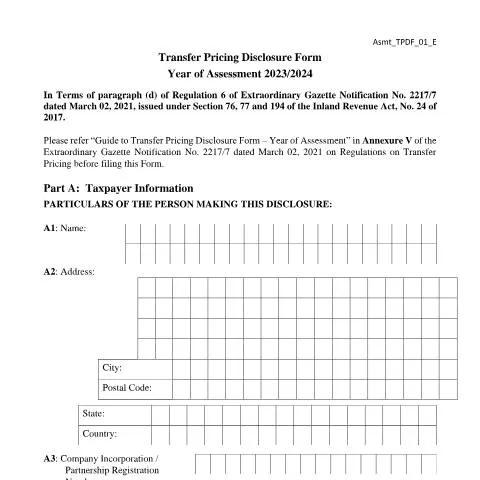
The Transfer Pricing Disclosure Form (Asmt_TPDF_01_E) has emerged as a pivotal document for both resident and non-resident companies operating within the jurisdiction of Sri Lanka. Envisioned within the framework of the Inland Revenue Act, No. 24 of 2017, this form requires diligent attention from companies engaged in transactions with associated enterprises. Its essential role lies in the compliance with transfer pricing regulations, which not only aim to ensure fair taxation but also seek to prevent tax base erosion through inappropriate profit shifting.
Failure to accurately submit this form may result in significant penalties, operational challenges, and reputational risks for the entities involved. Thus, understanding the intricacies of this form is vital for all stakeholders to ensure adherence to local laws and regulations.
Historical Context and Regulatory Framework
The establishment of the Transfer Pricing Disclosure Form is deeply rooted in the need for transparency and fiscal accountability in Sri Lanka. Recent reforms in tax legislation have been introduced to align local regulations with international standards, specifically given the increasing scrutiny by tax authorities globally regarding transfer pricing practices.
The Extraordinary Gazette Notification No. 2217/7, dated March 02, 2021, is a landmark document in this context. It serves as a regulatory backbone that outlines the framework within which the Transfer Pricing Disclosure Form operates. Companies are required to comply with the provisions set forth in this notification to avoid punitive measures. The form thus becomes a tool for the Inland Revenue Department (IRD) to assess whether transactions between related parties are conducted at arm's length and to safeguard the revenue base of the nation.
The Arm's Length Principle
Central to the implementation of the Transfer Pricing Disclosure Form is the Arm's Length Principle (ALP). According to this principle, transactions between associated enterprises must be priced in a manner that is consistent with the pricing for similar transactions conducted by unrelated parties under comparable circumstances. Companies must demonstrate that their transfer pricing methodologies are robust and align with this crucial standard.
Understanding Your Obligations with the Transfer Pricing Disclosure Form
The Transfer Pricing Disclosure Form serves multiple purposes and imposes various obligations on the filing parties. It is important to understand both the rights and responsibilities that come with this form to ensure compliance and mitigate potential risks.
Who Must File?
All resident and non-resident companies that engage in transactions with associated enterprises are required to complete and submit this form. This encompasses a wide range of entities, including but not limited to:
- Domestic companies with foreign parent companies.
- Foreign subsidiaries operating in Sri Lanka.
- Joint ventures and partnerships involving international stakeholders.
It is imperative to recognize that even minor entities may fall under the purview of this requirement, depending on the nature and volume of transactions with associated enterprises.
Consequences of Non-Compliance
Failure to file the Transfer Pricing Disclosure Form in a timely manner or providing inaccurate information can lead to severe penalties, including:
- Fines imposed by the IRD.
- Increased audit scrutiny.
- Potential reassessments of tax obligations, leading to higher tax liabilities.
Such repercussions underscore the necessity for companies to treat this form with the utmost seriousness and diligence.
Decoding the Transfer Pricing Disclosure Form: An In-Depth Analysis
The Transfer Pricing Disclosure Form is composed of several sections, each designed to capture specific data pertinent to the transfer pricing framework of a company. A thorough understanding of each section will aid in the effective completion and submission of the form.
Part A: Taxpayer Information
Part A of the form collects vital information about the taxpayer. The sections include:
- Name: Full legal name of the company or entity filing the form.
- Address: Complete physical address, including postal code, which must correspond to the registered office.
- Company Incorporation Number: This is essential for identification purposes and verifies the legal standing of the entity.
- Taxpayer Identification Number (TIN): Unique identification number assigned by the IRD, crucial for tax administration.
- Contact Information: Telephone number and email address for communication with the IRD.
Ensuring accuracy in this part is fundamental, as any discrepancies may lead to delays in processing or rejection of the submission.
Part B: Transactions with Associated Enterprises
Part B addresses the details of transactions between the taxpayer and associated enterprises. This section is critical for compliance with the arm's length principle. Key fields include:
| Transaction Item | Associated Enterprise (AE) | TP Methodology | Arm’s Length Price |
|---|---|---|---|
| Specify the type of transaction | Name of the associated enterprise | Method used to determine pricing (e.g., Comparable Uncontrolled Price, Cost Plus) | Price determined at arm's length |
Filing entities must provide detailed transaction amounts, methodologies, and reasoning for pricing. This section is particularly sensitive, as incorrect data could lead to significant financial implications.
Special Case Scenarios and Considerations
While the Transfer Pricing Disclosure Form applies broadly, certain unique scenarios warrant special consideration.
Foreign Entities and Their Obligations
Non-resident companies engaging in business activities in Sri Lanka may have different responsibilities regarding the Transfer Pricing Disclosure Form. For instance, foreign entities must be acutely aware of:
- The necessity to obtain a Taxpayer Identification Number (TIN) in order to file the form.
- The requirement to understand local tax laws and regulations that may differ significantly from their home jurisdiction.
- The legal implications of failing to comply, which may extend to enforceable penalties by the IRD.
Complex Situations: Joint Ventures and Partnerships
In partnerships or joint ventures, the intricacies of transactions can become more complicated. Each partner or entity may need to disclose information about how profits and expenses are shared, as well as the rationale behind transfer pricing between the parties involved. Clarity in this context is crucial to ensure that compliance standards are met.
Submission Process and Follow-Up
Once the Transfer Pricing Disclosure Form is accurately completed, it must be submitted to the IRD within the designated timeframe. Understanding the submission process is essential for avoiding penalties.
Filing Deadlines
The filing deadline for the Transfer Pricing Disclosure Form aligns with the fiscal calendar as stipulated by the IRD. Companies should be aware of the following:
- Fiscal year ending dates that dictate the assessment year for the form submission.
- Specific dates outlined in the IRD notifications for timely submissions.
Tracking Your Submission
After submission, entities can track their application status through the IRD's official channels. It is advisable to retain copies of all filed documents and correspondence for record-keeping and future reference. In the event of discrepancies or requests for additional information, being organized can significantly smoothen the process.
Distinguishing the Transfer Pricing Disclosure Form from Other Forms
The Transfer Pricing Disclosure Form is often confused with other tax-related forms, making it important to delineate its unique characteristics. Unlike general tax return forms, which cover a broad spectrum of income and deductions, the Transfer Pricing Disclosure Form specifically focuses on inter-company transactions and transfer pricing methodologies.
Additionally, while forms related to corporate tax filings may only require summary data, this document necessitates in-depth transactional details and justifications based on the arm's length principle.
Integrating the Transfer Pricing Disclosure Form into Broader Processes
Completing the Transfer Pricing Disclosure Form is not merely a standalone task; it forms part of a wider compliance and operational framework for companies engaged in international business. This integration may include:
- Preparing documentation for audits, where transfer pricing data may be scrutinized.
- Engaging in comprehensive financial planning that incorporates transfer pricing strategies.
- Collaborating with tax advisors to ensure that practices align with both local and international tax compliance frameworks.
Thus, the completion and submission of this form must be viewed through a wider lens of fiscal responsibility and international business strategy.
Final Thoughts on the Transfer Pricing Disclosure Form
The Transfer Pricing Disclosure Form stands as a critical component of the fiscal landscape in Sri Lanka, especially for entities engaged with international trade and associated enterprises. With its role firmly entrenched in regulatory compliance, understanding the nuances and requirements of this document is essential for businesses aiming to thrive within this evolving tax environment.
Companies should prioritize accuracy, timeliness, and a thorough comprehension of both the form and relevant regulations to ensure that they can navigate the complexities of transfer pricing effectively. By doing so, businesses not only safeguard against potential penalties but also position themselves for sustainable growth in a globalized marketplace.
Understanding Transfer Pricing in Sri Lanka: Legal Framework and Implications
Transfer pricing refers to the pricing of transactions between associated enterprises, including the transfer of goods, services, and intellectual property. In Sri Lanka, the legal framework governing transfer pricing is primarily based on the Income Tax Act No. 35 of 2006, which incorporates guidelines aligned with the OECD Transfer Pricing Guidelines. These guidelines aim to prevent profit shifting and tax base erosion by ensuring that the pricing of intra-group transactions reflects market conditions.
Companies operating in Sri Lanka must adhere to specific documentation requirements to substantiate their transfer pricing policies. This includes maintaining detailed records of transactions, methodologies used, and benchmarks that justify their pricing. Failure to comply with these requirements can result in tax adjustments by the Inland Revenue Department (IRD), leading to potential penalties or interest charges. The current landscape necessitates a thorough understanding of the legal implications surrounding transfer pricing, particularly for both Resident and Non-Resident Companies.
The IRD has the authority to audit and examine the transfer pricing practices of entities operating within its jurisdiction. As a result, companies must not only prepare the Transfer Pricing Disclosure Form - [Asmt_TPDF_01_E] but also ensure that they have robust documentation in place. This includes financial information, economic analyses, and industry comparisons that support the arm's length principle. By complying with these regulations, businesses can mitigate risks and demonstrate their commitment to transparency.
Completion of the Transfer Pricing Disclosure Form - [Asmt_TPDF_01_E]: Step-by-Step Guide
Completing the Transfer Pricing Disclosure Form - [Asmt_TPDF_01_E] is an integral part of a company's compliance obligations related to transfer pricing in Sri Lanka. Below is a detailed guide on how to accurately fill out this essential form to avoid any discrepancies that could trigger audits or penalties.
- Section 1: Taxpayer Information Begin by providing your company's Tax Identification Number (TIN), business registration number, and contact details. Ensure that the information matches what is registered with the IRD to avoid any mismatches.
- Section 2: Associated Enterprises List all associated enterprises involved in transactions during the fiscal year. This includes both domestic and international associated entities. Include their names, addresses, TINs if applicable, and a description of their relationship to your company.
- Section 3: Transaction Types Detail the nature of the transactions with associated entities. This may include the sale of goods, provision of services, or the use of intellectual property. Furthermore, specify the total transaction amounts and the applicable currencies.
- Section 4: Pricing Methodology Indicate the transfer pricing methods used for the reported transactions, such as Comparable Uncontrolled Price (CUP), Cost Plus Method, or Transactional Net Margin Method (TNMM). Justify the choice of method and align it with the arm's length principle.
- Section 5: Financial Information Provide comprehensive financial data, including balance sheets and profit and loss statements for the relevant fiscal year. This section is crucial for establishing the economic context of the transactions reported.
After completing the form, it is essential to review all entries for accuracy. Any discrepancies or incomplete information could lead to further inquiries from the IRD. If the form is submitted electronically via the e-services platform, ensure that you receive a confirmation of submission to maintain an audit trail.
Common Challenges and Solutions in Transfer Pricing Compliance
Compliance with transfer pricing regulations can be complex and challenging for many companies in Sri Lanka. Below, we outline some common challenges faced by businesses and provide practical solutions to address these issues effectively.
1. Lack of Documentation One of the primary challenges companies encounter is insufficient documentation to support their transfer pricing policies. Many businesses fail to maintain adequate records of their transactions with associated enterprises, which are crucial for proving compliance with the arm's length principle.
Solution: Establish a robust documentation process that includes transaction details, pricing methodologies, and benchmark studies. This proactive approach will help organizations prepare for potential audits by the IRD and validate their pricing strategies.
2. Understanding Local and International Regulations The interplay between local laws and international guidelines can lead to confusion. Companies often struggle to align their transfer pricing practices with both national regulations and the OECD guidelines.
Solution: Engage with tax advisors or legal experts specializing in transfer pricing to ensure compliance with both local and international regulations. This can help mitigate potential risks related to inconsistent practices.
3. Adjustments and Penalties Companies may face unanticipated adjustments to their taxable income due to the IRD's review of their transfer pricing practices. This can lead to significant penalties and interest charges.
Solution: Conduct periodic internal reviews of transfer pricing practices and engage external auditors to identify potential compliance issues before they arise. This proactive approach can help companies address discrepancies early and avoid costly penalties.
By understanding the common challenges and implementing strategic solutions, businesses in Sri Lanka can navigate the complexities of transfer pricing compliance more effectively. This not only helps in reducing risks associated with audits but also fosters a culture of transparency and accountability.